Get Full Government Meeting Transcripts, Videos, & Alerts Forever!
Get email alerts on the Special Education topic
No spam. Unsubscribe anytime.
After months of parent testimony, HCPSS lays out short‑term special education actions and timeline
Summary
Following extensive public testimony alleging delays and gaps in special education services, HCPSS staff presented a short‑term office plan that includes targeted staffing changes, non‑instructional team leader roles, and reestablishing an advisory group; parents and advocates demanded urgency and clearer accountability.
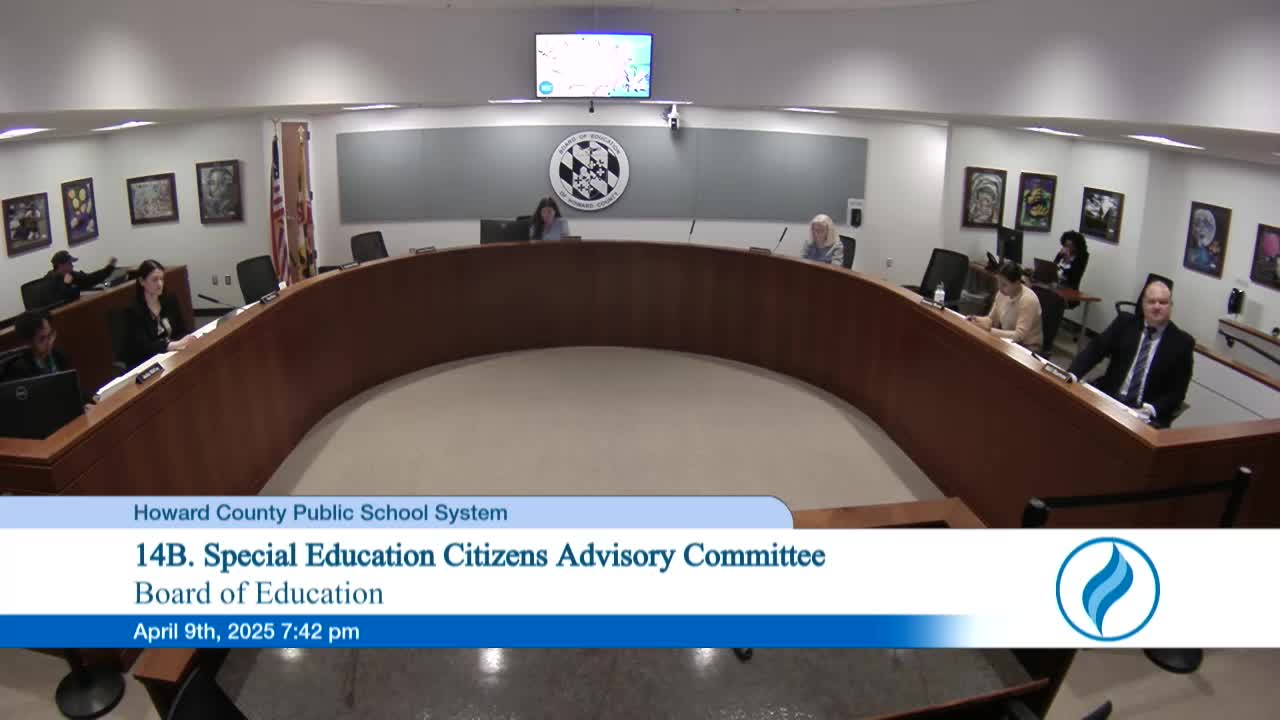
Howard County Public School System officials responded Wednesday to repeated parental complaints and a Special Education Citizens Advisory Committee (CCAC) presentation by announcing a short‑term office plan to address workload, staffing and service delivery in special education.
The plan, described by Chief Academic Officer Terry Savage and Executive Director of Special Education Richard Jeffries, includes immediate steps: (1) create and post a new non‑instructional instructional team leader (ITL) job description to give schools administrative capacity; (2) reallocate central office program assistants to better support elementary regional programs; (3) co‑host recruitment open houses with Human Resources and local higher‑education partners; (4) provide targeted office hours for first‑ and second‑year special educators; and (5) reestablish a Superintendent’s Special Education Advisory Group to provide ongoing stakeholder feedback.
Jeffries said the actions are short‑term milestones that will be implemented for the remainder of the school year and into the summer. “This plan will be in place for the remainder of this year and some actions will continue into the summer as we engage stakeholders in our process to implement the redesign efforts,” he said.
The presentation followed more than an hour of public testimony from CCAC and families alleging systemic delays, inconsistent implementation of IEPs, fractured communication and problematic transitions from early childhood to kindergarten. CCAC members told the board the system is experiencing “a crisis” in special education, and speakers used stark language: “Inaction equals neglect,” one CCAC speaker said, while a CCAC leader told the board, “We demand action. Our children can’t wait and neither can we.”
School psychologists who testified described large, time‑consuming caseloads and paperwork burdens. One school psychologist said she spent nearly half of a recent two‑week period on tasks tied to implementing behavior intervention plans, functional behavior assessments, crisis response and other special education compliance activities.
Superintendent Barnes and staff said the short‑term plan will be followed by a more comprehensive special education redesign and a formal strategic plan to be developed over the summer. Staff pledged to publish a timeline of milestones and to hold biweekly updates for the board and community. Jeffries also said the Department of Special Education will work with bargaining units and community groups, such as CCAC and the Autism Society, to refine staffing formulas and to pilot expanded in‑district program models intended to reduce out‑of‑district placements.
Parents said the initiatives are welcome but urged the board to put these commitments in writing and to produce immediate “quick wins” — visible changes that show progress before the next school year. Board members asked staff to return with implementation details, fiscal implications and measurable indicators the board can use to monitor performance.