Get Full Government Meeting Transcripts, Videos, & Alerts Forever!
Get email alerts on the Capital Budget topic
No spam. Unsubscribe anytime.
Howard County Board adopts data-driven capital budget prioritization process
Summary
After extended questions from board members and public, the Howard County Board of Education voted unanimously to adopt a new, objective process for scoring and prioritizing capital projects to inform the FY2027 capital improvement program.
The Howard County Board of Education on Wednesday adopted an objective, data‑driven process to prioritize school capital projects as part of its FY2027 capital budget planning.
Board members approved the superintendent’s recommendation to use weighted criteria — including facility condition and utilization — to score and rank buildings and projects, with the aim of producing a transparent Educational Facilities Master Plan that will inform future capital requests to the county and state.
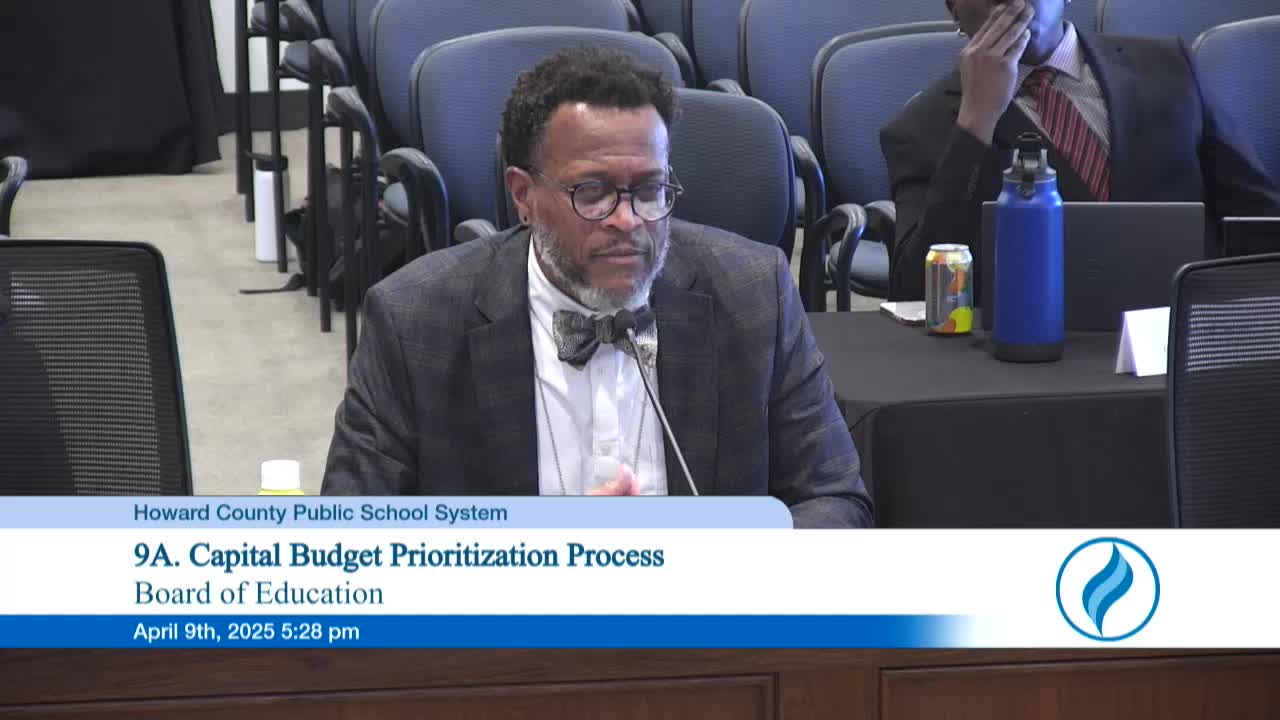
The process, presented by Chief Operating Officer Cornell Brown, ties facility scores to specific needs and assigns weights to criteria such as deferred maintenance and space utilization. Brown told the board the prioritization framework is “a program that will live,” meaning the scores and priorities can be updated annually as new data, standards and completed projects change the system’s needs.
Student Member Abasioglu, who moved adoption of the process, emphasized the equity rationale during debate, saying a consistent, data‑driven approach would “honor our commitment to all 57,000 students” by allocating resources on measurable need rather than political pressure. Board members pressed staff on how the list would be used if funding fell short of the total cost of high‑ranked projects; staff responded that the prioritized list would guide decisions but that some flexibility would be required to maximize available funds.
The board will return later this year with the Educational Facilities Master Plan that applies the scoring templates to all school buildings. Staff said the plan will differentiate state‑eligible projects from locally funded or program‑driven projects and will present recommended Year 1, Year 2 and Year 3 portfolios for board approval and submission to fiscal authorities. Staff also said they will seek to improve the scoring tool over time and to publish the underlying data to support transparency.
Board Chair Mosley called for a roll‑call vote after members completed questions about implementation. The motion carried 7‑0.
The new process does not itself authorize construction spending; it is a method to rank needs and guide future capital budget proposals that the board will vote on separately.