Get Full Government Meeting Transcripts, Videos, & Alerts Forever!
Get email alerts on the Planning And Zoning Appeals Attendance topic
No spam. Unsubscribe anytime.
Cochise County supervisors and planning staff debate P&Z attendance rules and appeal procedures
Summary
At an April 9 joint work session, Development Services staff reviewed the Planning & Zoning Commission’s authority and appeals process while supervisors raised concerns about absentee commissioners and proposed tightening bylaws and a pre-appeal review process for new evidence.
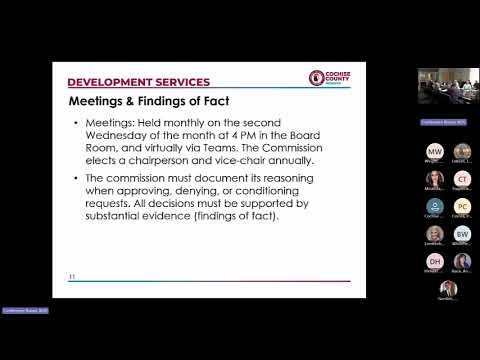
Christine McLaughlin, Development Services staff, reviewed the Planning and Zoning Commission’s authority and processes, telling the joint meeting that “the authority comes from Arizona Revised Statutes §11-802” and that the commission serves both advisory and quasi‑judicial roles.
The presentation outlined how the commission makes findings of fact on special uses, rezonings and text amendments, and how most rezoning decisions are a recommendation to the Board of Supervisors. McLaughlin described the appeal process, noting, “The appellant has 15 days to apply from a date of a hearing,” and said appeals may present new evidence that the board may consider.
Supervisors and commission members pressed staff about two recurring problems: commissioners who rarely attend in person and appeals that arrive at the board with new material the commission did not see. Supervisor Kathleen Billman said in-person participation matters to constituents, arguing that “it is important to be here at least…once a month” so officials can hear people face to face. Several supervisors said continued remote‑only participation by some commissioners had become a concern.
Board members discussed possible bylaw changes to address prolonged absenteeism. Supervisor Robert Montgomery observed that “many other boards…will dismiss a member if they miss three consecutive meetings.” Staff said the existing bylaws specify amendment processes and that any change would come back to the Board of Supervisors for consideration. Multiple supervisors asked staff to draft options and to consult the county attorney on legal risks before returning recommendations.
The meeting also focused on how appeals that include new evidence should be handled. Staff described current practice: when an appeal arrives the board receives the Planning & Zoning Commission’s recommendation plus a staff recommendation and any additional materials submitted with the appeal. Supervisors and staff discussed a procedural option to remand appeals that rely on new evidence back to the commission for a limited, expedited reconsideration before the board decides. Christine McLaughlin said remand is a recognized option and discussed the practical steps staff could take to make the presence or absence of new evidence more explicit in staff reports and application materials.
No formal votes were taken at the work session. Supervisors asked staff to draft clear options for (1) bylaw language or administrative policies that would address long‑term nonattendance by commissioners, (2) a transparent pre‑appeal or remand process for handling new evidence, and (3) any required public‑notice or timing changes those options would trigger. Staff said they would work with the county attorney and return with recommended language and process options for the Board’s consideration.
The discussion underscored persistent tensions between the advisory role of the Planning & Zoning Commission and the Board’s role as final decision‑maker, especially when applicants present additional material between the commission hearing and a board appeal. Staff noted that making exhibit lists and “new evidence” fields on appeal forms more explicit would help document what the commission actually reviewed and when new materials have been added.