Get Full Government Meeting Transcripts, Videos, & Alerts Forever!
Get email alerts on the Housing Finance Omnibus Bill topic
No spam. Unsubscribe anytime.
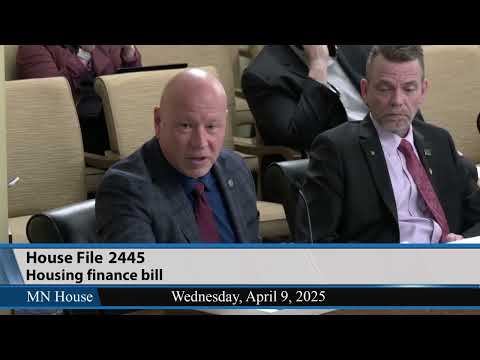
Minn. House Housing Committee adopts finance omnibus, adds zoning‑incentive scoring for grants
Summary
The House Housing Finance and Policy Committee approved the housing finance omnibus, House File 2445, including an amendment that gives scoring incentives to cities adopting pro‑housing land‑use policies; one amendment was withdrawn and several technical and procedural motions passed by voice vote.
The House Housing Finance and Policy Committee on an apparent voice vote adopted the housing finance omnibus, House File 2445, and approved a series of amendments that add incentives for local land‑use reforms and prioritize certain housing investments.
The bill, moved out of committee as the DE2 as amended, includes a provision that lets Minnesota Housing award additional scoring points to projects located in jurisdictions that adopt specified pro‑housing policies, and a $100 million housing infrastructure bond position and a $30 million boost for the Family Homeless Prevention and Assistance Program (FHPAP) were highlighted by members during debate.
The measure’s authors and committee leaders said the bill is intended to expand housing supply, boost affordability and support diverse housing types across Minnesota. Chair Howard moved adoption of the DE2 as amended and then moved that House File 2445 as amended be re‑referred to the committee on Ways and Means; both motions were adopted by voice vote. The committee also adopted a technical A1 amendment and approved the A4 amendment, while an A5 amendment was withdrawn by its sponsor.
Greater Minnesota Partnership executive director Darryl Dannon told the committee he supports the bill’s intent but urged care in how density priorities are structured. “We wanna ensure that we’re not, kind of creating a blunt instrument,” Dannon said, cautioning that some Greater Minnesota communities that seek homeownership and diversified housing types could be disadvantaged if scoring favors density without nuance.
Libby Murphy, director of policy at Minnesota Housing Partnership, testified in favor of an amendment that reduces barriers to housing production and gives local governments options to earn points by reforming zoning. “Reducing barriers to housing production can unleash new supply,” Murphy said, arguing the amendment is a “light touch incentive” that adds a new category of scoring points but leaves Minnesota Housing flexibility in the scoring system.
Committee co‑chair Igo described the A4 amendment as a “friendly” change that provides a “carrot, not a mandate,” by allowing projects in municipalities that adopt measures such as allowing duplexes, accessory dwelling units and eliminating onerous parking or lot‑size mandates to earn additional points in competitive Minnesota Housing grant scoring. The committee chair and several members emphasized the amendment’s intent to stretch scarce public resources by prioritizing public dollars in places where local policy changes make those dollars go further.
Members from both parties spoke in support of provisions addressing manufactured housing, conversions to resident‑owned cooperatives, down‑payment assistance and investments targeted to Greater Minnesota. Representative Norris and Representative Johnson both cited manufactured housing and resident ownership conversions as priorities. Several members praised the bipartisan committee process and urged further work in subsequent sessions.
Committee debate also included program and outcome figures cited by members: Chair Howard noted past statewide shortages and said the state’s housing gap has widened from a previously cited 50,000 units to “now it’s a hundred thousand.” The bill’s investments in FHPAP and a housing infrastructure bond were described by members as critical to preventing homelessness and leveraging other housing construction.
Formal recorded vote tallies were not entered in the committee transcript; the record shows adoption and referral actions passed by voice vote. The committee’s actions were:
- A1 amendment (technical, drafting correction): moved and adopted by voice vote. - A5 amendment (to prioritize greater density in a specific program): withdrawn by the sponsor. - A4 amendment (adds scoring incentives for jurisdictions that adopt specified pro‑housing land‑use policies): moved and adopted by voice vote. - DE2 as amended: moved and adopted by voice vote. - House File 2445 as amended: moved and re‑referred to the committee on Ways and Means by voice vote.
The committee chair and co‑chair closed the meeting by noting the bipartisan effort that shaped the bill and expressing intent to continue work as the bill proceeds to Ways and Means. The committee adjourned after the referral.
Votes at a glance: A1 — adopted (technical); A4 — adopted (adds local policy scoring incentives); A5 — withdrawn; DE2 (as amended) — adopted; HF 2445 (as amended) — re‑referred to Ways and Means.
The committee hearing included invited testimony and member discussion; no formal roll‑call vote totals or recorded ayes/nays by member were included in the committee transcript.