Get Full Government Meeting Transcripts, Videos, & Alerts Forever!
Get email alerts on the State Budget Medi Cal topic
No spam. Unsubscribe anytime.
Senate subcommittee passes AB 100 to provide $2.8 billion general fund for Medi‑Cal and fund wildfire, local programs
Summary
The Senate Committee on Budget and Fiscal Review (subcommittee) voted to pass Assembly Bill 100, an early‑action budget bill that authorizes $2.8 billion in general fund expenditure authority for the Medi‑Cal program and provides funding to backfill local property‑tax losses and support wildfire recovery and other local programs.
The Senate Committee on Budget and Fiscal Review (subcommittee) voted to pass Assembly Bill 100 on a recorded roll call after roughly an hour and a half of discussion and public comment. AB 100 is an early‑action “budget bill junior” that gives the administration authority to increase expenditure authority for Medi‑Cal and to reappropriate or augment funds for wildfire response, local assistance and other programs.
AB 100 authorizes $2,800,000,000 in general fund expenditure authority for the Medi‑Cal program in fiscal year 2024–25 and recognizes roughly $8,300,000,000 in matching federal funds related to those adjustments, according to the Department of Finance. The bill also amends control sections enacted in special session to make $2,500,000,000 available for response and recovery needs arising from the Eaton and Palisades fires in Los Angeles County and authorizes augmentations to backfill property‑tax revenue losses for certain local governments in fiscal years 2024–25 and 2025–26.
Why the action matters: committee members and administration witnesses said AB 100 is intended primarily to address a near‑term cash‑flow and cost increase in the Medi‑Cal program so the state can continue timely payments to managed‑care plans, hospitals, clinics and other providers. "This early action budget bill is intended to ensure that this critical healthcare program has sufficient cash flow to continue to pay managed care plans and healthcare providers up and down the state," Erica Lee of the Department of Finance told the committee during the presentation.
Key provisions and amounts - Medi‑Cal: $2.8 billion general fund expenditure authority for 2024–25; administration cited higher caseload and pharmacy costs as major contributors to increased spending. - Federal match: The Department of Finance noted this request aligns with approximately $8.3 billion in expected federal matching funds tied to program expenditures. - Wildfire response and local backfill: The bill authorizes use of funding previously appropriated in special session for the Eaton and Palisades fires and adds language allowing augmentations to provide funding to Los Angeles County and cities for unmet response and recovery needs. - Prop 4 (climate/wildfire bond) appropriation: Approximately $181,000,000 is appropriated from the Proposition 4 bond for wildfire prevention and resilience grants administered through several state conservancies and a training center grant. - Cal OES: The bill augments California Office of Emergency Services reimbursement authority to extend a contract to monitor utilities’ implementation of wildfire mitigation measures (DOF testimony included a numeric augmentation figure in the presentation materials). - Nonprofit security and education assistance: Restores $20,000,000 for California Nonprofit Security Grant Program (unencumbered 2023–24 funding) and reappropriates $1,000,000 (one‑time, Proposition 98 GF) to the Fiscal Crisis & Management Assistance Team (FCMAT) for assistance to local educational agencies impacted by Los Angeles wildfires. - Foster family insurance fund: Authorizes the Department of Finance to approve expenditures up to $2,000,000 from the Foster Family Home and Small Family Home Insurance Fund to address claims paid on behalf of foster and resource families. - Clean Cars for All: Adds $17,000,000 from the Enhanced Fleet Modernization subaccount to support local air districts’ Clean Cars for All programs that help low‑income households replace older polluting vehicles; committee members and staff said the subaccount is funded by a $1 vehicle registration fee.
Committee debate and questions Committee members asked whether the early‑action bill reflects longer‑term policy work on Medi‑Cal cost containment. Vice Chair Senator Agnello and several senators pressed the administration and Legislative Analyst’s Office (LAO) for more detail about drivers of the higher costs and for earlier engagement on possible policy adjustments that would affect future budgets.
Department of Finance witnesses attributed the higher near‑term costs to greater enrollment (including the recent eligibility expansions), continuation of federal pandemic‑era eligibility flexibilities, and higher pharmacy spending. "The governor's budget identified increased costs for our expansion of Medi‑Cal due to higher than expected caseload and expenditures," Erica Lee said. LAO staff added that pharmacy spending rose materially and that specialty drugs — including certain diabetes and weight‑loss therapies — have driven much of the increase.
Several members emphasized caution about proposals that would reduce eligibility. Senator Blake Spear said he is "100% opposed" to dropping people from coverage and urged focusing on narrowing coverage to core services or other cost‑containment measures rather than removing people from Medi‑Cal.
Foster family agencies and child‑placement issues Senator Menjivar raised the ongoing operational challenges facing foster family agencies (FFAs), noting multiple closures and concern that the early‑action package did not include a stopgap payment to stabilize FFAs while the state transitions to a reformed rate system. Department of Finance staff told the committee the Foster Family Home and Small Family Home Insurance Fund indemnifies foster parents for certain claims and that the administration is meeting with stakeholders; the Department of Social Services has issued an all‑county letter describing expedited portability options when FFAs close.
Clean Cars for All and program details Committee members asked several technical and programmatic questions about the Clean Cars for All program: income eligibility, typical subsidy amounts, whether vouchers are limited to new vehicles, and program uptake. DOF and LAO staff said the $17 million in AB 100 is a backfill for local air districts that have exhausted earlier program funds; LAO and DOF staff said income eligibility ties to the federal poverty level (DOF cited "300% of the federal poverty level" for eligibility in the committee exchange) and that local air districts administer the program. Rachel Ehlers of the LAO added that the program often provides up to about $7,000 per household (fact sheet‑level guidance cited by staff) and can include options such as vouchers for alternative mobility and modest support for charging infrastructure.
Public comment Speakers from advocacy and affected local entities urged passage. Linda Way of Western Center on Law and Poverty said, "the increase in medical caseload is a, is, showcases, the program success," and urged the committee to preserve coverage expansions. Jean Hurst, representing Altadena Library District, urged support for property‑tax backfill tied to the Eaton Fire because the district lost property tax revenue after parcel damage. Health‑sector advocates and regional equity groups spoke in favor of fully funding Medi‑Cal and resisting cuts to eligibility.
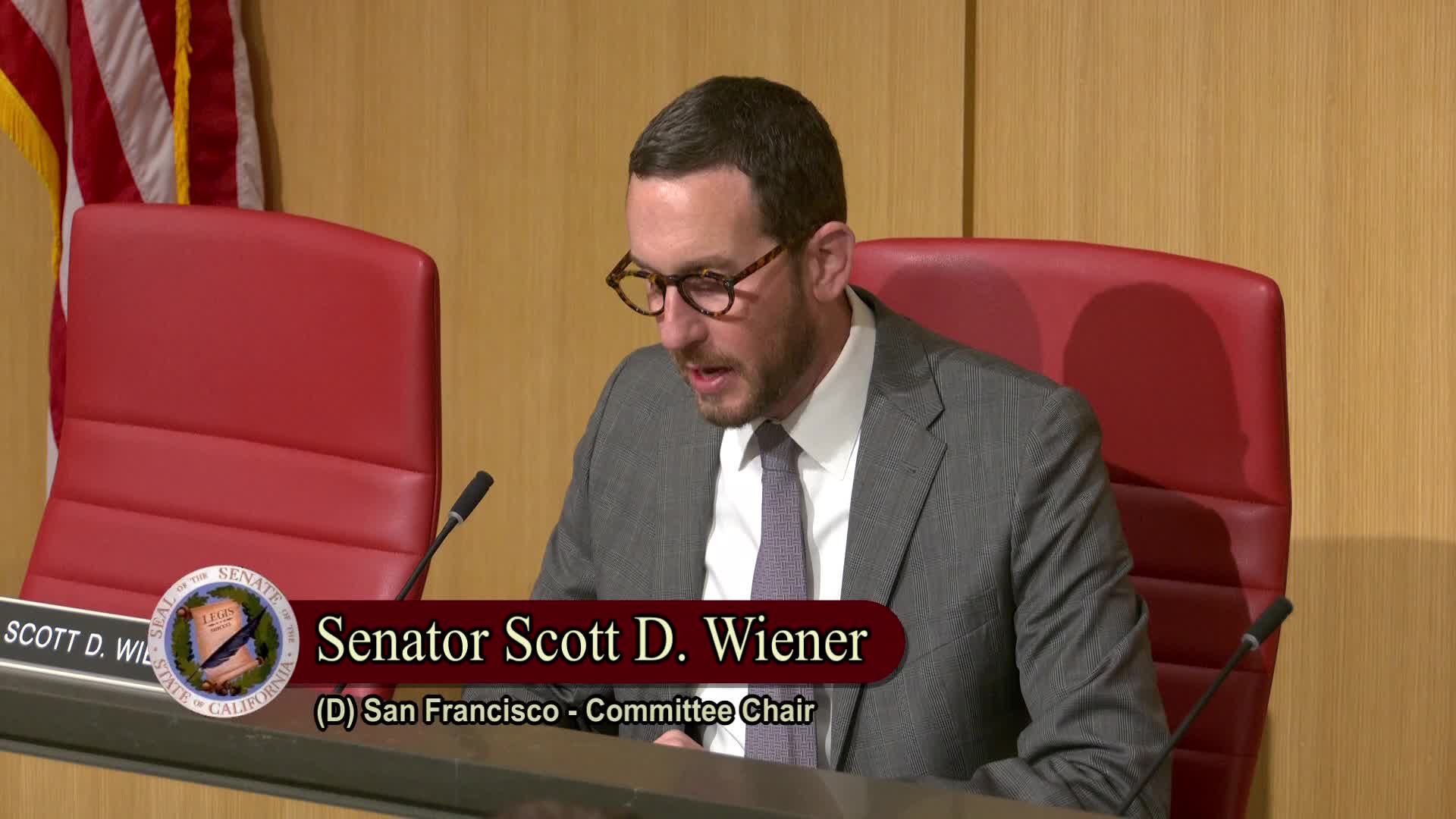
Vote and next steps After discussion and public comment, the committee moved AB 100 and held a roll call; committee leadership announced the motion passed with 14 ayes and 4 no votes on the recorded call. Members repeatedly noted that AB 100 is an early‑action stopgap and that further budget decisions — including more detailed proposals to address out‑year gaps — will be taken at the May Revision and in subsequent budget hearings.
Quotes (selected) "This early action budget bill is intended to ensure that this critical healthcare program has sufficient cash flow to continue to pay managed care plans and healthcare providers up and down the state," Erica Lee, Department of Finance. "This expansion plays a critical role in supporting our struggling hospitals by moving previously uninsured individuals from seeking the most expensive kind of care in emergency rooms to a more stable source of primary care at a doctor's office," Chair Scott Wiener. "The increase in medical caseload is a, is, showcases, the program success," Linda Way, Western Center on Law and Poverty (public comment).
Ending AB 100 passed the subcommittee as an early‑action measure to preserve cash flow for Medi‑Cal and to provide targeted wildfire recovery and related local assistance. Committee members and administration witnesses said the bill does not close the broader discussion about long‑term cost containment; members expect further analysis and proposals at the May Revision and in follow‑up budget hearings.