Get Full Government Meeting Transcripts, Videos, & Alerts Forever!
Get email alerts on the School Funding topic
No spam. Unsubscribe anytime.
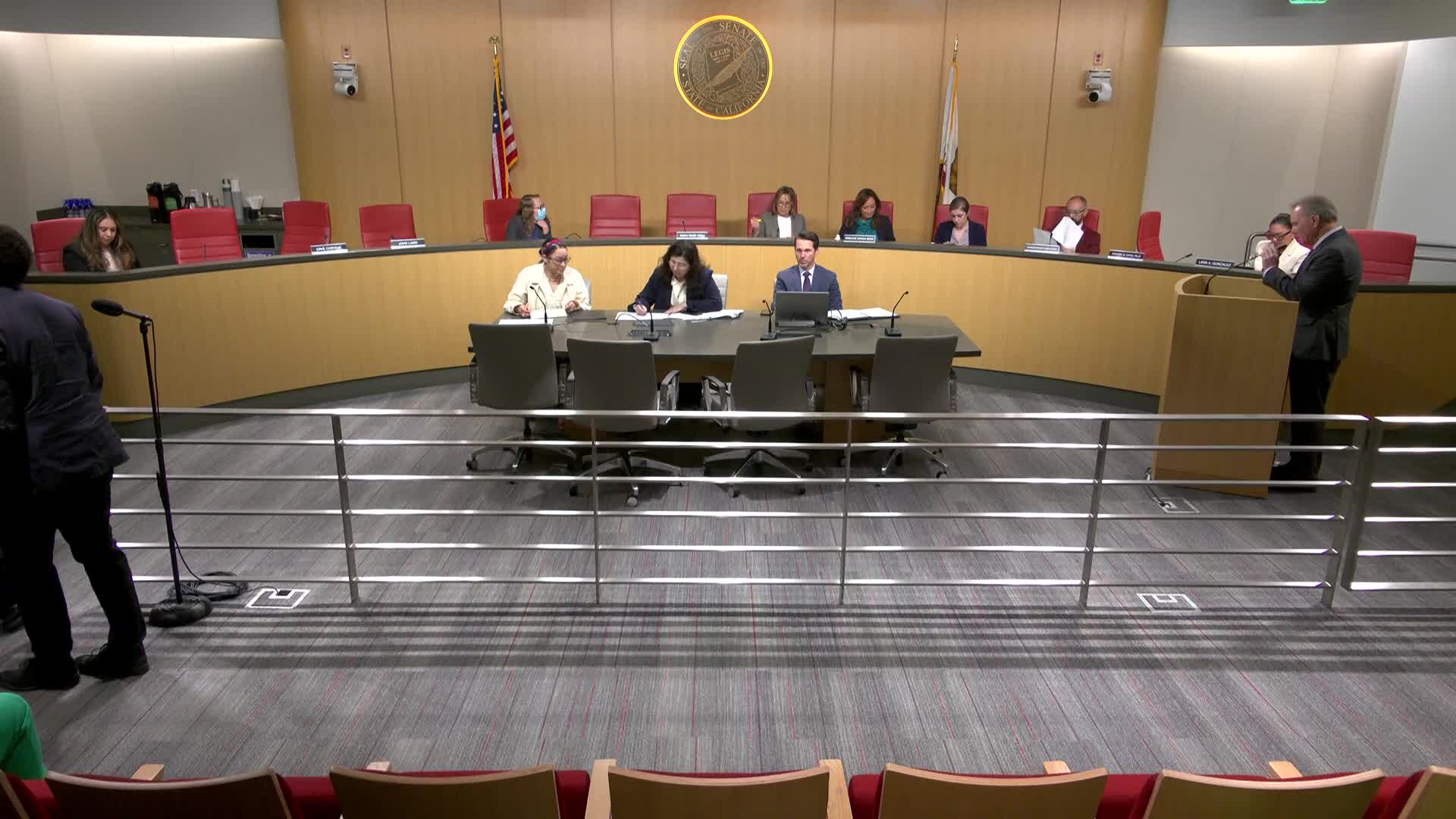
Senate panel debates SB 743 to create an equalization reserve targeting underfunded school districts
Summary
SB 743 would establish an 'equalization reserve' to allocate additional dollars to underfunded school districts and begin closing historic funding gaps between property-wealthy and property-poor districts; witnesses stressed large disparities and urged the committee to refine how basic-aid districts are treated.
Sen. Cortese presented SB 743, which would establish an equalization reserve account to provide additional dollars to districts that receive less funding under the state's current property-tax based distribution. The author framed the bill as correcting long-standing funding inequities, saying, "For far too long, where a child lives has determined how much funding their school receives."
Witnesses described large local disparities in per-pupil funding and urged action. Lisa Andrews, CEO of the Silicon Valley Education Foundation, and Glenn Vanderzee, superintendent of East Side Union High School District, testified that differences between basic aid and non-basic aid districts can reach tens of thousands of dollars per pupil in some counties. Vanderzee told the committee that the bill would give underfunded districts local control to invest in teacher salaries, counselors and early-intervention programs. Analysts from the Legislative Analyst's Office and other witnesses described the proposal's interaction with Proposition 13, Proposition 98 and the Local Control Funding Formula (LCFF).
Committee members pressed the author for detail on how the bill would treat basic-aid districts (those receiving more property-tax revenue than their LCFF allocations) and noted significant variation among basic-aid districts — some are high-wealth while others have declining enrollment or limited local resources. Sen. Cabaldon and Sen. Gonzales urged the author to refine the bill to address the "basic aid nuance" so that the policy does not unintentionally lock in new inequities. The author said the committee staff and stakeholders would continue to work on the approach; he described the reserve concept as a long-term mechanism, possibly paired with a constitutional amendment, to begin equalizing districts across the state.
The committee accepted the author's amendments and voted to move the bill to the Appropriations Committee for further fiscal analysis and refinement.
What happens next SB 743 proceeds to the Senate Appropriations Committee where staff will model fiscal triggers, distribution methodology and options for addressing differences among basic-aid districts. The author and witnesses signaled ongoing negotiations on technical fixes before any final enactment.