
Columbus Promise expands college access as public–private partners announce $17.6M raised toward $25M six‑year goal
Get AI-powered insights, summaries, and transcripts
Sign Up Free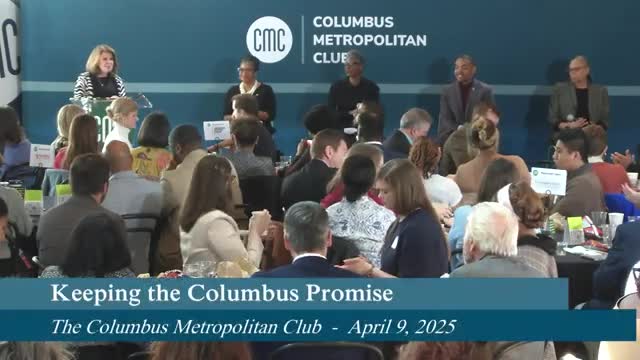
Summary
At a Columbus Metropolitan Club forum, city and education leaders described the Columbus Promise programand announced recent corporate gifts and a fundraising total of $17.6 million toward a $25 million goal to support a multi‑year cohort of Columbus City Schools graduates attending college or Columbus State Community College.
Columbus — Leaders from the city, Columbus City Schools and Columbus State Community College said at a Columbus Metropolitan Club forum that the Columbus Promise program has expanded college access for Columbus City School graduates and has secured $17,600,000 of a $25,000,000 fundraising target to fund the next six‑year cohort.
The Columbus Promise is a public‑private partnership that guarantees eligible Columbus City Schools graduates tuition support if they complete an application, apply for federal student aid and meet enrollment requirements. "If you graduate from high school, if you apply for the FAFSA, and if you apply for this program, you get to go to college for free. No questions asked," Council President Shannon Harden said at the forum.
Organizers and partners said the program began as a three‑year pilot that raised $10,000,000 for initial funding and has since broadened. "The city put in $5,000,000, the private sector put in another $5,000,000 and Columbus State put in a million dollars that got us to the first round," Harden said. For the next phase, Harden said the city committed $10,000,000 and organizers have raised $17,600,000 toward a $25,000,000 goal to support the expanded cohort over six years.
Why it matters: Speakers framed the promise as both a student‑support initiative and a workforce strategy. "We are doing it because we want to pay back, we want to invest in our young people, but really we're doing it because we need these young people to have the credentials, and the degree so they can take the jobs of the future," Harden said. Panelists said increasing credential attainment is intended to supply Central Ohio employers with trained workers as the region grows.
Program results and scale: Dr. Angela Chapman, superintendent of Columbus City Schools, said the program helped raise collegegoing rates for district graduates. "A third of our graduates now are Promise Scholars," Chapman said. Dr. Desiree Polk Bland, senior vice president for student success at Columbus State Community College, said Columbus State enrolled 848 Promise Scholars this term and that more than 1,700 Columbus City students were registered at Columbus State across terms. Polk Bland described the college's response as increased advising, case management and course supports to prevent "lost momentum" among students who had pandemic‑era disruptions to their high school experience.
Private sector support and recent donations: Janelle Coleman, vice president of community engagement and corporate philanthropy and president of the AEP Foundation, said AEP contributed $750,000 in the program's first iteration and announced a $1,000,000 gift for the second cohort. Forum remarks and acknowledgements named additional donors and amounts cited by speakers: the Columbus Foundation ($200,000), Nationwide ($300,000), Huntington ($300,000), J.P. Morgan Chase ($225,000), and a $100,000 gift from a small business donor mentioned by panelists. Council President Harden and others also acknowledged a $2,000,000 contribution from Cardinal Health among round contributors; speakers said the most recent group of donors totaled roughly $2.1 million for this fundraising announcement.
Employers and work experience: Panelists said the program pairs financial support with employment and internship opportunities. "We need the financial support to continue the program, but we also need companies to hire these young people and to give those internship experiences," Coleman said. Panelists pointed to companies already placing Promise Scholars in work roles, including IGS Energy and Nationwide Insurance, and discussed efforts to align Columbus State coursework and career advising with employer needs, including partnerships with advisory boards and "earn and learn" placements.
Funding and sustainability concerns: Speakers discussed state budget pressures that could affect school funding. Chapman urged community advocacy if state budget proposals reduce the state share for public education, noting local levy investments could be undermined. Panelists described the current fundraising as a bridge to a longer‑term, locally charted sustainability plan; Harden said organizers expect to "figure this out on the local level" to maintain the benefit for students.
Voices from participants: Columbus Promise Scholars attending the forum were recognized onstage; one scholar, Lumiere Conte, who planned to graduate in the spring, described the program as a pathway to reduce debt and secure stable employment after college. Vangela Barnes, a Canal Winchester Schools board president who also owns a local electrical company, asked how the program might be expanded to serve Columbus residents who attend suburban schools. Harden and others said expansion to a countywide model that includes additional adults and four‑year pathways is part of future planning.
Context and next steps: Panelists said the program launched after a 2019 Central Ohio convening that found credential attainment rates needed to rise substantially to meet future labor demand. Organizers described the Promise as intentionally broad (not limited to a single career pathway) to avoid excluding students who later move into in‑demand fields. The panelists urged continued private and public investment and employer engagement to provide both financial aid and meaningful career pathways for graduates.
The forum ended with recognition of donors and a call from panelists for ongoing community support and advocacy on school funding and program sustainability.