Get Full Government Meeting Transcripts, Videos, & Alerts Forever!
Get email alerts on the Housing Policy topic
No spam. Unsubscribe anytime.
Monterey County staff seek direction on 2025–26 long‑range work program after housing element, pipeline update
Summary
Planning staff presented the 2024 annual progress reports for the Monterey County General Plan and the 2024–31 housing element, summarized housing pipeline figures and asked the commission to recommend priorities for the 2025–26 long‑range planning work program; the commission added a request to place a Pajaro community plan on the priority list.
Monterey County planning staff presented the county’s 2024 annual progress reports for the general plan and the 2024–31 housing element at the April 9 planning commission meeting, reviewed accomplishments from the prior year, summarized an updated housing pipeline for the unincorporated county and asked commissioners to provide direction on priorities for the 2025–26 long‑range planning work program.
Melanie Barretti, chief of planning, said the county completed 28 work‑program tasks in the prior year, including acceptance of the Salinas Valley Zone 2C groundwater basin investigation and finalization of certain East Garrison amendments. Staff emphasized the housing element and rezoning implementation, permit‑process streamlining, and several community plans (Castroville, Moss Landing, Chualar/Pajaro) as major ongoing efforts.
Housing pipeline and affordability shortfalls
Darby Marshall, the county’s housing program manager, reported that the county saw 89 low‑income units and 92 above‑moderate units permitted in the reporting year and that most permitted production consisted of single‑family detached homes. She said employer‑sponsored multifamily housing (H‑2A/employer‑sponsored units) accounted for the new multifamily production in unincorporated areas. ADU production was also noted, with a large share of detached or junior ADUs in Castroville likely intended for rental use.
Staff briefed commissioners on the pipeline of approved and pending projects. Marshall said the county has sufficient approved projects or projects in process to meet its above‑moderate RHNA obligations, but remains “very short” on very low, low and moderate units and that meeting those affordability levels would remain a continuing challenge without additional subsidy or county‑led initiatives.
State law and local inclusionary requirements
Marshall explained how the state’s density‑bonus and builder’s remedy rules constrain the county’s ability to stack or redistribute affordability requirements imposed by the county’s inclusionary housing ordinance. In some small subdivisions the developer elected the state density‑bonus option that produced three moderate‑income units rather than a mix that would have included a low‑income unit under the county ordinance. County staff and the Housing Advisory Committee concluded the selected approach was appropriate for this project given financial feasibility concerns and legal limits on layering requirements.
Work‑program priorities and community plans
Staff presented a list of roughly 80 identified long‑range planning tasks and highlighted a top set of roughly a dozen priorities for the coming year, including housing element rezoning and implementation, permit streamlining, Big Sur Coast land‑use plan update, Castroville and Moss Landing community plans, environmental justice and safety element updates, Fort Ord Habitat Resource Management Plan implementation and vacation‑rental ordinance implementation.
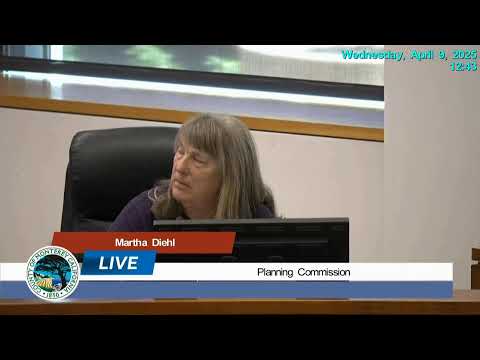
Commissioners pressed staff on sequencing and synergies. Commissioner Jonathan Deal urged staff to make clear how community plans and other elements interrelate with the housing element and to exploit efficiencies where possible. Several commissioners—especially Commissioner Shaw and Commissioner Diehl—asked that the Pajaro community plan be advanced because of funding opportunities tied to recovery work and because they view Pajaro as an area where permit streamlining, environmental justice work and community planning could be coordinated to accelerate housing production. Staff responded that Pajaro is the next community plan in the queue but that available staff time and outstanding housing‑element tasks make substantive work on Pajaro unlikely in the coming fiscal year. Commissioners asked staff to bring back a recommended funding plan if additional resources were needed.
Other topics: vacation rentals, ADUs, county workforce housing
Staff told the commission that the board adopted inland vacation‑rental ordinances, which go into effect for inland areas the week after the hearing; coastal certification by the Coastal Commission is anticipated in July. Commissioners asked for updates on whether the Coastal Commission seemed likely to support the ordinance; staff reported preliminary, positive staff‑to‑staff interactions.
On county workforce housing, staff noted county participation in the Golden State Finance Authority program that helps employees access mortgages; staff said Natividad Medical Center is piloting an employee housing subsidy program. The county has also begun a facilities master plan to identify potential county‑owned parcels that could be used for housing, with a priority for deeper affordability levels on those sites if feasible.
Commission action and next steps
Commissioner Gomez moved — and Commissioner Mendoza seconded — an amendment to staff’s recommendation asking the board to add a Pajaro community plan “on the radar” (item 13) for the 2025–26 priorities list; the commission approved the amendment unanimously and then recommended the board authorize the Housing and Community Development director to submit the annual progress reports to the state as required. Staff said it will use the commission’s input on priorities to prepare the staff recommendation to the Board of Supervisors and noted some items are tied to external grants or funded consultant contracts that impose timing constraints.
Ending
Commissioners emphasized sequencing and coordination across community plans, the housing element and safety/environmental justice updates as the county moves into the next fiscal year. Staff committed to bringing clarified findings and budget implications back to the commission and to preparing the formal packet for the Board of Supervisors to transmit the annual reports to state agencies.