Get Full Government Meeting Transcripts, Videos, & Alerts Forever!
Get email alerts on the Budget And Cip topic
No spam. Unsubscribe anytime.
Hampton manager previews $677.9 million fiscal 2026 budget and five-year capital plan; proposes tax cut, fee increases and wage boost
Summary
City Manager Mary Bunting presented the manager's recommended FY2026 budget and the FY26'FY30 Capital Improvement Plan to the Hampton City Council, proposing a $677,930,817 budget, a real estate tax-rate cut to $1.14 per $100 of assessed value, fee increases for stormwater and wastewater, and a 3.5% general wage increase.
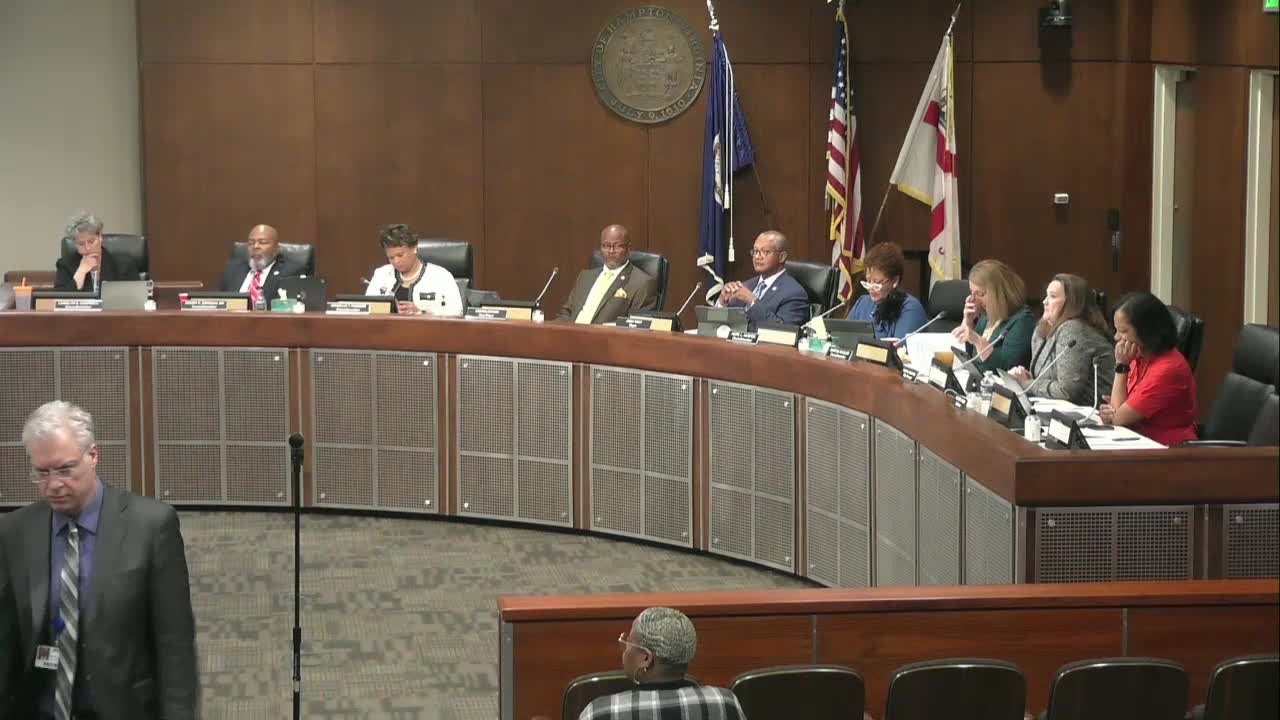
City Manager Mary Bunting presented Hampton's manager-recommended fiscal 2026 budget and a preview of the five-year Capital Improvement Plan (CIP) at a Hampton City Council work session, outlining a $677,930,817 proposed budget, a proposed real-estate tax-rate cut from $1.15 to $1.14 per $100 of assessed value, increases to stormwater and wastewater fees, and a 3.5% general wage increase for city employees.
The presentation also summarized the FY26'FY30 CIP, which the manager described as the city's five-year roadmap for major durable investments. Staff said the CIP proposal allocates roughly $460 million to capital projects organized around council priorities such as infrastructure (described by staff as central to 'excellence in government'), education, living with water/resilience, placemaking and public safety.
Why it matters: the manager framed the recommended budget as balancing fiscal restraint with priority investments. The plan includes a proposed fourth consecutive reduction in the city's real-estate tax rate, targeted personnel additions and pay adjustments, and fee increases the manager said are necessary to meet state and regional regulatory requirements and aging infrastructure needs.
CIP overview and priorities
Shu Mohammed, a management analyst in the city manager's office, opened the CIP presentation by describing the CIP as a five-year plan for projects over $50,000 with a useful life of at least five years. Mohammed said the FY26'FY30 CIP distributes funding across seven priorities, and that the first year of the five-year plan becomes the capital portion of the manager's recommended budget. "The 5 year capital improvement plan or CIP for short is going to be presented by Shu Mohammed..."
Staff described four main funding sources for capital projects: bonds, the general fund, dedicated fees or taxes, and state and federal grants. They also warned that restricted funding and state or federal mandates reduce local flexibility, and that inflation and rising maintenance costs are increasing capital needs.
Key CIP notes from staff
- Staff said the CIP proposal allocates about $460 million across the five-year window and ties each project to council priorities. The largest share was described generally as funding core infrastructure and facility maintenance. - Highlighted projects included street resurfacing and traffic signal maintenance, Mercury Boulevard reconstruction, network infrastructure replacement affecting municipal sites and traffic systems, maintenance of city-owned properties and facilities, and targeted downtown and waterfront investments such as Millpointe Park renovations. - Resilience and stormwater: staff outlined several water-plan projects (Newmarket Creek, downtown water-defense measures, Long Creek Blueway and others) and said the "Resilient Hampton" initiative will invest on a recurring basis from bonds and stormwater fees. - Parks and placemaking: items noted include playground and community center renovations, athletic field improvements, and downtown landscape enhancements.
Manager'recommended budget: totals, schools and taxes
Bunting said the total proposed fiscal 2026 budget is $677,930,817, a 5.39% increase from the prior year. She said the Hampton City Schools budget included in the package is $307,189,611; the city's local contribution to the schools was cited as $99,081,479 and the transcript references the state-required SOQ amount as $57,215,568.
On taxes and fees, Bunting said she is proposing a real-estate tax-rate reduction from $1.15 to $1.14 per $100 of assessed value. She said this would represent the fourth straight year of a proposed rate reduction. The manager told council she did not propose an increase to the solid-waste fee for FY26, but that both the stormwater and wastewater management fees would need to increase. Specific fee proposals cited in the presentation were:
- Stormwater: an increase of $1 per equivalent residential unit (ERU) per month, intended to support system maintenance, flood reduction and required regulatory work. - Wastewater: an increase of $2.74 per hundred cubic feet (ccf) per month to support rehabilitation and regulatory compliance; the manager cited regional DEQ consent-decree spending requirements and state guidance that require substantial upcoming expenditures.
Personnel, compensation and public-safety investments
Bunting said the recommended budget would include a 3.5% general wage increase for civilian employees and funding to cover an anticipated 4.5% rise in health-insurance costs so employees realize the full benefit of the pay increase. For sworn public-safety employees, the presentation notes continuation of an existing step plan and ongoing attention to market competitiveness for recruit and retention pay.
Public-safety capital projects noted included fire station roof replacement, marine dive and boat equipment replacement, modernization of fire-station alerting systems, HVAC upgrades at the Public Safety Building, and funding for a Willow Oaks field office and a future canine wellness center.
Council reaction and next steps
Multiple council members thanked staff for the presentation and discussed the possibility of increasing the proposed general wage increase to 4%. Councilmember comments also touched on using city-owned vacant properties to accelerate development and return sites to the tax rolls, and on prioritizing playground and park upgrades.
Manager Bunting identified the next steps and public dates cited during the session: the manager said the full budget document would be released on April 15 (per the city charter), full copies would be made available in libraries on April 18, the CIP public hearing would occur April 23, a first reading/public hearing on the budget would be scheduled for May 7, and a final vote on the budget was planned for May 14. She said staff would present the final recommended budget for council action at those ordinance-reading steps.
Formal action recorded
Council voted to convene a closed session under Virginia Code (see authorities) to discuss appointments and pending-litigation strategy. The motion passed on recorded "aye" votes by the mayor and council members present.
Where the public can review materials
Bunting said the manager-recommended budget will be published online at www.hampton.gov/budget when it is released and that staff will return to council for the statutory public hearings and readings identified in the presentation.
Ending
Staff requested public comment during the statutorily required hearings. The council session moved next into a closed session per the recorded motion on the meeting agenda.