Beaverton Police chief outlines staffing, specialized units and training in budget workshop
Loading...
Summary
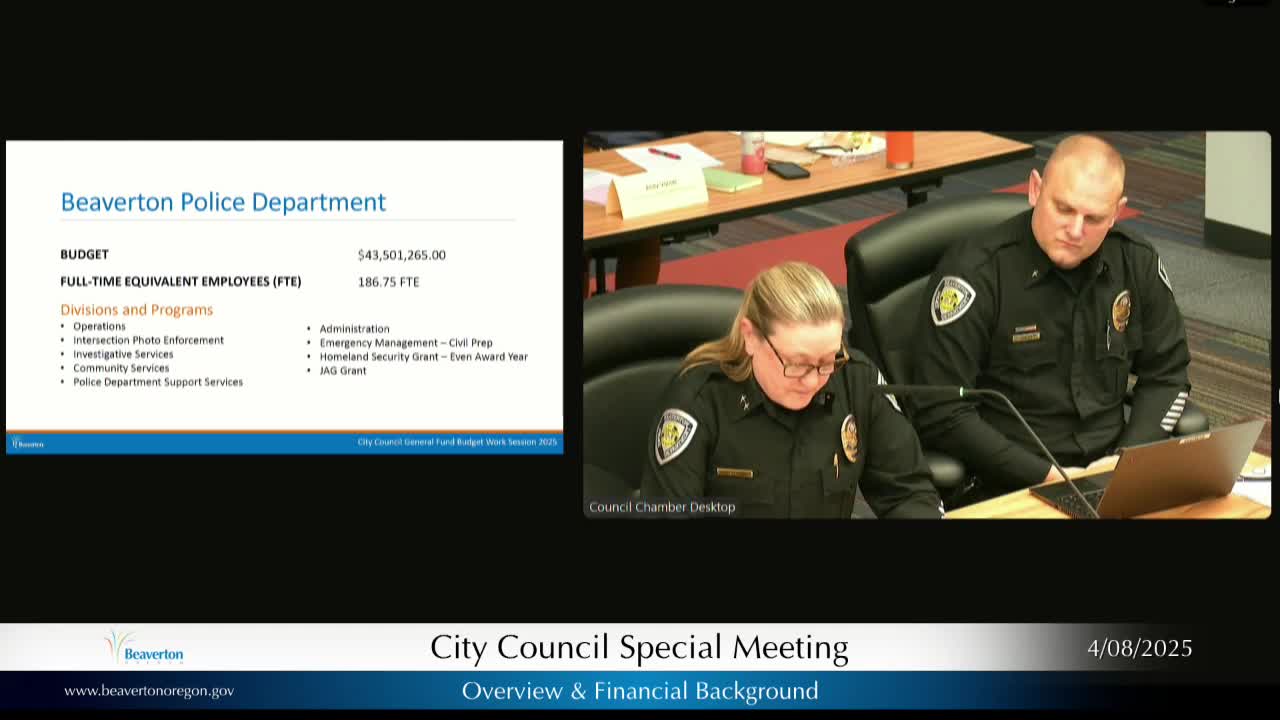
Chief Jeppson told council the police department has 186.75 FTEs, including 140 sworn officers, and described patrol, investigations, canine, drone, traffic and wellness programs as major cost and service drivers.
Beaverton — Police Chief Jeppson told the City Council at a fiscal workshop that the department comprises about 186.75 full-time-equivalent positions, including roughly 140 sworn officers, and outlined how those staffing levels and specialized programs drive significant general-fund spending.
"Our police department is comprised of 186.75 dedicated public servants. 140 of those are sworn police officers," Jeppson said during her presentation.
Nut graf: The chief framed public safety as foundational to the city's livability and noted patrol operations, investigations, specialized teams and mandated training as the primary cost and service areas the council should understand before budget choices.
What the department told council: - Patrol: The uniformed patrol division includes 66 full-time employees across four shifts and responded to about 79,000 calls for service a year, per the chief's presentation. Patrol also recorded more than 3,300 traffic crashes and issued approximately 5,300 traffic citations and 8,000 warnings in the prior year. - Specialized resources: The department described several embedded resources including a canine unit (four dogs), a remote-operated-vehicle (drone) team, and a traffic unit with motor officers. The canine unit and drone program were described as "force multipliers" that improve efficiency and officer safety. - Investigations and professional standards: Detectives (about 17) handle felony-level person and property crimes and work with regional task forces; a small professional standards team manages recruitment, backgrounds, internal affairs and accreditation. - Training and wellness: The training division delivers more than 20,000 hours of annual training, including de-escalation and mental-health response. The department also described a new wellness program staffed by a full-time wellness officer and a comfort canine.
Councilors pressed on program details and cost drivers such as materials and services (M&S) for equipment and training, reimbursement arrangements (TriMet reimburses the city for four assigned positions at 105% of cost), and how technology and data are used for deployment and investigations. Chief Jeppson said TriMet-funded officers cover the MAX West Line beyond Beaverton and that the city receives a full cost reimbursement plus a 5% administrative fee.
What councilors heard about trade-offs and next steps: Councilors asked about the split between enforcement and community engagement, the structure of training and professional standards, and how data and AI might support efficiency. The chief and staff said some efficiencies come from technology and regional partnerships but stressed that equipment replacement cycles and training requirements are recurring cost drivers. No formal decisions were made at the workshop; councilors asked staff to park unanswered questions and return with more detail.