Get Full Government Meeting Transcripts, Videos, & Alerts Forever!
Get email alerts on the City Finance topic
No spam. Unsubscribe anytime.
Beaverton leaders hold workshop to review current-year general fund shortfall
Summary
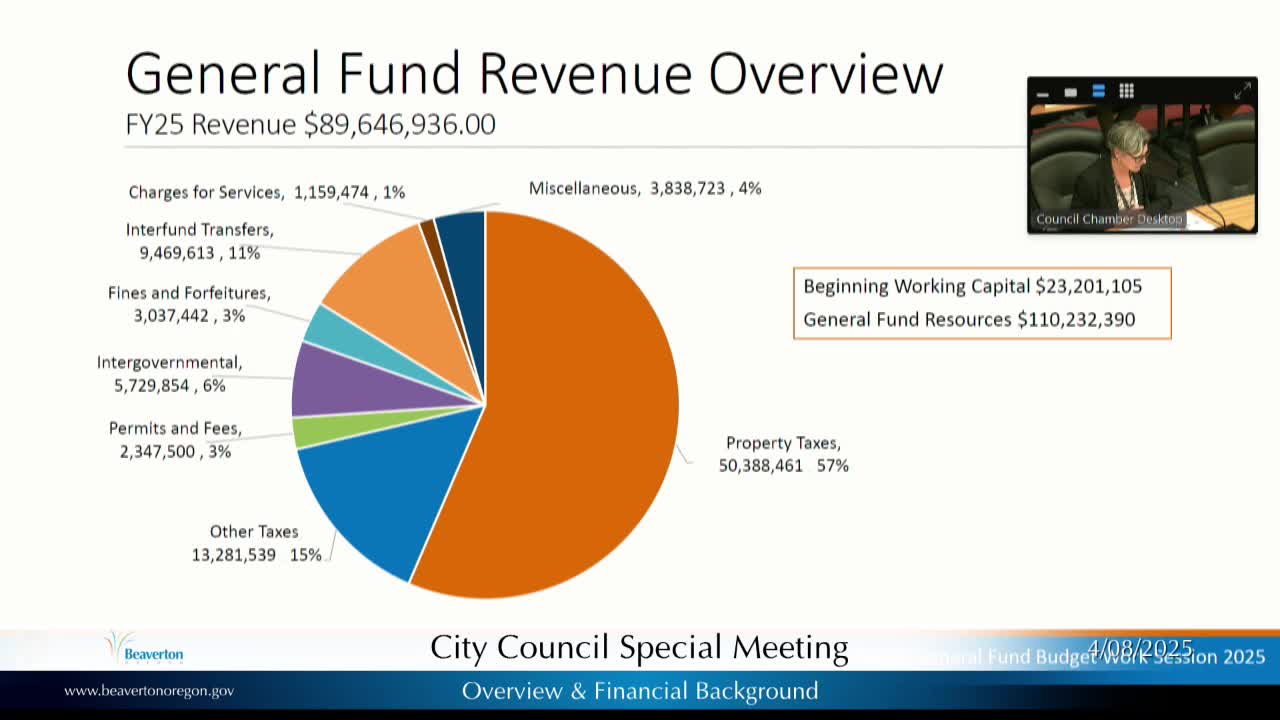
City officials met in a council-requested workshop to review the current fiscal year general fund, hear program-level presentations and establish a common baseline ahead of the 2025–26 budget process. City staff said property tax provides about 60% of general fund revenue and noted a current-year gap between revenues and expenditures.
Beaverton — City officials convened a council-requested workshop to review the current fiscal-year general fund, hear department-level briefings and build a shared baseline before next year's budget is published.
The meeting was not intended to set policy for the 2025–26 budget, Mayor Lacey Beatty said; rather, it was to increase council members' understanding of the city's fiscal position and each department's cost drivers. "As a reminder, tonight's meeting is not about our future budget," the mayor said.
City Manager Jocelyn Lisonbee opened the packet of financial slides and said the general fund currently brings in roughly $89,000,000 in revenue, while general fund expenditures are about $97,000,000. "We currently have approximately $89,000,000 coming in in revenue," she said. The city also holds about $15,000,000 in reserves and contingencies, making total budgeted expenditures shown on the presentation roughly $112,000,000.
Why it matters: Council members said the workshop's goal was transparency and education about the current-year fiscal position so they would have a consistent starting point for upcoming decisions. Staff emphasized that the workshop would not include deliberations about next year's proposed budget because of Oregon budget law constraints.
Key facts and department impacts: Presentations from senior staff described the revenue mix and program-level pressures: - Property taxes account for about 60% of general fund revenue; other revenues include permits, fees, charges for services, intergovernmental grants, and specific local taxes such as marijuana and cigarette taxes. - Expenditures are dominated by public safety; the police department was shown as about 45% of general fund spending, with an "administration" grouping of programs (city manager, city attorney, communications, HR, IT and internal services) comprising about 24% and community development about 14%. - Citywide full-time equivalents (FTEs) were shown to have declined from a peak of about 395 to roughly 367 over the past three years (a reduction of 28 FTEs), reflecting staff reductions and reallocations. - The library fund was presented separately: a roughly $12,000,000 budget with personnel at about 63% of expenditures; the city pays about 41% of the library's revenue and Washington County Cooperative Library Services (WCCLS) and county contributions make up most of the remainder.
Council reaction and next steps: Councilors repeatedly asked staff to log follow-up questions in a parking-lot list so staff could provide more detail later. Staff and councilors discussed cost recovery options, the role of enterprise funds vs. general fund subsidies, and where investments could produce future revenue. The city manager said staff would return with more detailed answers to parked questions.
The workshop concluded with department-level briefings (police, community development, library, public works, finance, IT, human resources, equity and municipal court) that councilors said helped them understand programmatic drivers behind the general-fund pressures. The presentations will inform the council's work as staff begin formal budget development and follow-up memos.