Get Full Government Meeting Transcripts, Videos, & Alerts Forever!
Get email alerts on the Legislation topic
No spam. Unsubscribe anytime.
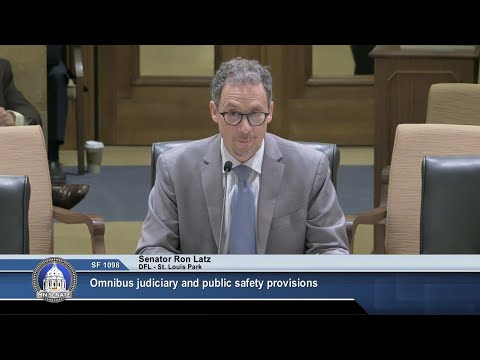
Senate Judiciary Committee adopts wide-ranging amendments to SF1098; lays bill over to be incorporated into SF1417
Summary
The Minnesota Senate Judiciary Committee on April 9 adopted a package of amendments to Senate File 1098 and laid the bill over to be incorporated into Senate File 1417 on Friday, April 11.
The Minnesota Senate Judiciary Committee on April 9 adopted a package of amendments to Senate File 1098 and laid the bill over for incorporation into Senate File 1417 on Friday, April 11.
The amendments approved by the committee touched on a range of issues that members described as technical fixes, stakeholder-driven clarifications and policy changes. Major items included changes to guardianship procedures and visitation notice, a requirement giving certain crash claimants access to investigative recordings, a technical correction to community supervision funding language, authorization for law enforcement to use mobile tracking devices on fleeing vehicles, and several Department of Corrections funding and technical fixes.
Why it matters: The omnibus package reflects the Judiciary Committee’s attempt to consolidate disparate bills and stakeholder changes into a single vehicle. Committee members said the amendments were largely the product of negotiations with affected parties and were intended to correct drafting errors, clarify procedures, or move limited policy provisions forward while other parts of the larger package are deferred.
Guardianship: expanded notice and visit limits
The committee adopted the A9 amendment to provisions previously carried in Senate File 1920, which adjusts emergency guardianship and guardianship visitation language. Suzanne Scheller, a stakeholder who described the amendment to the committee, said the change "expands the notice requirements to the court and the affected persons" and would add language requiring guardians to consider and report less restrictive alternatives before imposing visitation restrictions. Scheller told the committee the change also preserves language clarifying that mere residency in a facility or hospital is insufficient alone to meet the threshold for emergency guardianship.
Access to investigative recordings in crash claims
The A7 amendment, adopted without recorded opposition, requires that certain recorded evidence made during law enforcement investigations of automobile crashes be made available to claimants before litigation, subject to guardrails on use and access. Sponsor remarks said the intent is to facilitate pre-lawsuit resolution by making investigative recordings available earlier in the claims process; supporters described the evidence as material commonly disclosed during discovery in litigation.
Corrections and probation funding adjustments
The committee adopted several Corrections-related technical fixes. The A6 amendment inserted the word "juvenile" into a community supervision funding formula to ensure the formula targets the intended population. The A23 amendment, explained by Paul Schnell, Commissioner of the Department of Corrections, was described as "largely technical fixes" that modify how funding flows to counties and adopt a three-year averaging period for probation population calculations so that sudden shifts do not unduly affect county billings. Schnell characterized the changes as adjustments to existing administrative processes.
Law enforcement tracking and criminal definitions
The A16 amendment, taken from language in another file, authorizes law enforcement to use mobile tracking devices to track vehicles that have fled. Earlier in the hearing the committee discussed an amendment (A3) that would change language in Minn. Stat. § 624.712 (the statute referenced in the discussion as the definition of "crime of violence") so that only felony violations of the chapter on prevention of cruelty to animals would be implicated; committee members and counsel stated the proposal does not change animal cruelty statutes themselves and remains within Judiciary Committee jurisdiction.
Fiscal note for A3
On fiscal impacts for the amendment affecting definitions tied to animal cruelty felony violations, fiscal staff indicated the cost would be minimal. "It's a fraction of a bed, and that's flat going out. So it would dollarize into like $5,000 a year," Mr. Turner, a fiscal analyst, told the committee.
Public-safety and censorship-related provisions
The committee adopted the A18 amendment related to legislation banning childlike sexualized dolls and certain AI-created child sexual abuse material; sponsors said the language reflected negotiations between industry participants and the Bureau of Criminal Apprehension (BCA). Committee discussion did not produce additional debate over the underlying policy in the hearing record.
Wage-theft and criminal justice technical items
The A11 amendment incorporated language from Senate File 1909 to give county attorneys subpoena power for certain documents in wage-theft investigations, as revised in committee. Other adopted amendments included A20 (technical changes to drug-possession-in-school-zone language and a retroactivity date tied to the 2023 decriminalization statute), A22 (a measure to help families obtain information about missing persons consistent with language from Senate File 631), and A25 (clarifying effective dates for a separate provision).
Administrative and fee changes
The committee adopted A19, which deletes a provision that had specified percentages of grant awards that administering departments may retain for administrative costs (language had specified up to 5% for noncompetitive grants and up to 10% for competitive grants). Members said the deletion was intended to allow a separate, blanket bill to address administrative percentages across multiple omnibus bills. Separately, the committee accepted an oral amendment from Senator Latz that deleted a section from Senate File 1409 that would have increased certain local fees for marriage records; committee counsel and fiscal staff said those fees would have been directed to local registrars.
Votes at a glance
- A3 — Amendment to definition language tied to Minn. Stat. § 624.712 (felony animal cruelty scope). Moved and adopted (voice vote). Sponsor: Senator Wessel (mover recorded in transcript); fiscal impact described by Mr. Turner as about $5,000/year (de minimis). - A4 — State Fire Marshal bill to repeal obsolete statutes predating the state fire code (Senate File 1578 language). Moved and adopted (voice vote). Sponsor: Senator Seeberger. - A6 — Technical fix to community supervision funding formula (adds the word "juvenile"). Moved and adopted (voice vote). Sponsor: Senator Seeberger. - A7 — Access to investigative recordings for automobile-accident claimants; adds guardrails on access and use. Moved and adopted (voice vote). Sponsor: Senator Seeberger. - A8 — Foreclosure-related amendment (Senate File 1962 language). Moved and adopted (voice vote). Sponsor: Senator Pappas. - A9 — Guardianship amendment: visitation, emergency guardianship notice, and clarification that facility residency alone is not a presumption. Moved and adopted (voice vote). Stakeholder presenter: Suzanne Scheller. - A11 — Wage-theft subpoena authority for county attorneys (Senate File 1909 language). Moved and adopted (voice vote). Sponsor: Senator Umu Verbatim. - A12 — Removes Senate File 1626 (DOC local licensing changes) from the omnibus package; adopted (voice vote). Sponsor: Senator Clark. - A16 — Authorizes law enforcement use of mobile tracking devices on fleeing motor vehicles (carved out from Senate File 191 language). Moved and adopted (voice vote). Sponsor: Senator Seeberger. - A18 — Language addressing childlike dolls and AI-generated child sexual abuse material (Senate File 1577 language), negotiated with industry and BCA; adopted (voice vote). Sponsor: Senator Seaburger. - A19 — Deletes specific grant-admin percentage language (removes 5%/10% caps), adopted (voice vote). Sponsor: Senator Seaburger. - A20 — Clarifies school-zone drug-possession language and makes a section retroactive to Aug. 1, 2023 (Senate File 1905); adopted (voice vote). Sponsor: Senator Umu Verbatim. - A21 — AI-notification-related amendment (includes grant administration language and an immunity provision added in Commerce); adopted (voice vote). Sponsor: Senator Umu Verbatim. - A22 — Missing-persons information measure (Senate File 631 language tied to a constituent case); adopted (voice vote). Sponsor: Senator Anderson. - A23 — Department of Corrections technical and funding-flow fixes, and three-year averaging for probation population calculations; adopted (voice vote). Presenter: Paul Schnell, Commissioner, Department of Corrections. - A25 — Clarifies effective dates (Senate File 206 language); adopted (voice vote). Sponsor: Senator Umu Verbatim. - Latz oral amendment — Deletes an increase to the fee paid to local registrars for certain marriage records (deletes section from SF1409); adopted (voice vote).
Following the roll of adopted amendments, committee leadership said the package as amended would be laid over to be incorporated into Senate File 1417 on Friday, April 11 at 9 a.m. in the Minnesota State Senate Building, room 1200.
Committee members and staff emphasized that many of the adopted changes were technical or stakeholder-driven and that remaining policy decisions for some topics may be addressed in separate legislation or later in the session.