Get Full Government Meeting Transcripts, Videos, & Alerts Forever!
Get email alerts on the Workforce Development Fund topic
No spam. Unsubscribe anytime.
House committee hears DEED briefing on workforce development fund as budget target cuts $50 million
Summary
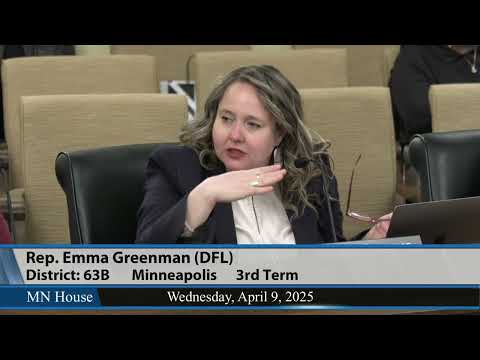
The House Workforce, Labor and Economic Development Finance and Policy Committee met April 9, 2025, in St. Paul to review budget constraints set by the House budget resolution and to receive a presentation from the Department of Employment and Economic Development (DEED) on the workforce development fund and related programs.
The House Workforce, Labor and Economic Development Finance and Policy Committee met April 9, 2025, in St. Paul to review budget constraints set by the House budget resolution and to receive a presentation from the Department of Employment and Economic Development (DEED) on the workforce development fund and related programs.
The committee’s nonpartisan fiscal analyst, Ashley Eng of the House Fiscal Analysis Department, told members that “the budget resolution must set the maximum limit on net expenditures for the next fiscal biennium for the general fund,” citing House permanent rules (rule 4.03, paragraph B) that govern adoption of the resolution. She said the committee’s February forecast base for workforce, labor and economic development was $331,622,000 and that the Ways and Means Committee had set a change-from-base target of negative $50,000,000, producing a total budgeted amount of $281,622,000 for the committee’s jurisdiction.
The committee was also shown that the workforce development fund base is listed in the resolution at $127,885,000. Eng explained that the figures on the committee spreadsheet reflect base spending for DEED, the Department of Labor and Industry (DLI), and the dislocated worker program.
At the Department of Employment and Economic Development presentation, Deputy Commissioner Kevin McKinnon and Deputy Commissioner Mark Majors described the workforce development fund’s structure and uses. McKinnon said the fund, established in 1990, is financed by a 0.1% assessment on taxable wages and is intended to support employment and training programs, especially for dislocated workers. He said the assessment applies to taxable wages up to 60% of the state’s average annual wage. McKinnon noted DEED’s quarterly monitoring and that fund balances fluctuate with labor-market changes.
McKinnon and Majors outlined major allocations and programmatic uses: a portion is set aside for legislative appropriations that can fund DEED, DLI and other workforce priorities; remaining funds support the dislocated worker program; and, after March 1 each year, the Minnesota Job Skills Partnership (MJSP) board may transfer funds to the MJSP program to meet demand. McKinnon said the MJSP program provides grants (up to $400,000) to accredited higher-education institutions for employer-partnered, customized training; the pathways program and a low-income worker training program provide other targeted grants (up to $200,000 for nonprofit-led grants).
DEED staff reported an approximate fund balance in the range of $85,000,000 at the time of the briefing (board-authorized balance reported by DEED staff), and explained that the dislocated worker program receives funding after the legislature sets appropriations and after other transfers or appropriations are made from the fund.
Committee members pressed on practical implications. Several members sought clarification that the $50 million reduction is a biennial (two-year) target and asked whether the Senate’s approach differs; committee chairs said the Senate has access to the workforce development fund and has set different targets, creating a notable gap between House and Senate proposals. Representative Schultz asked whether the $50,000,000 reduction applied to the biennium; fiscal staff confirmed it is biannual spending.
Members and DEED officials discussed program navigation and alignment across agencies. Deputy Commissioner Majors described interagency efforts launched under the governor’s direction to inventory and align workforce programs across agencies (DEED, Department of Education, Office of Higher Education, Department of Human Services and others) and noted local workforce development boards (16 across the state) that coordinate local partners and funding. Majors said recent work includes inventorying programs, avoiding duplication, and using labor-market information to target investments in high-vacancy, high-growth fields such as health care, information technology, manufacturing and construction.
Members raised equity and capacity concerns. Representative Frazier highlighted disparities in unemployment for Black Minnesotans and asked how programs and grants target communities with high unemployment and low educational attainment; Majors pointed to the targeted career pathways grants intended to invest in low-income communities, and the MJSP and related programs that can include capacity building and support for organizations delivering services.
DEED officials also warned that rising layoffs observed in the state mean local workforce development areas, which were funded based on last year’s numbers, may need additional resources to serve increasing demand for reemployment services. Majors said local boards and providers “will more than likely need additional dollars” to meet rising layoffs and service needs.
The meeting opened with a procedural vote approving committee minutes from April 8; Chair Dave Baker moved approval and the committee approved the minutes by voice vote. Committee leaders told members to expect a full hearing the next day as they work to finalize the omnibus bill before the legislative break.
For now, the House’s budget targets restrict net spending from the workforce development fund; DEED staff described how the fund operates and the program channels that state and local officials use to deliver training and reemployment services.
The committee adjourned at the end of the scheduled hearing; committee leaders noted the possibility of additional sessions to finish work on the omnibus bill.