Get Full Government Meeting Transcripts, Videos, & Alerts Forever!
Get email alerts on the Legacy Funds topic
No spam. Unsubscribe anytime.
Legacy omnibus cleared for Ways and Means after debate over Wilderness Inquiry carve‑out and cuts to museums, zoo
Summary
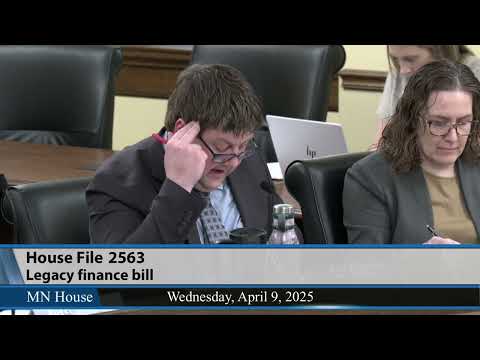
The House Legacy Finance Committee advanced House File 2,563 (DE1) to Ways and Means after adopting technical amendments and hearing testimony from park officials, nonprofits and cultural organizations about a proposed direct appropriation to Wilderness Inquiry and reductions to children's museums and the Minnesota Zoo.
The House Legacy Finance Committee on April 7 adopted amendments and voted to refer the biennial legacy omnibus, House File 2,563 (DE1), to the committee on Ways and Means after roughly two hours of staff explanation and public testimony from parks officials, nonprofit program leaders and cultural institutions.
The committee, co-chaired by Representative Cedric Vang (co-chair) and Chair (McDonald), approved three amendments — DE1, A2 and A1 — and advanced the bill by voice vote. The bill packages appropriations and policy language for the Outdoor Heritage, Clean Water, Parks and Trails, and Arts and Cultural Heritage legacy funds and includes extensions and carryforwards for several existing projects.
Why it matters: The omnibus sets the spending plan that will guide distribution of constitutionally dedicated legacy funds for the 2025–27 biennium. Committee members and dozens of testifiers focused on whether specific line items and carve-outs match the constitutional restrictions that limit parks-and-trails dollars to projects of state or regional significance, and they pressed the committee to preserve competitive grant processes that serve Greater Minnesota and metro systems.
Committee action and staff summary
Nonpartisan staff walked members through a spreadsheet dated 04/07 showing recommended appropriations and several carryforwards and cancellations. The presentation listed the Outdoor Heritage Fund total at $162,111,000 (including a $120,000 cancellation to meet a 5% reserve requirement); the Clean Water Fund totals at $144,625,000 in the first year and $159,301,000 in the second year; and the Parks and Trails Fund at about $61,400,000 in year one and $68,700,000 in year two. Staff also summarized Arts and Cultural Heritage allocations, including a package of grants to the State Arts Board, Minnesota Historical Society and other statewide programs.
A policy provision in the clean water article (DE1, section 12) would require the Clean Water Council to break its recommendations out by fiscal year rather than submit only a biennial total, nonpartisan staff told the committee.
Wilderness Inquiry appropriation drew the most sustained public attention. Several regional and statewide park agencies, including the Metropolitan Council, the Minnesota Department of Natural Resources and the Greater Minnesota Regional Parks and Trails Commission, urged the committee not to direct‑appropriate parks-and-trails funds to a standalone nonprofit organization.
"The state constitution dedicates the parks and trails legacy fund to parks and trails of state and regional significance," Lisa Barajas, executive director for community development at the Metropolitan Council, told the committee. "This is a different focus and approach than the programming and outreach work of Wilderness Inquiry." Laura Preuss, statewide programs and planning manager at the Department of Natural Resources (DNR), said adding individual line items undermines the well‑established partnership approach that distributes parks-and-trails money through the state and regional systems.
Meg Krueger (Wilderness Inquiry) described the Canoemobile program’s statewide outreach and asked the committee to consider an alternative funding source. "Wilderness Inquiry believes that everyone belongs in the outdoors," Krueger said, noting Wilderness Inquiry matches nearly $3 in philanthropic and earned revenue for every $1 of state support and that at current appropriation levels it serves nearly 10,000 Minnesota youth.
Brian Rice, an attorney speaking for the Minneapolis Park and Recreation Board and the 10 metro implementing agencies, said the Minnesota Constitution (art. 11, § 15) limits the parks-and-trails fund to parks and trails of state and regional significance and that "there's never been this kind of carve‑out put in the parks section for a nonprofit entity." He urged the committee to find a different funding home for Wilderness Inquiry's work.
Cultural and education testimony
Representatives of arts organizations and cultural institutions testified about funding levels. Diane Kriesen, president of Minnesota Children's Museum, said cuts in the committee package would halt work on new exhibits and force the museum to eliminate staff positions and some free programs for underresourced families; she asked the committee to consider $650,000 per year for children's museums. John Frawley, director of the Minnesota Zoo, said the current appropriation in the bill is a roughly $1.65 million reduction — "over 40% reduction from prior years" — and that the cut would reduce educational outreach, attendance-driving special exhibits and services to people with disabilities.
Community media representatives asked the committee to include stopgap funding for public, educational and government (PEG) cable stations, which have seen revenue declines as viewers exit traditional cable. Shannon Slatten Schwartz, executive director of CCX Media, requested a modest investment to sustain critical local coverage of city, school and county meetings.
Committee debate and next steps
Committee members from both parties praised staff for negotiating the omnibus and emphasized the constitutional stewardship role lawmakers have for legacy funds. Several members expressed disappointment that some individual requests were not funded and urged members to pursue outstanding priorities as the bill moves through Ways and Means, conference and floor action before the May 19 legislative deadline.
Co-chair Vang renewed his motion that House File 2,563, as amended, be referred to Ways and Means and instructed staff to make technical corrections. The motion passed by voice vote.
Votes at a glance: adoption and advancement
- Adoption of April 2 meeting minutes — mover: Representative Kristin Olsen; outcome: adopted (voice vote). - Motion to move House File 2,563 B and adopt DE1 (place bill in agreed shape) — mover: Co-chair Cedric Vang; outcome: adopted (voice vote). - Amendment A2 (technical corrections: dollar figures, names, capital projects clarifications) — mover: Co-chair Vang; outcome: adopted (voice vote). - Amendment A1 (extension/carryforward for Ash River project) — mover: Vice Chair Scribe; outcome: adopted (voice vote). - Final motion to refer House File 2,563 as amended to committee on Ways and Means with instruction for technical corrections — mover: Co-chair Cedric Vang; outcome: referred (voice vote).
What the committee did not decide formally
No final floor or conference‑level appropriations were enacted in this hearing; committee action advanced an omnibus package to Ways and Means and accepted technical and project‑extension amendments. Members and testifiers emphasized that some contested items — including the Wilderness Inquiry carve‑out and funding levels for children's museums, community media and the Minnesota Zoo — remain subject to change as the bill moves through subsequent chambers.
Ending note
Committee chairs and members thanked staff and dozens of public witnesses for their testimony. Co-chair Vang noted the committee’s limited discretion in a part‑time legislature and urged continued stewardship of legacy dollars as the bill advances through the process.