Get email alerts on the Automated Traffic Enforcement topic
No spam. Unsubscribe anytime.
Safer Streets bill clears committee; would let cities opt in to revised automated enforcement program
Summary
SB 720 would allow local jurisdictions to opt into a revised automated traffic-enforcement system that shifts liability to vehicle owners, lowers fines and removes facial-identification procedures. The Transportation Committee advanced the measure to Judiciary after extensive testimony from safety advocates and city officials.
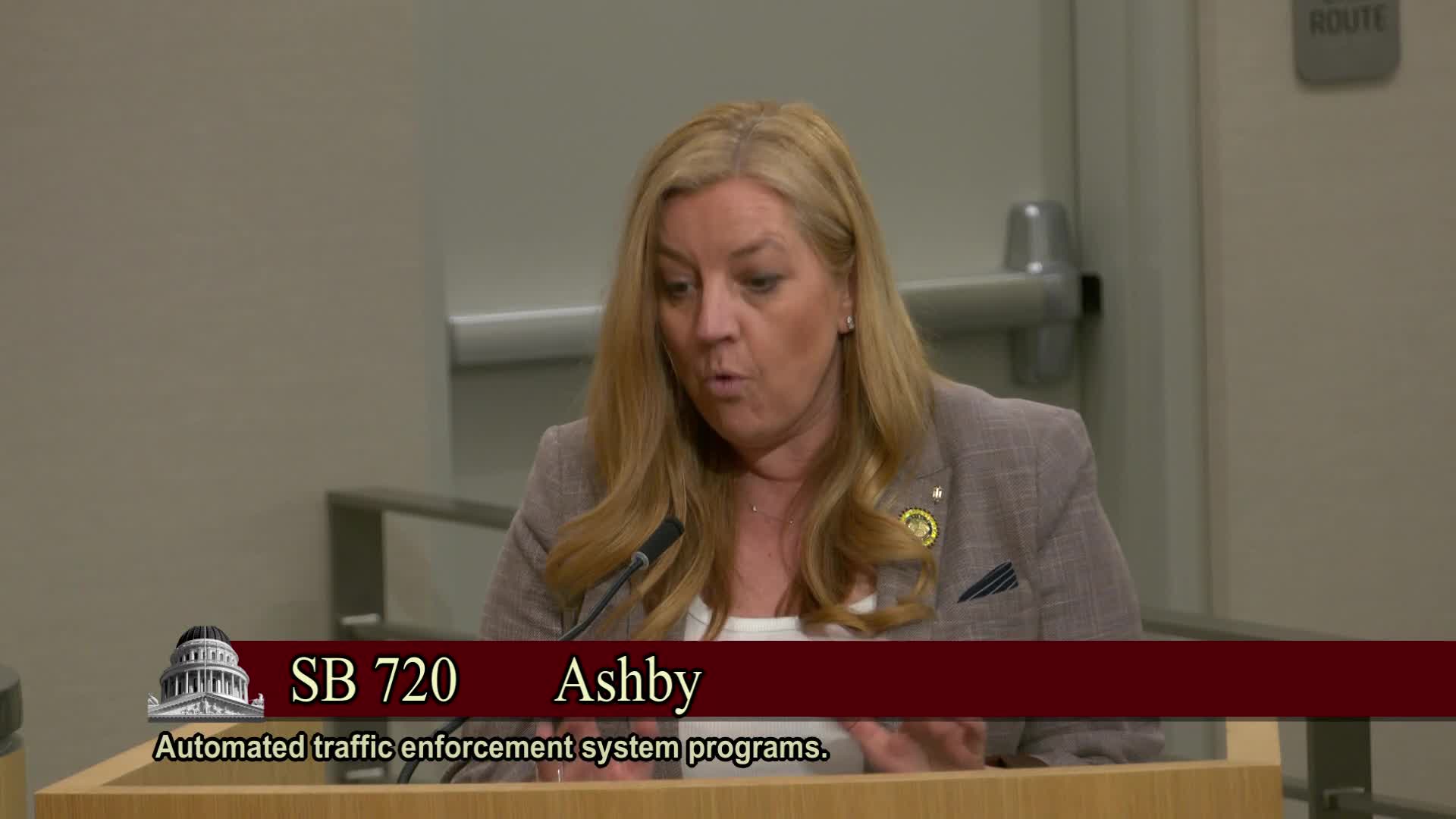
Senate Bill 720, the Safer Streets Act by Sen. Ashby, was advanced by the Senate Transportation Committee after supporters described the bill as an updated, opt‑in automated enforcement program for red light (and related) violations. The proposal would permit local governments to adopt an owner‑liability, civil penalty system for automated enforcement while placing several guardrails on how cameras are sited and how revenues are used.
What the bill would do: SB 720 shifts liability for camera-recorded violations from the driver to the vehicle owner, removes the criminal penalty and associated insurance points for camera‑issued citations, and caps the maximum civil fine at $100 (including administrative fees). The measure would eliminate use of facial‑identification processes for enforcement and direct a portion of revenue back to multimodal safety programs where the cameras are installed.
Supporters’ case: Pastor Patricia Strong-Fergus, representing Faith for Safe Streets, and Lisa Kaplan, a Sacramento city council member and volunteer with a Walk-to-School program, urged the committee to adopt the bill as a safety tool. "Automatic traffic‑enforcement systems improve driver behavior," Pastor Strong-Fergus said, citing national studies. Councilmember Kaplan said Sacramento has among the highest fatality rates for large and mid-sized cities in California and described local interest in camera tools as one component of a Vision Zero strategy.
Opposition: At the hearing no organized opposition witnesses came forward; committee members noted privacy concerns and asked about placement, revenue use and equipment standards. The bill requires local guidelines for camera placement that prioritize high-collision locations and includes reporting requirements.
Committee action: The Transportation Committee approved a motion to pass SB 720 to the Judiciary Committee. The chair called the roll and the clerk recorded the bill's status; the chair left the roll open for absent members while recording multiple affirmative votes in committee.
Next steps: The bill will be considered by the Senate Judiciary Committee. Supporters urged that the measure be considered as a toolbox option for cities that wish to adopt automated enforcement while opponents and some members asked for continued attention to privacy, equity and data‑use protections.
Ending: Authors and supporters framed SB 720 as a voluntary, equity‑minded tool local governments can choose to deploy to reduce severe injuries and deaths on city streets; committee members asked for additional technical details as the bill moves to the next committee.
AI generated
The text on this page is AI generated. Summaries, highlights, analysis, and video transcripts are all produced from the original source material.
AI can make mistakes, so if you spot one, and we will fix it for everyone.
Note: the source content is unaltered by us. Any content source we link to, be it a video, an audio recording, or a document, is presented exactly as its publisher released it. That publisher is usually a government body, sometimes an individual official or another organisation.