Get Full Government Meeting Transcripts, Videos, & Alerts Forever!
Get email alerts on the Food Allergens topic
No spam. Unsubscribe anytime.
Ohio House Ag Committee holds first hearing on bill requiring allergen disclosures at food service operations
Summary
Representatives offered sponsor testimony on House Bill 364, which would require restaurants and food vendors to disclose presence of major allergens; sponsors said the measure is intended to improve safety and transparency and that an amendment to add sodium will be filed.
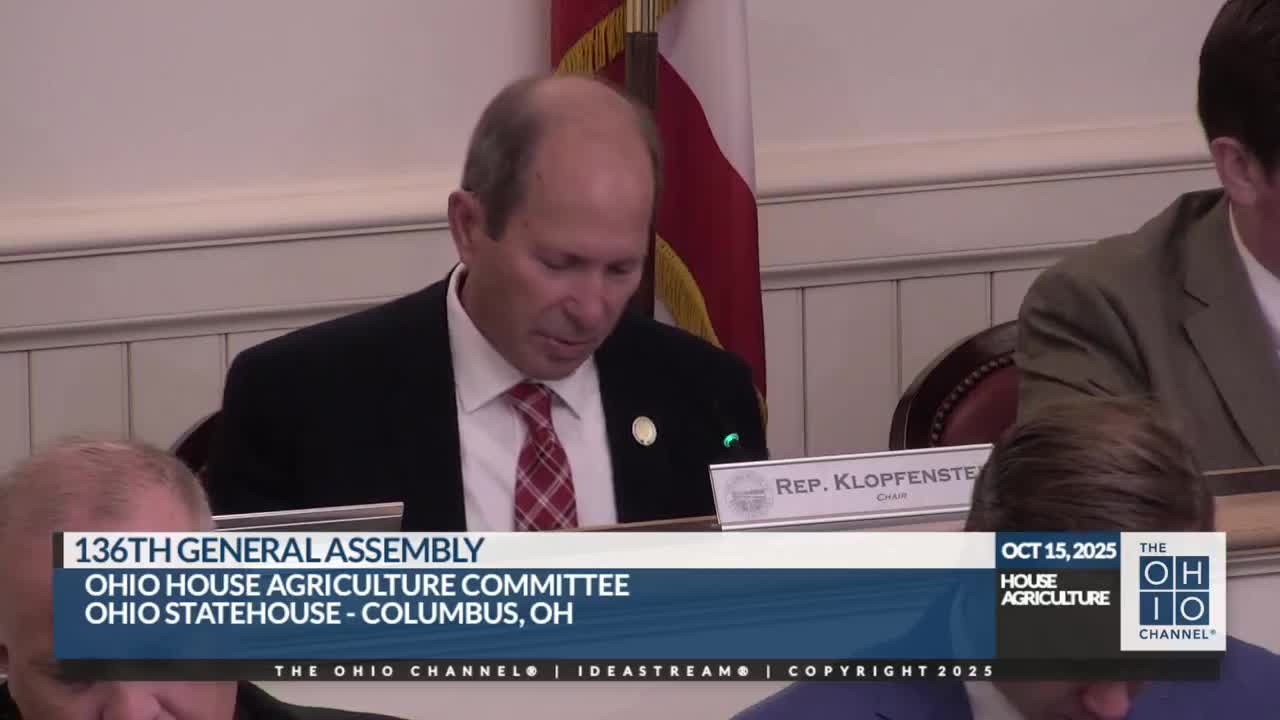
Chair Klopfenstein convened the Ohio House Agriculture Committee for a first hearing on House Bill 364, which would require food-service operations to disclose whether menu items contain any of eight major allergens. Representative Young, the bill’s sponsor, and a co-sponsor identified in committee records spoke in favor of the measure and answered committee questions.
Representative Young told the committee the bill “is a simple and common sense proposal” that “ensures that restaurants and food vendors clearly identify whether any of these 8 major allergens, milk, eggs, fish, crustaceans, shellfish, tree nuts, peanuts, wheat, or soybeans, are present in their dishes.” He said the bill grew out of a family’s difficulty eating out because of severe allergies and called the measure “a matter of life and death.”
The bill’s co-sponsor described personal experience carrying epinephrine auto-injectors and said the proposal seeks “baseline care and attention” rather than new bureaucracy. The co-sponsor also said the sponsors expect to file an amendment recommended by the American Heart Association to add sodium disclosure to the list of items the bill would require restaurants to report.
Committee members asked implementation questions during the hearing. Representative Heiner asked whether buffet-style service and catering would be covered; Representative Young answered, “Yes.” Committee members also sought clarification about liability and enforcement. Representatives observing the bill noted that the text does not include penalties: “There’s no penalties listed on the bill itself,” Representative Young said, adding that follow-up conversations would be needed to determine whether enforcement duties would lie with county health departments or with the Ohio Department of Agriculture.
Representative Conkling asked whether the bill would be accessible for food providers of different sizes, such as food trucks or small catering operations. Representative Young said sponsors had tried to limit burdens and expected costs to be “very minimal,” noting options such as adding sticker labels rather than reprinting entire menus.
The first hearing ended with no committee vote. Committee staff and members said further drafting and conversations with regulatory agencies will be required to settle questions about enforcement pathways and any potential penalties. The sponsors said they will return with an amendment to add sodium at a later date.
No formal action or committee vote on the bill was recorded at the hearing.