Get Full Government Meeting Transcripts, Videos, & Alerts Forever!
Get email alerts on the Pensions topic
No spam. Unsubscribe anytime.
Actuary: Franklin City pension liabilities grow; recommended contribution rises to about $11 million
Summary
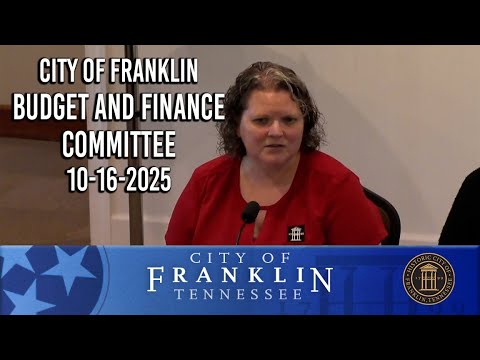
Kevin Sullivan, the USI actuary for Franklin City, presented the 2025 actuarial valuation of the city's defined benefit pension plans to the Budget & Finance Committee on Oct. 16, reporting an entry‑age normal funded ratio of about 67.8% and a recommended contribution of roughly $11.0 million (about 30.2% of active payroll).
Kevin Sullivan, the USI actuary for the City of Franklin, presented the city's 2025 actuarial valuation for its defined benefit pension plans at the Budget & Finance Committee meeting on Oct. 16. Sullivan said the entry-age normal funded ratio used for GASB measurement is about 67.8% for the consolidated plan, down from roughly 83% in 2021.
Why this matters: the valuation determines the city's recommended annual pension contribution and informs budget planning. Sullivan warned the city's recommended cash contribution has risen substantially in recent years because of changes in assumptions and greater-than-expected salary increases for active employees.
Sullivan opened by describing the two-plan structure used in Franklin: a legacy closed plan for employees hired before Jan. 1, 2017, and an open plan enrolled in the Tennessee Consolidated Retirement System (TCRS) for employees hired on or after that date. "We're actually now at the point where ... we have slightly more active members in the TCRS plan than in the legacy plan," Sullivan said, adding that liabilities remain concentrated in the legacy plan because those participants typically have longer service and more retirees.
Sullivan reviewed key assumption changes and results. The plan's discount rate was lowered from 6.80% to 6.75% as part of a multi-year step-down tied to prior action (identified in the presentation as resolution 2025-18) and to align with TCRS assumptions; Sullivan said that 6.75% is likely to remain in place for a few years. He also noted the mortality assumption uses 105% of the RP‑2014 healthy annuitant/non-annuitant blue-collar table with 10 years of projected improvements under Society of Actuaries scale MP‑2021, and that TCA 9-3-501 requires use of projected mortality improvements.
On assets and smoothing: Sullivan reported a beginning‑of‑year market value near $159.4 million, an actuarial (smoothed) asset value "just over $176,000,000," and a five‑year smoothing approach to recognize gains and losses. For 2024 the plan had an asset gain versus expected of about $2,500,000; that gain will be phased in under the five‑year smoothing approach. He said the 2022 investment loss (about $27.8 million) and a 2021 gain (about $15.4 million) are part of the multi‑year blend.
Recommended contribution and drivers: Sullivan said the recommended contribution for the 2025 valuation is about $11,000,003.78, representing roughly 30.23% of active payroll. That recommendation combines (1) the normal cost — the value of benefits earned by active employees (about $2.9 million) — plus (2) a 15‑year amortization of the unfunded past service liability (the presentation showed an unfunded supplemental liability of roughly $83.5 million) and interest on expected contributions. He attributed much of the recent increase in the recommended dollar amount and percent of payroll to (a) the gradual lowering of the discount rate over recent years and (b) actuarial losses tied to compensation (salary increases greater than expected). Sullivan noted compensation‑related experience produced a liability loss of a little over $4,000,000 on the valuation basis, while the discount‑rate step down from 6.80% to 6.75% added about $1,200,000 of liability and increased contribution by a few hundred thousand dollars.
Sullivan also summarized demographic trends: the active population is shrinking while the retiree and disabled population is growing (retirees and disabled numbered about 341 in the closed plan), which makes mortality assumptions increasingly significant over time. For the TCRS open plan portion, Sullivan reported active membership around 352, an accrued liability near $12.1 million, actuarial assets about $10.9 million, and a funded ratio just under 90%; the employer contribution rate for that portion is about 7.44%.
Committee discussion focused on the contribution drivers and timing. An alderman asked how much of the current recommended contribution increase is attributable to compensation experience versus the discount rate change; Sullivan replied that the compensation/salary experience accounted for the bulk of recent losses and that the 1.2 million liability increase from the discount rate change is smaller than the multi‑million dollar compensation loss.
The presentation concluded with Sullivan inviting questions and offering to provide additional information if the committee wanted more detail on assumptions, amortization schedules or the five‑year smoothing of asset gains and losses.
Ending: The committee heard the actuarial presentation and asked follow‑up questions; no committee vote was taken on the valuation itself during the meeting. The city will use the valuation and assumptions in upcoming budget planning and in preparing disclosures for the 2025 audit and fiscal reports.