Get Full Government Meeting Transcripts, Videos, & Alerts Forever!
Get email alerts on the Opportunity Public Charter Schools topic
No spam. Unsubscribe anytime.
Commission staff proposes adjusted performance framework for Opportunity Public Charter Schools; commissioners raise concerns about 75% at‑risk requirement
Summary
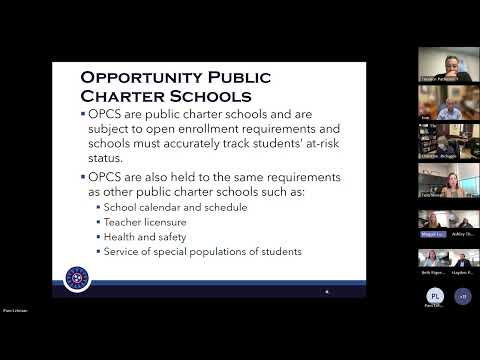
Deputy Director of Authorizing Maggie Lund presented a draft of Commission policy 3.71 on Oct. 7, proposing an adjusted performance framework for Opportunity Public Charter Schools created under state law.
Deputy Director of Authorizing Maggie Lund presented a draft of Commission policy 3.71 on Oct. 7, proposing an adjusted performance framework for Opportunity Public Charter Schools created under Tennessee law.
The proposed framework would apply the Tennessee Department of Education's adjusted letter grade for Opportunity schools, increase the weight for mission-specific goals from 10% to 20%, retain the TVOS growth composite and add a time-and-model comparative analysis that compares proficiency and performance-level movement for students who remain enrolled year to year. The draft also adds an organizational-performance line item to ensure schools track and maintain the statutory 75% at‑risk enrollment requirement.
Why it matters: Tennessee Code Annotated 49-13-133 establishes Opportunity Public Charter Schools and requires authorizers to adopt an adjusted accountability framework that measures multiple performance indicators and prepares students for post‑secondary success. The commission's framework will determine how new Opportunity schools are evaluated, monitored and, if necessary, intervened upon.
Key elements of the draft framework
Maggie Lund said Opportunity Public Charter Schools must serve at least 75% at‑risk students as that term is defined in statute: household income at or below 400% of the federal poverty level plus one of several risk criteria such as prior dropout, juvenile adjudication, chronic absenteeism, retention, pregnancy or parenting status, documented substance abuse, or history of abuse or neglect. Lund said at‑risk status is determined at the time of enrollment and must be tracked by the school.
Lund described the academic measures in the draft. Student outcomes would remain an adjusted letter grade set by the state. The mission-specific goal (tied to each school's charter agreement) would carry more weight to recognize models tailored to high‑risk populations; Lund said those goals are school‑reported but must be written into the charter and are subject to the charter's interim-review process. The comparative-performance indicator would initially be a time-and-model analysis (school-to-self over time for continuously enrolled students) because there are not yet statewide datasets of Opportunity schools for direct comparisons. Schools serving high school grades may opt into a college-and-career-readiness (CCR) comparison to their resident district if data are available.
On growth and nonacademic measures, the draft keeps the TVOS composite to ensure growth is recognized; Lund said bonus weighting for TVOS 4 or 5 schools has helped some schools meet standards despite low proficiency. The draft also adds an organizational-performance item to confirm schools accurately document and report at‑risk status and to monitor that schools maintain the required 75% at‑risk share; Lund noted that if a school falls below 75% for three consecutive years, it must amend its charter agreement to cease designation as an Opportunity Public Charter School.
Questions and concerns from commissioners
Commissioner Tom Griscom said staff should anticipate how external audiences (legislators, auditors, the public) might interpret numbers from a school that uses different measures than traditional charters and asked staff to prepare context to avoid misinterpretation. He also said he wanted the commission to monitor absenteeism patterns to see whether the Opportunity model yields lessons other charters might adopt.
Commissioner Christine Richards said the hard 75% threshold raised concerns because small cohorts could see large percentage swings if one or two students' status changes. Lund and other staff responded that at‑risk status is fixed at enrollment for the purpose of meeting the requirement, and that the policy would trigger amendment only after three consecutive years below 75%, not after a single year.
Staff responses, next steps and related items
Lund said the commission's approach follows several guiding principles: use of publicly available, valid data; alignment with state accountability; allowance for innovation via mission-specific goals; and maintaining a reasonable performance bar. She described outreach with the State Board of Education, other authorizers and national alternative-school authorizers, and said the commission tested the draft against available data.
Lund also outlined operational next steps: continued stakeholder engagement, additional pressure-testing when new state data are released, and a plan to bring the framework back for final read at the commission's January 2026 meeting. She noted the commission has already approved at least one Opportunity school (Rock Academy) and will continue conversations with operators.
Related updates raised during the same agenda segment
- Enrollment: Staff reported mixed results for new and expanding schools this year, with some slightly over and some under their budgeted projections; school funding is based on the October enrollment "true up." - Amendments: The commission received one fall amendment application (submitted Oct. 1) from an entity listed in materials as "Lead Lehi Neeley's Bend" seeking increased enrollment and seats; staff said the amendment will be presented to the committee in January 2026 after committee discussion. (Application name recorded as provided in committee materials.) - Interventions and data: Staff said Promise Academy Spring Hill moved off intervention; Bluff City High School remains on tier 2 with a plan of correction and bimonthly meetings. Tennessee Nature Academy and Rutherford Collegiate Prep have low TVOS composites; staff reported they have begun closeout and follow‑up meetings with operators and will decide any intervention actions after the release of letter-grade data. - Timeline for public state releases: Lund presented the data-release timeline staff will use for further pressure-testing: TVOS public site (Oct. 8), federal designations (Nov. 21), state report card with letter grades (Dec. 18) and the commission's annual report (target Jan. 1).
Ending
Lund said the draft is intended to evolve as data and operating experience accumulate. Staff will return to the committee with stakeholder feedback and a final recommendation at the January 2026 commission meeting.