Get Full Government Meeting Transcripts, Videos, & Alerts Forever!
Get email alerts on the Capital Improvement Plan topic
No spam. Unsubscribe anytime.
Auditors urge faster closeout of long-dormant Jacksonville CIP projects, propose small inspection reserve
Summary
Kim Taylor, the council auditor, presented spreadsheets showing multiple groups of projects. Taylor said the committee’s review found an “item number 1” group with about $8.3 million that auditors believe could largely be closed, and a second group totaling about $8.9 million that also appears ready for closeout.
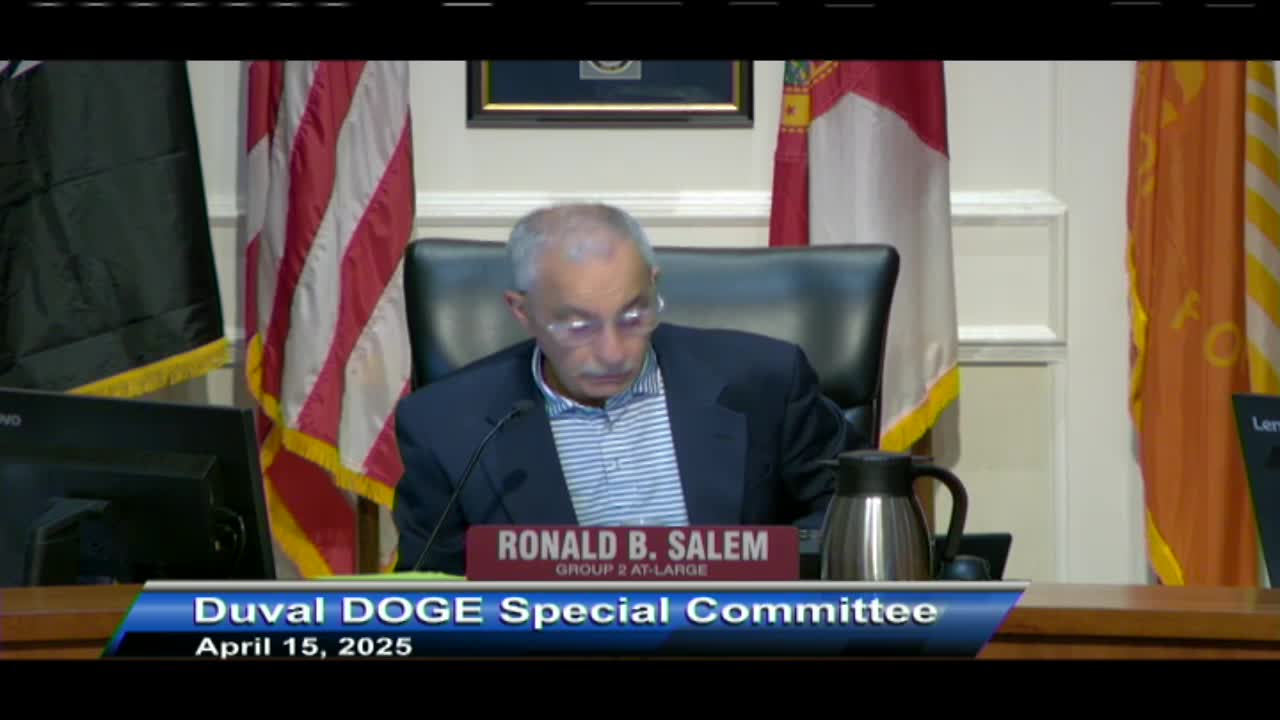
At a Special Committee meeting in Jacksonville, auditors and budget staff told committee members that hundreds of capital projects remain open long after work ended and that closing completed projects could free cash to reduce borrowing for future capital needs.
Kim Taylor, the council auditor, presented spreadsheets showing multiple groups of projects. Taylor said the committee’s review found an “item number 1” group with about $8.3 million that auditors believe could largely be closed, and a second group totaling about $8.9 million that also appears ready for closeout. Taylor cautioned some projects have funding restrictions that limit where dollars can be reallocated and recommended working with the budget office and accounting to complete formal closeouts.
Why it matters: closing finished projects into a closure or contingency account can create PAYGo capacity and reduce the need to issue additional debt. Taylor and other staff framed the item as a timing and process issue — projects that have not recorded expenditures since October 2023 or earlier are tying up capital capacity.
Budget office staff described the administrative closeout process and timing. Kathleen Collins of the Budget Office said, "For a project to close, you have to balance the revenue and the expenditures," and described a memo routed to the CAO, the CFO and the comptroller that triggers accounting to zero out and close a project. Collins estimated the administrative closeout and fund reallocation process can take "probably a few months" depending on volume.
Public Works staff explained why some completed projects remain open during warranty and inspection periods. Nina Stichler, Public Works, said that for the eleventh-month warranty inspection "a minimum of $2,000 would be requested" to cover an inspector and that some inspections have found items that must be corrected and therefore have kept projects open. She also said Public Works has started a monthly engineering-and-finance report in the last six months aimed at reducing unnecessary hold time.
Committee members pressed on the financial scale and options. One staff presenter noted that for some clusters of projects a small inspection fund could replace holding millions of dollars on individual project accounts. Taylor suggested closing most projects and leaving a modest, centralized inspection reserve to cover warranty checks and small follow-ups so the bulk of dollars can be reallocated.
Council members raised examples and constraints. Council member Mike Gay asked whether performance/payment bonds already cover contractor warranty obligations; staff replied that bonds exist but some post-occupancy or user-caused issues have been handled out of project accounts. Members also highlighted individual long-running projects — an Argyle Forest lane-widening account with about $2.7 million tied to a state process and a Lonnie Miller ash-remediation project that has required scope changes and remains complicated.
Staff walked the committee through additional schedules: a list of projects with balances over $100,000 (about $81 million when aggregated across pages and funding sources, per staff presentation, though much of that total includes items departments say remain active) and a supplemental list of smaller accounts under $100,000 totaling about $2.2 million. Taylor asked district council members to review projects assigned to their districts so department staff and the auditors can confirm which accounts are truly completed.
On next steps, the committee directed auditors to coordinate with the relevant departments and district council members to (1) identify projects that departments already consider complete and accelerate closeout, (2) quantify a modest inspection reserve to cover warranty follow-ups (staff estimated typical inspection costs range from $2,000 to as much as $50,000 for outsourced third-party inspections), and (3) return with a refined list for use in the upcoming FY 2025–26 budget process. The committee noted that administrative closeouts can proceed but any reappropriation of closed dollars to new capital projects will require council action during the budget process.
The committee set a follow-up timeline; the next meeting was scheduled for May 6 and staff said they would circulate updated lists to district council members and departments beforehand.