Get Full Government Meeting Transcripts, Videos, & Alerts Forever!
Get email alerts on the Transportation Active Transportation topic
No spam. Unsubscribe anytime.
Council approves feasibility study to compare Buttercup and Park Street shared‑use paths
Summary
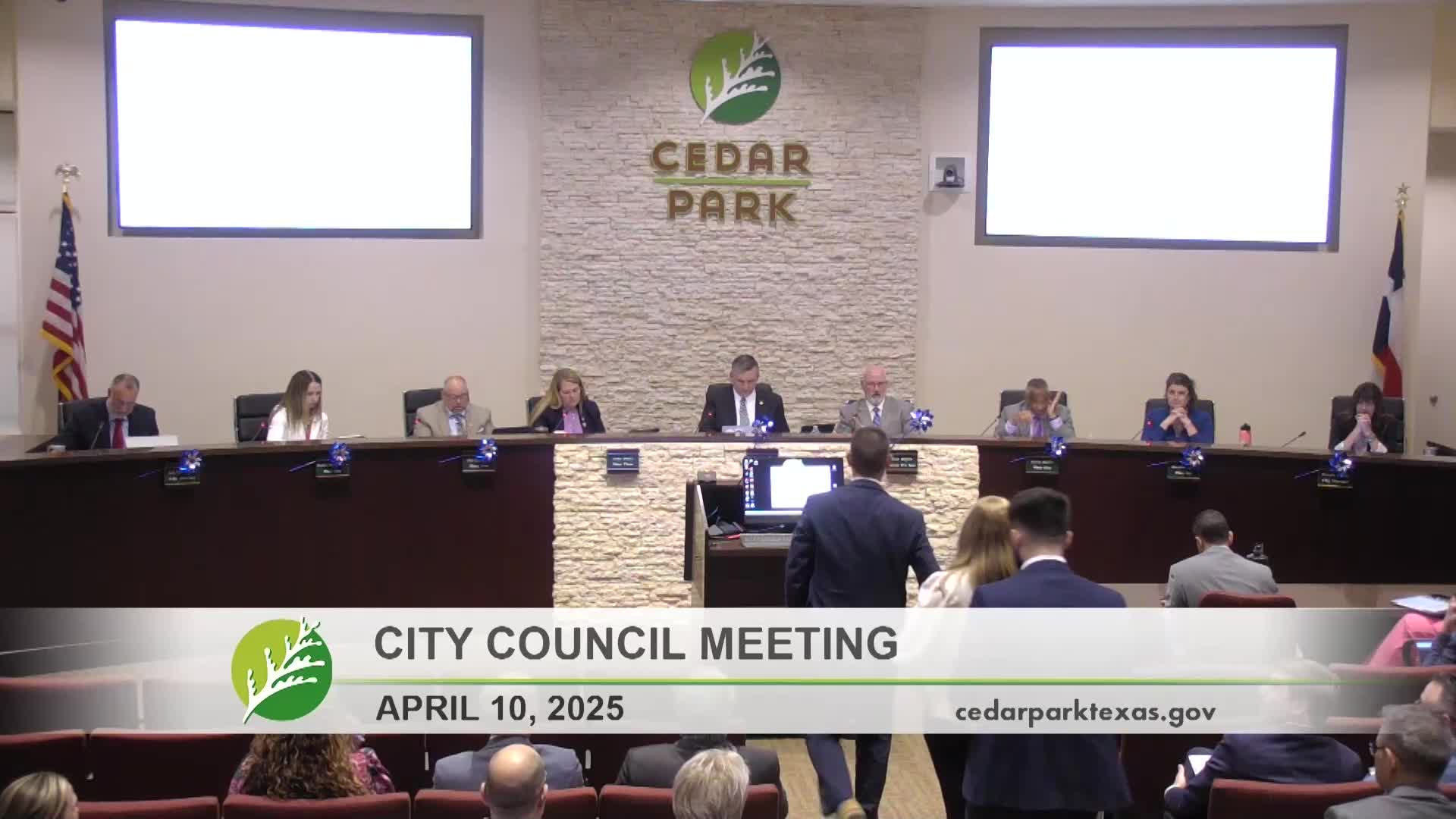
Cedar Park’s City Council voted April 10 to hire consultants to study and compare the feasibility, preliminary design and costs of shared‑use paths along Buttercup Creek Boulevard and Park Street.
The Cedar Park City Council voted unanimously April 10 to authorize a professional services agreement to study feasibility and preliminary design for shared‑use paths on Buttercup Creek Boulevard and Park Street.
Randy Leeters, director of engineering capital projects, said the mobility master plan’s trails plan had identified Park Street as a priority connection but noted Buttercup has greater right‑of‑way width and other advantages. The study will evaluate both corridors, produce preliminary cost estimates and identify right‑of‑way needs, potential utility easement uses and connections to the Bell District and the recently installed Belt line shared‑use path.
Council discussion emphasized several design points: distinguishing between shared‑use paths aimed at casual walkers and families versus road cyclists who prefer through‑street riding; evaluating how the proposed paths would connect to existing and planned trails and to the Bell District; and preliminary schematic design sufficient to support cost estimates and future engineering. Leeters said the study would evaluate a north‑south pedestrian connection through an existing utility easement and identify easement acquisition needs if required.
Councilmembers also voiced safety and tree‑preservation concerns on Park Street, noting narrow sections and tree canopy that make a direct on‑street path more challenging; several council members said until feasibility is studied, the city should avoid removing trees and should prioritize designs that minimize tree loss. The council approved the study to provide decision‑grade information ahead of potential future design and construction funding.