Get Full Government Meeting Transcripts, Videos, & Alerts Forever!
Get email alerts on the Land Use Solar topic
No spam. Unsubscribe anytime.
Franklin County commissioners deny special-use permit for commercial solar project at 3800 Montana Road
Summary
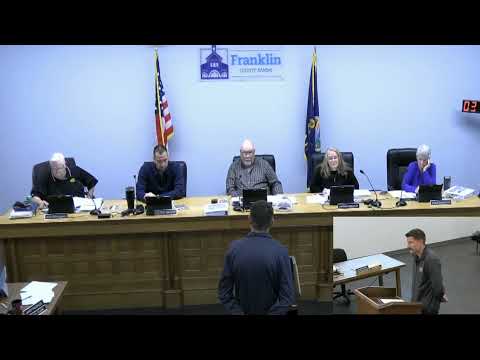
After hours of testimony and a divided planning commission recommendation, the Franklin County Commission voted unanimously to uphold the planning commission’s recommendation and deny a special-use permit for a proposed commercial solar energy conversion system at 3800 Montana Road.
Franklin County commissioners on April 9 upheld the Planning Commission’s recommendation and denied a special-use permit that would have allowed a commercial solar energy conversion system at 3800 Montana Road, about one mile north of Ottawa.
The application proposed panels on a reclaimed quarry pond and adjacent land: the applicant said the project would include roughly 1,180 floating panels on the pond and about 7,500 ground-mounted panels on the surrounding land, plus two-axis trackers. Pat Toth, Franklin County planning and building director, summarized the Planning Commission record, saying the Planning Commission held two public hearings and a study session and unanimously recommended denial, citing “insufficient information required in articles 3 section 3-3.01(v)(3)(f) and 3-3.01(v)(3)(b) of the county zoning regulations.”
Applicant Jason Edwards and several technical witnesses described the project in detail and answered commissioners’ questions. Edwards said he had prepared a tabbed binder of materials aligning application responses to county code and that he has worked on the proposal for roughly two years. He described using reclaimed quarry land and said he planned to connect to a nearby Evergy distribution line rather than a transmission substation. Carl Privateer of Mark 1 Electric, an electrical contractor Edwards brought forward, described his firm’s experience building utility-scale projects around Kansas City and urged the commission to approve the project.
Opponents at the hearing raised water-quality, environmental and precedent concerns. Public commenters said they feared potential contamination of groundwater and nearby streams, the effects of damaged panels in storms, and long-term land-use impacts. Several speakers asked the commission to wait until the county updates its comprehensive plan or enact a moratorium on commercial-scale renewable projects. Barb Wunderly said residents were “here today to plead for the commission to protect our quality of life.” Jessica Christopher asked the commission to “take time to fully integrate your vision for Franklin County into the comprehensive plan prior to making any allowances for any energy projects in this county.”
Edwards and supporters responded that he had included toxicity and leaching reports in his submission, that the panels and floats he selected met laboratory test limits for heavy metals, and that he was willing to do baseline and ongoing water testing and to aerate the pond. Edwards said the floating and tracker technologies were intended to use previously disturbed quarry land rather than prime farmland and that he had engaged utility and energy-market contacts about the project’s role in supplying local industrial loads.
After public comment and a final round of commissioner discussion, a motion was made to uphold the Planning Commission’s recommendation of denial for Special Use Permit Application 2410-003 for construction and operation of a commercial solar energy conversion system in the A-1 Agricultural Zoning District. The motion passed unanimously: Commissioner Wehmeyer — yes; Commissioner Meador — yes; Commissioner Dickinson — yes; Commissioner Saldemeyer — yes; Chair Harris — yes.
The commission’s vote denies the specific permit application brought by Edwards; commissioners and staff said action does not establish a binding legal precedent for future applications. Pat Toth told the commission that, under Kansas law, an override of a unanimous Planning Commission denial would require a supermajority of four votes to pass if the commission were to instead approve an application that the Planning Commission recommended denying.
Commissioners and staff identified outstanding items that figured in the Planning Commission’s recommendation and public comments: the level of detail needed for stormwater and sediment controls, documentation of reclamation and site ownership and leases, water-rights and water-structure approvals from the Kansas Department of Agriculture for any dam or diversion work, baseline and follow-up water-quality testing plans, and evidence regarding potential disturbance during installation (core samples, piling and fence-post plans). Edwards said many of those items would be addressed at building-permit stage but critics and some commissioners said required environmental and hydrology information should be provided before special-use approval.
The denial leaves open administrative and legislative paths: the applicant can revise and reapply; commissioners can pursue comprehensive-plan language or a moratorium on large-scale renewable projects; and county staff can seek further guidance about what pre-application studies the county should require for water-adjacent solar projects. Edwards said he would consider his options and that he had additional documentation he had already provided to Planning and Zoning.