Get Full Government Meeting Transcripts, Videos, & Alerts Forever!
Get email alerts on the Instructional Budget topic
No spam. Unsubscribe anytime.
Board hears detailed instructional-budget workshop focused on literacy, math and BOCES partnerships
Summary
Assistant Superintendent Sagrati Rudacinda O'Neil outlined proposed curricular priorities and professional development tied to next year's instructional budget, including expanded literacy interventions, math "thinking classroom" work, Science21 implementation and use of BOCES services.
Assistant Superintendent of Curriculum and Instruction Sagrati Rudacinda O'Neil presented the Beacon City School District's instructional priorities and the professional-development elements anchoring next year's instructional budget during the April 7 board meeting.
O'Neil said the district's academic plan is anchored to the state's emerging Portrait of a Graduate framework and a local emphasis on vocabulary acquisition. "Our academic goal was vocabulary acquisition," she said, describing a year of teacher training in literacy, math, science, social-emotional learning and AI use. The presentation summarized multiple intervention tiers and named programs the district plans to expand or adopt.
Why it matters: the workshop lays out the district's operational choices that drive staffing and materials requests in the proposed 2025-26 budget. The board and public heard specific proposals that would affect classroom instruction, intervention staffing and outside contracts.
Key instructional proposals and details
- Literacy: The district currently has five teachers in LETRS training (Language Essentials for Teachers of Reading and Spelling) and will add a second cohort of five next year. All academic intervention (AIS) teachers are enrolled in LETRS. The district will continue Foundations coaching (K'2) and will add Just Words (a Wilson/Orton-Gillingham derivative) as a tier-2 intervention for grades 4'8 and possibly some ninth graders. O'Neil said the district will train seven special-education teachers in the Wilson Reading System level-1 certification (a year-long, intensive credential) to support the highest-tier interventions.
- Assessments and pilots: The district is piloting DIBELS with about 100 students at Roundabout to add a second data point alongside classroom measures and I-Ready. I-Ready has an "I-Ready Pro" feature the district plans to use for older students to address vocabulary gaps.
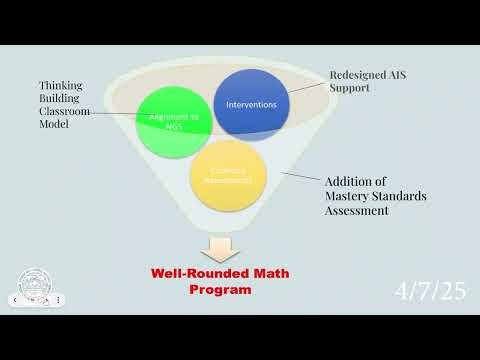
- Mathematics: The secondary math department is engaged in a "building thinking classrooms" book study and instructional model emphasizing problem solving, student discourse and group whiteboard work. The district plans to redesign its math-intervention block and develop common math assessments modeled on the literacy work.
- Science and social studies: The district will continue implementation of Science21 (K'5), which requires vendor training for new teachers. New state Regents in chemistry and physics are expected in 2026 and the district is planning pacing accordingly. The district also highlighted the Seal of Civic Readiness and inquiry-based social studies instruction as elements of the Portrait of a Graduate.
- MTSS/RTI expansion and SEL: The district has fleshed out RTI/MTSS at the elementary level and plans to expand to middle school next year. The Positivity Project and Responsive Classroom approaches will continue in elementary schools, and staff will meet the state's 15% professional-development requirement for English learners.
- BOCES partnerships and contracted services: O'Neil described multiple contracted services through Dutchess County BOCES and other BOCES partners for coaching, specialized programs (for example, Foundations coaching and Wilson certification), print and facilities services, and Science21 support (PNW BOCES noted as a partner for K'2 Science21). The presentation emphasized the district's use of BOCES to leverage aidable spending and to scale professional development across the region.
Board questions and next steps
Board members asked about rollout details, lay explanations of fractional staffing (for example, 0.5 positions), and how increased BOCES contracting affects district aid. O'Neil said implementation would be phased; for example, foundations coaching currently covers two elementary demo sites (Gliedam and South Avenue) and will expand to others (Sargent and JBF) next year. She confirmed some items, such as Wilson level-1 training, are multi-year investments.
Ending
The presentation closed with an acknowledgement that some proposed expansions (notably additional reading positions) carry an asterisk tied to federal funding uncertainty; O'Neil and the administration said they would prioritize sustaining current services if external aid falls short. The board moved on to the broader budget discussion after members thanked staff for the detailed instructional overview.