Get Full Government Meeting Transcripts, Videos, & Alerts Forever!
Get email alerts on the Sidewalks Public Maintenance topic
No spam. Unsubscribe anytime.
Resident group tells Dallas City Council the city wrongly charged homeowners for sidewalk repairs
Summary
A representative of the North Dallas Neighborhood Alliance told the council that city ordinances do not authorize charging residents for sidewalk repairs because private property does not abut sidewalks in Dallas; the speaker urged the council to stop erroneous assessments.
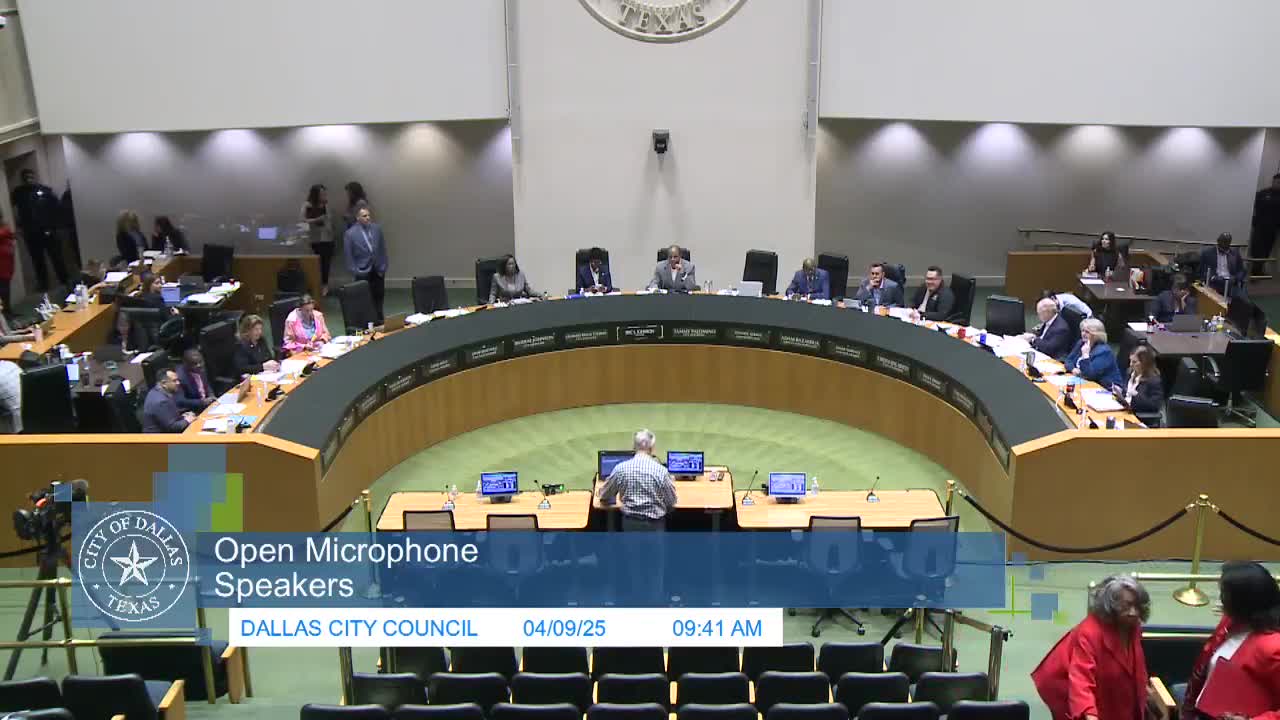
Rod Scales, representing the North Dallas Neighborhood Alliance, told the Dallas City Council during the April 9 open-microphone session that the city has been incorrectly charging homeowners for sidewalk repairs that lie on city property.
Scales said residential front property lines in Dallas stop “anywhere from 6 to 10 feet from the back of the curb,” and therefore, “you don't own the land where the sidewalks have been placed.” He cited Chapter 43, Section 33 of the city code in arguing that sidewalk repairs are residents’ responsibility only if private property “touches or butts the concrete sidewalk.” Scales said his group's review of 93 locations across all 14 council districts found none of those properties abutted the sidewalk.
“Therefore, the City has been in error in charging residents for those sidewalk repairs,” Scales said, urging the council to stop assessing residents and to cease billing practices he described as unauthorized. He told council staff had been asked to stop charging residents since July 2023, and that “about a thousand residents” were charged over an 18-month period.
The remarks came during public comments; council members did not take immediate action on the allegation during the meeting. Staff responses and any follow-up direction from council were not recorded on the public transcript for the open-microphone portion. The transcript records the claim that staff in earlier meetings—an assistant city attorney and the director of public works—had concurred that no residential properties abut sidewalks in any council district, a point Scales cited as supporting his stance.
Council members may request that staff clarify the legal basis for residential assessments and provide a status report back to the council; the council did not announce a formal referral during the April 9 meeting.