Get Full Government Meeting Transcripts, Videos, & Alerts Forever!
Get email alerts on the Social Media Excise Tax topic
No spam. Unsubscribe anytime.
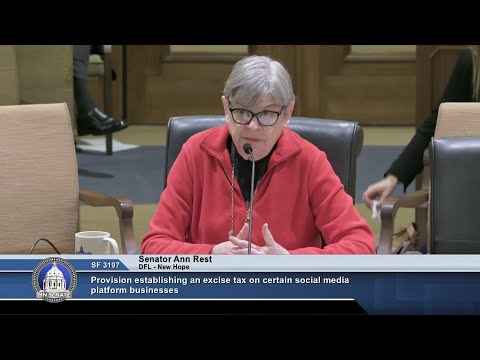
Senate Taxes Committee debates excise tax on social media data; A2 amendment adopted, bill laid over
Summary
The Minnesota Senate Taxes Committee considered Senate File 3,197, a bill that would impose a graduated excise tax on social media platform businesses that collect data on Minnesota consumers. The committee adopted an author's A2 amendment and laid the bill over for further consideration.
The Minnesota Senate Taxes Committee considered Senate File 3,197, a bill that would impose a graduated excise tax on social media platform businesses that collect data on Minnesota consumers. The committee adopted an author's A2 amendment and laid the bill over for further consideration.
Sen. Rest, the bill's author, told the committee the proposal would tax "the businesses of social media" rather than Minnesotans as individuals, drawing the line by applying the excise to platforms that collect data on more than 100,000 consumers in any given month. "No Minnesotans as individuals or companies, individually will be, will be taxed by this," she said, and described the proposal as a way to "modernize the way in which our tax systems work." The bill would be administered under procedures similar to Minnesota's sales tax system and deposit revenues into the state general fund.
Why it matters: The bill targets a rapidly growing sector of the economy that the author and supporters say has been lightly taxed relative to its economic value. The committee heard competing views on whether the proposal would raise durable revenue and on its legal vulnerability under federal law.
How the bill would work: As presented in committee, the bill defines a "consumer" as an individual who establishes an account on a social media platform (by app or website) and defines a "social media platform business" as a for'profit entity that collects consumer data to support its business and collects data on more than 100,000 individuals in a month. The bill includes: - A 100,000-monthly-user threshold to determine applicability. - A graduated per-capita excise rate applied to counted Minnesota consumers. - A credit for tax paid to another state (subdivision 9). - Recordkeeping and reporting requirements administered by the commissioner of revenue using the sales-tax administrative framework. - An effective date for data collected after Dec. 31 of the current year, as drafted in committee.
Revenue estimate and administration: The fiscal note presented to the committee estimated roughly $45 million in the first (partial) year (an 11-month collection period) and about $100 million per year thereafter, based on an assumption that 14 large platforms would meet the threshold. The author said platforms would be required to "just count how many" Minnesota consumers they have and to report that number to the Department of Revenue; she emphasized that the bill would not require submission of personal consumer data to the state.
Supporters and arguments in favor: Testimony in favor stressed equity and revenue diversification. - Eric Bernstein, director of We Make Minnesota, said the tax would ask a "powerful and fast growing industry" to help fund public services and described the proposal as an example of a Pigouvian approach to externalities tied to attention'maximizing business models. - Philip Sandro of Isaiah Minnesota and Taryn Fritzinger of the Minnesota Association of Professional Employees urged new revenue to cover potential federal funding shortfalls and to avoid job losses in state services; Fritzinger described layoffs at the Department of Health tied to abruptly ended federal grants. - Shannon Slatten Schwartz of CCX Media and MACDA said revenues could be used to modernize funding for community public-access television (PEG) stations that provide local government coverage.
Opponents and arguments against: Testimony against the bill raised economic and legal concerns. - Wendy Paulson, president of the Minnesota Broadcasters Association, warned the bill's broad definitions might sweep in local broadcasters that collect user data through websites, newsletters and apps, unintentionally subjecting them to the excise. - Cory Marshall of the Chamber of Progress argued the tax could cause platforms to scale back free services and force up costs for small businesses that rely on affordable digital advertising. - Deb Peters, a past president of the National Conference of State Legislatures and a certified public accountant, said taxing digital advertising risks higher prices for consumers and expressed legal concerns about the bill's interaction with federal law.
Legal questions raised: Committee members and testifiers debated possible legal challenges. Professor Darian Shankski (UC Davis School of Law) said states have broad revenue power and noted the bill's nondiscriminatory application across platforms could help defend it from Internet Tax Freedom Act (ITFA) and commerce clause claims, but he also said litigation is likely. Several senators referenced concerns about ITFA's ban on discriminatory taxes and ongoing litigation elsewhere, including Maryland's digital ad tax.
Implementation and practical issues discussed: Committee members pressed on operational questions: how platforms would identify Minnesota consumers, how the bill would treat visitors versus residents, how controlled groups would be treated, and whether platforms could shift the cost to advertisers or users. The author said the bill presumes platforms already maintain the subscriber information necessary to count "Minnesota consumers" and that platforms would bear the burden of proving a user is not a Minnesota resident if questioned.
Committee action and next steps: The committee adopted Sen. Rest's A2 author's amendment and then "laid over" Senate File 3,197 as amended for further consideration; no final vote on enactment occurred. Committee members requested additional follow-up information, including Department of Revenue materials about auditing capacity and revenue modeling. The committee was also reminded it will reconvene in a subsequent meeting for further consideration of tax proposals.
What was not decided: No final legislative action was taken to enact the excise; questions about legal exposure, enforcement mechanics (IP addresses, cookies, VPNs), the potential for cost pass-through to local advertisers, and the bill's ultimate contribution to solving Minnesota's budget gap were left unresolved and were prominent in committee discussion.