Get Full Government Meeting Transcripts, Videos, & Alerts Forever!
Get email alerts on the Education Omnibus A3 topic
No spam. Unsubscribe anytime.
Senate education finance committee walks through A3 omnibus; proposes delink from inflation, cuts to nonpublic aid and charter facility funding
Summary
The Minnesota Senate Committee on Education Finance reviewed the A3 omnibus amendment on April 9, outlining proposals to delink the general education formula from inflation in later years, extend school unemployment aid, change special education and English‑learner cross‑subsidy aid, and eliminate or reduce funding for several programs including nonpublic pupil aid and long‑term facilities maintenance for some charter schools.
Saint Paul — The Minnesota Senate Committee on Education Finance reviewed the A3 “delete everything” amendment to the education omnibus bill Wednesday, April 9, laying out a package of policy and budget changes that would alter school funding and several targeted education programs across the state.
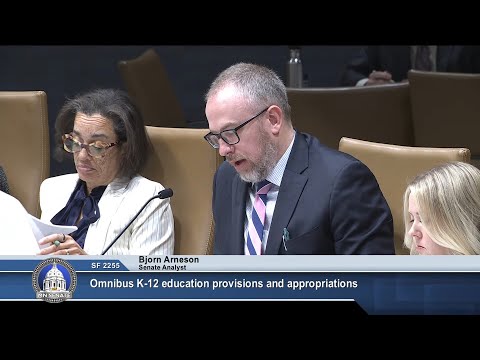
The walkthrough — led by Senate fiscal staff and accompanied by Minnesota Department of Education (MDE) and Department of Children, Youth and Families (DCYF) officials — described a bill that would keep the basic formula allowance at forecasted February 2025 levels through fiscal 2026–27 but would “delink” it from inflation for fiscal years 2028 and 2029. Jenna Hofer of Senate counsel, research and fiscal analysis told the committee the A3 would leave the formula allowance at $7,705 per pupil in fiscal years 2028 and 2029 instead of applying an inflationary increase and that the change would reduce general fund spending by roughly $219.6 million in FY28 and $391.0 million in FY29 for the general education portion.
Why it matters: The basic formula allowance is the foundation for per-pupil general education revenue. Reducing or removing the automatic inflator affects many other aid lines that are calculated as a function of the formula allowance, the fiscal staff said, and prompted strong concern from both agency leaders and public witnesses.
Key provisions identified by staff and agency witnesses
- Delinking of formula inflator: The A3 would hold the formula allowance at forecasted February figures for FY26–27 and stop the automatic inflation adjustment in FY28–29, lowering projected general education spending in the 2028–29 biennium.
- Compensatory revenue hold-harmless: The amendment contains temporary hold-harmless provisions for compensatory revenue calculations in fiscal 2026 and a second-year hold-harmless element for fiscal 2027 intended to blunt estimated losses for some districts under the new compensatory aid formula.
- School unemployment aid: The A3 would provide an additional $100 million in school unemployment aid in the FY26–27 biennium and transfer some formerly general fund appropriations (Come Teach in Minnesota hiring bonuses, Grow Your Own, and school unemployment aid) to a special revenue account. Senate fiscal staff said the net change to special revenue items would sum to zero in each biennium.
- Nonpublic pupil programs: The amendment would repeal the district obligation and state aid for transporting nonpublic pupils and eliminate nonpublic pupil aid, while maintaining a one-time 10% cleanup payment for FY25 that would be paid in FY26. Fiscal staff estimated general fund savings in the tens of millions of dollars across the biennia as a result.
- Special education and English learner cross-subsidy reductions: The A3 proposes increasing the special education cross-subsidy reduction factor beginning in FY28 (a projected $96.7 million increase in special education aid in 2829) and adds EL cross-subsidy reduction aid to cover a portion of districts’ EL costs beginning in FY28 (about $26.7 million in 2829).
- Transfers and eliminations: Several grants and program appropriations would move from the Professional Educator Licensing and Standards Board (PELSB) to MDE (for example, collaborative urban and greater Minnesota educators of color grants and mentoring/retention incentive grants) and other program line items would be eliminated or reduced (computer science appropriation, gender-neutral single-user restroom grants, STARBASE Minnesota, Santa Foundation, Minnesota Independence College and Community base funding in later years, and teacher recruitment marketing).
- Facilities and charter funding: The A3 modifies long-term facilities maintenance (LTFM) aid rules, would expand allowable LTFM uses in some cases (roof repair/replacement), and would repeal LTFM aid for charter schools under the bill’s repealer language; it also authorizes cooperative levy apportionment for ice arenas. Senate staff noted an LTFM change that would reduce LTFM for charter schools by $19.994 million in the FY26–27 biennium and $22.194 million in 2829 under the A3’s current text.
- Other items: The amendment includes a provision requiring cardiac emergency response plans for interscholastic athletic activities under Minnesota State High School League authority, a compensatory revenue task force, and several appropriations or operating adjustments for MDE programs, state academies and Perpich Center funding timing.
Agency and committee concern
Commissioner Willie Jett, commissioner of education, praised several inclusions of the governor’s proposals but urged lawmakers to “reconsider the proposed elimination of this inflator,” calling the 2023 automatic inflator “one of the most significant achievements of the 2023 session.” He also asked the committee to reconsider reductions to Compass and MTSS funding and the proposed elimination of gender-neutral restroom grants. (“We urge the senate to reconsider the proposed elimination of this inflator,” Commissioner Jett said.)
Tiki Brown, commissioner of the Department of Children, Youth and Families, warned the committee that delinking the formula from inflation would make it harder for schools to operate school‑based early learning programs and said removing the early childhood teacher shortage grant would make implementation of new licensure requirements more difficult.
Public testimony: themes and examples
More than 50 members of the public and school leaders testified during the hearing; recurring themes included: strong opposition to cuts to nonpublic pupil aid and nonpublic transportation; opposition to elimination or reduction of LTFM funding for charter public schools; broad support for continuing unemployment insurance for hourly school workers; and requests to preserve targeted program funding (Reading Corps, Math Corps, STARBASE and other student supports).
- On nonpublic aid cuts: Peter Russ, principal at St. Mary’s School in Sleepy Eye, said the proposed cuts to nonpublic aid would “significantly affect our ability to serve our students,” highlighting transportation and counseling. Dan Allstrom, head of Heiliter Jewish Day School, and multiple Catholic, independent and faith-based school leaders warned that removing nonpublic aid would reduce student access to transportation, nursing and counseling and would disproportionately affect low‑income families who rely on those services.
- On charter facilities: Multiple charter school leaders warned that eliminating or reducing LTFM payments for charter schools would force staff cuts or cuts to counseling and student support. Julie Lundgren, CFO at Lakes International Language Academy, said the LTFM allocation the school receives “is equal to three teachers” and that losing it would force difficult program and staffing reductions.
- On unemployment insurance: Paraprofessionals, bus drivers and other hourly education support professionals repeatedly urged continuation of UI funding. Educators and union leaders said UI reduced summer turnover and improved continuity for students; one bus driver said that with UI “it is easier to retain staff, especially new drivers.”
- On supportive programs: Representatives from Serve Minnesota, Minnesota Reading Corps, and Math Corps described the value of corps-based early literacy and math interventions; several witnesses thanked the committee for including funding increases for those programs.
Process, next steps and committee direction
Committee staff described the A3 as an informational walkthrough and asked members to save substantive questions until later in the hearing or for the committee’s markup scheduled for the next day. Senator Farnsworth voiced immediate opposition, saying he could not support the bill as drafted: “We have a hundred million dollars for unemployment for seasonal employees, but we can’t pay to give kids a ride to a school,” he said, arguing the package prioritized some items over basic student services.
No formal committee votes or final actions were taken during the hearing; the committee proceeded to receive public testimony and scheduled markup for a later session.
Ending note
The A3 amendment represents a broad reworking of the education omnibus bill with both programmatic and structural changes to how Minnesota funds education. The proposal’s most consequential changes — delinking the formula from inflation, eliminating some targeted program appropriations, and removing long‑standing nonpublic pupil aids — drew strong pushback from agency leaders, local school leaders and service providers. With committee markup set for a later date, lawmakers and advocates said they would continue negotiations as the session moves forward.