Get Full Government Meeting Transcripts, Videos, & Alerts Forever!
Get email alerts on the Budget topic
No spam. Unsubscribe anytime.
Neshaminy SD projects $10.7 million preliminary deficit for 2025-26; 4.7% tax index would cut gap
Summary
District finance staff presented a preliminary 2025-26 budget showing $214.48 million in projected revenue, $225.19 million in projected expenditures and a $10.70 million shortfall; major drivers are rising health-care costs and special-education spending.
Neshaminy School District finance staff told the board on April 8 that the district’s preliminary 2025-26 budget projects $214,484,026 in revenue against $225,186,200 in expenditures, producing a projected deficit of $10,702,174.
The presentation by Deb Clayhold, who delivered the budget development overview, identified multiple drivers of the shortfall: a projected 24% increase in health-care costs, rising special-education tuition and outsourcing costs, flat state subsidy growth and the end of federal ESSER COVID relief funds. “Currently in our preliminary budget, our anticipated revenue is $214,484,026 but our anticipated expenditures are $225,186,200. So we’re projecting a deficit of 10,702,174,” Clayhold said.
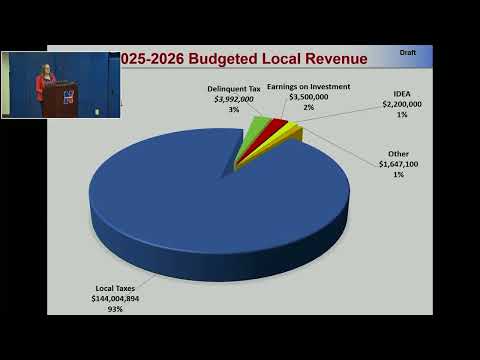
Clayhold showed that local taxes account for the largest share of revenues (about $155 million), with state aid near $56–57 million and federal funding roughly $2.4 million. She said raising taxes to the state index of 4.7% would generate about $6.7 million in local revenue and reduce the projected deficit to $3,997,930. “If we would raise taxes to the index, which is 4.7%, that would decrease the deficit to $3,997,930,” she said.
The presentation broke down several significant cost pressures. Special-education expenditures were described as growing much faster than the state subsidy; Clayhold showed estimated special-education expenditures of about $42.7 million for 2024–25 with state reimbursement of roughly $7.8 million. Charter tuition rates were presented as $15,173 per regular-education charter student and $39,205 per special-education charter student. Transportation costs for 2024–25 were projected at about $10.9 million, with state reimbursement of about $1.6 million.
Clayhold outlined enrollment and special-education trends: the district has seen enrollment shifts over recent years and significant increases in specialized needs. She noted early-intervention counts rising from 83 students in 2021–22 to about 160 in 2024–25 and cited examples of high-cost placements and tuition: an autistic-support (AS) class of eight students cost about $90,000 per student in 2023–24 and Clayhold said the district is budgeting for three level-3 K autistic-support classes in 2025 (roughly 24 students) at an estimated $98,000 per student.
She also explained fund-balance activity that affects available resources: during 2023–24 the board transferred $6 million to an internal service fund for benefits and $12 million to the capital fund, lowering the general fund balance. Clayhold cautioned that bond-rating agencies look at fund balance as a percent of revenue; she said an ongoing decline below roughly 14–15% would be concerning for future borrowing costs.
On homeowner impact, Clayhold said an average homeowner (average assessed value cited in the presentation as $276,000) would pay about $236 more annually if the district raised taxes by the 4.7% index. She added that homestead/farmstead property tax relief from the state—if the anticipated figures materialize—would reduce the homeowner impact; Clayhold said the state was expected to post finalized homestead numbers by April 15.
Board members asked clarifying questions about the presentation and document status. One board member asked why the presentation was labeled “draft”; Clayhold replied that the budget is preliminary and the district continually updates revenue and assessment information. Trustees also pressed on whether the district is exploring options to curb insurance costs; Clayhold said the district reviews consortium options but remains largely self-insured and that administrative services and high-claim members limit near-term savings.
No formal budget votes occurred at the April 8 meeting; the board was informed that the district’s preliminary budget will be refined in the coming weeks and that routine and budget-related items are scheduled for the April 22 public meeting.
The presentation and subsequent discussion emphasized monitoring revenues (transfer and mercantile taxes, investment interest) and continued review of expenditures, including retirements and staffing changes that may reduce salary costs, while noting many cost drivers—especially special education and health benefits—are largely external to the district’s direct control.