Get Full Government Meeting Transcripts, Videos, & Alerts Forever!
Get email alerts on the Housing Policy topic
No spam. Unsubscribe anytime.
Senate finance panel advances housing omnibus with task force on property insurance, targeted funding for homelessness prevention
Summary
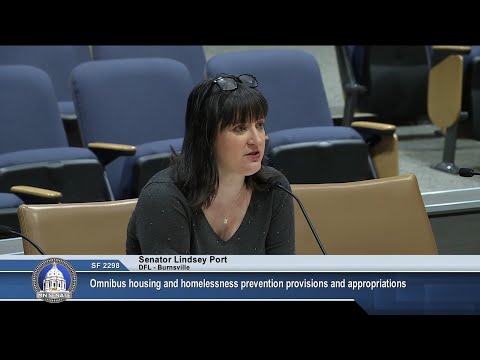
Senator Port introduced SF2298, a housing omnibus budget bill, to the Senate Finance Committee on April 9 and the committee recommended the bill for passage after adopting technical and scope-limiting amendments.
Senator Port introduced Senate File 2298, the housing omnibus budget bill, to the Senate Finance Committee on April 9, saying Minnesota faces rising housing costs and that the bill focuses on homelessness prevention, workforce housing infrastructure in Greater Minnesota and programs to help first-time homebuyers. "The cost of housing is higher than ever in Minnesota, and the dream of homeownership is slipping out of reach for more and more families," Senator Port said.
The committee adopted two amendments affecting bill language and scope. Senator Murphy moved and the committee adopted a technical amendment (A8) that, according to Senator Port, revises fiscal-year phrasing for consistency. Senator Friend moved and the committee adopted the A9 amendment, which narrowed the scope of a proposed task force on property insurance; the amendment removed common-interest communities, cooperatives and small businesses from the task force's charge so members can focus on residential and commercial property insurance related to multifamily housing.
Senator Port described the task force's charge as examining factors driving rising insurance costs, reviewing risk mitigation, liability, enforcement and oversight, reinsurance possibilities, catastrophe-based insurance and other areas to stabilize the homeownership market. The senator told colleagues stakeholders asked to narrow the task force so it would be a manageable scope for the stated timeline.
Eric Olafson, senate fiscal analyst, walked the committee through the bill's spreadsheet. Key change items listed on the spreadsheet include a one-time general fund appropriation of $10,150,000 for the Family Homelessness Prevention and Assistance Program (FHPAP); $2,000,000 in FY2026 for Greater Minnesota housing infrastructure grants with a $500,000 ongoing base beginning in FY2028; $2,000,000 in FY2026 for a community-based first-generation homebuyer down-payment assistance program through the Midwest Minnesota Community Development Corporation (MMCDC) with ongoing funds beginning in FY2028; and a $10,000,000 reduction to a community stabilization appropriation for single-family housing. Olafson reported net savings to the general fund of $10,450,000 in FY2025; net new general-fund spending of $13,450,000 in FY2026–27; and net new spending of $1,000,000 in FY2028–29. He said the bill meets the committee's $3,000,000 and $1,000,000 general-fund targets for the two budget periods.
An amendment offered by Senator Sarah Mohammed (A10) would have altered recertification language for a rental-assistance program (referred to in committee as the Bring It Home program), striking a provision that required annual recertification of eligibility. Mohammed said the change would align the state program with federal Section 8 practice, where initial eligibility is determined and families remain on assistance until they reach an exit threshold rather than being asked to re-prove initial eligibility yearly. Committee members debated the operational and eligibility effects of the change, including concerns that leaving eligibility as a strict annual recertification could force households off assistance because area median income changes rather than because their need ended. After extended questioning from multiple senators about how recertification interacts with program exit rules and waiting lists, Senator Mohammed withdrew the A10 amendment for further work.
Jennifer Ho, commissioner of Minnesota Housing, testified in support of the bill's investments, calling the proposed funding "critical to providing housing stability, creating new homes, and preserving the homes we have across the state." Ho said the investments would help renters, homeowners, developers and owners statewide, and offered agency support for implementation and technical assistance.
The committee took voice votes on the amendments. The A8 and A9 amendments were adopted by voice vote. After discussion and closing remarks from several senators who said they supported additional production funding when possible, Senator Graham moved that SF2298, as amended, be recommended to pass; the motion prevailed by voice vote.
The bill's change items, task force language and the withdrawn A10 amendment remain in the bill text as amended and will be available for further amendment and action when the measure is considered on the Senate floor.
Votes at a glance: A8 (technical fiscal-language amendment) — adopted (moved by Senator Murphy; voice vote). A9 (narrow scope of property-insurance task force) — adopted (moved by Senator Friend; voice vote). A10 (recertification change for rental-assistance eligibility) — withdrawn by the mover, Senator Sarah Mohammed. SF2298 as amended — recommended to pass (moved by Senator Graham; voice vote).