Get Full Government Meeting Transcripts, Videos, & Alerts Forever!
Get email alerts on the Veterans Funding Legislation topic
No spam. Unsubscribe anytime.
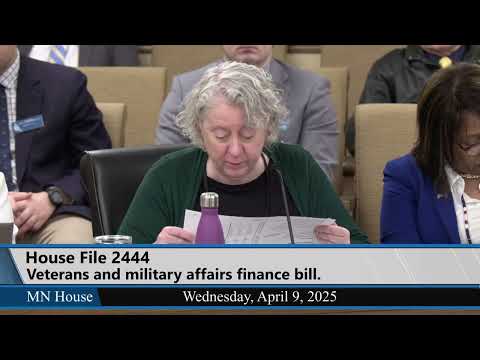
House Veterans and Military Affairs Division adopts amended HF2444, sends bill to Ways and Means
Summary
The Minnesota House Veterans and Military Affairs Division on April 9 voted to adopt the DE2 co-chairs amendment to House File 2444 and referred the bill to the House Ways and Means Committee after adopting several technical amendments and hearing testimony about funding for veterans homes, homelessness prevention and suicide-prevention programs.
The Minnesota House Veterans and Military Affairs Division on April 9 voted to adopt the DE2 co-chairs amendment to House File 2444 and referred the bill to the House Ways and Means Committee after approving several technical amendments and hearing testimony from agency officials and veteran-service organizations.
The bill, as amended, includes operating increases for veterans homes, an increase for suicide-prevention programs, reductions to certain homelessness-prevention grants, language recognizing veterans who served in the secret guerrilla units (SGU) in Laos, and multiple one-time grants and program changes. Nonpartisan staff were directed to correct remaining technical errors in the bill language and spreadsheets before the bill moves to Ways and Means.
The DE2 amendment was moved by the chair and adopted by voice vote. The committee also adopted an A2 amendment correcting an error in the average-cost care calculation for three new veterans homes and an A4 amendment, requested by the Minnesota Department of Veterans Affairs (MDVA), that changed the terminology for the new SGU category from “certification of veterans eligibility” to “verification of veteran eligibility.” Nonpartisan staff identified a numerical error on page 2 (should read 126,748,000) and were authorized to make technical corrections or the committee could adopt a formal A5 amendment if desired.
Lieutenant Colonel Eric Othman, operations director for the Minnesota Department of Military Affairs, thanked the committee for the operating increase and expanded bonding authority but urged continued discussions about funding for enlistment incentives. “Incentives are the thing that really help us have a competitive edge to keep our units filled with soldiers,” Othman said, noting the department’s request for incentives had been removed in the DE2 draft.
Brad Lindsey, commissioner of the Minnesota Department of Veterans Affairs, told the committee the MDVA’s health-care division would be funded about 12 percent below the governor’s recommendation in the DE2 amendment and warned of operational consequences if funding is not increased. “Funding at these levels will force the Minnesota Department of Veterans Affairs to absorb cost pressures and make strategic decisions about staffing or providing benefits and services,” Lindsey said, saying shortfalls could lead to empty beds, reduced census and longer wait lists at newly opened state veterans homes in Bemidji, Montevideo and Preston.
Representatives of veteran-service organizations warned of immediate impacts from the proposed cuts to homelessness programs. Neil Lytle, president and CEO of the Minnesota Assistance Council for Veterans, said elimination of the state’s direct financial-assistance funding would jeopardize supports that prevented homelessness for hundreds of veteran households in the past year. “If you eliminate these funds, we anticipate immediate impacts leading to more than doubling of the state's homeless veteran registry,” Lytle said.
The DE2 amendment also incorporates a range of policy provisions drawn from multiple authors: access to the MAXIS database for the MDVA (from HF1662), changes tied to the state active-duty pension-offset (from HF2338 and HF1443), bonding-limit increases for the State Armory Building Commission, federal alignment of burial eligibility language, and the new SGU category and an advisory task force to set eligibility criteria for veterans who fought in Laos as part of irregular forces. The bill carries several one-time grant items and program adjustments, including an $11.6 million operating adjustment for veterans homes and a $2.2 million increase for suicide-prevention programs (both recorded in the bill materials presented by nonpartisan staff).
Committee members expressed bipartisan support for many provisions while also flagging concerns. Representative Olson and others urged continued work on a separate proposal to require federal accreditation for paid veterans-benefits advisers — legislation they described as intended to prevent predatory “claims predator” practices — and stressed due diligence before finalizing that measure. Multiple members said they prioritized increased suicide-prevention funding given the persistent numbers of veteran suicides nationally.
Before adjourning, Chair Bliss renewed the motion that HF2444, as amended, be re-referred to Ways and Means; the motion carried by voice vote. Nonpartisan staff were directed to make any further technical corrections to bill language and associated spreadsheets discovered before transmittal.
Votes at a glance - HF2444 (as amended, DE2 with A2 and A4 adopted): Referred to Ways and Means; outcome: approved by voice vote (no roll-call tally recorded). Notes: committee directed staff to make technical corrections; an A5 amendment was drafted to correct a numeric error if the committee required a formal change.
What’s next HF2444 moves to the House Ways and Means Committee for fiscal consideration; sponsors and agency staff said they will continue discussions with Ways and Means and the Senate on funding levels and unresolved items. The division noted the bill’s policy and funding provisions will be subject to further negotiation as part of the broader budget process.