Get Full Government Meeting Transcripts, Videos, & Alerts Forever!
Get email alerts on the Public Safety topic
No spam. Unsubscribe anytime.
Office of Public Safety outlines $67 million operating budget, expands grants and wellness court pilot
Summary
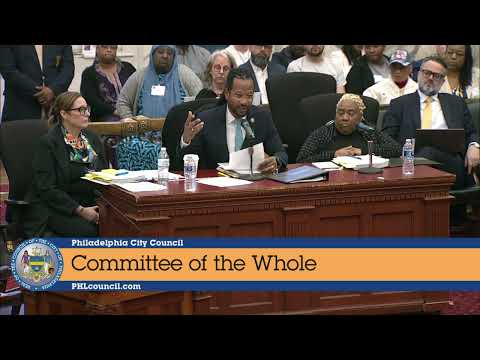
Adam Gere, the city’s chief public safety director, told the City Council the Office of Public Safety is requesting about $67 million to operate and outlined expansions to anti‑violence grants, a Kensington wellness‑court pilot and an AI tool for deploying violence‑intervention teams.
Adam Gere, the city’s chief public safety director, told the Philadelphia City Council during a budget hearing that the Office of Public Safety (OPS) is requesting an operating budget of roughly $67 million and is coordinating what he described as a historic, cross‑agency anti‑violence investment.
Gere said his office’s analysis identified about $264,489,920 — described in testimony as “roughly a quarter of a billion dollars” — across city agencies that is tied to anti‑violence prevention efforts, not including the police department’s budget. “We are building something stronger than a program or policy. We are building trust, building connection, and building an ecosystem that protects and uplifts every resident of this city,” Gere said.
Why it matters: Gere framed OPS as an interagency coordinator that combines funding, community partners and new program capacity to target violent crime, open‑air drug markets and overdose risk. Council members pressed for program‑level data and timelines before approving or expanding new line items.
Key numbers and programs described by Gere - OPS operating budget: roughly $67,000,000 (requested). - Citywide anti‑violence spending identified across agencies: about $264,489,920 (Gere’s analysis; he rounded to “roughly $265 million”). - OPS anti‑violence grant program: a $25,000,000 program described as the administration’s top anti‑violence grant initiative. - Direct opioid response grants: $3,600,000 in direct funding for opioid response activities (announced in testimony). - Victim burial assistance: Gere referenced a proposed $3,000,000 investment for funeral/burial costs for victims of violent crime, an initiative driven by the Office of Victim Advocate. - Office of Victim Advocate budget: stated in testimony as $2,400,000 total for that office.
Gere described a three‑tier grants structure for anti‑violence funding and gave counts and ranges for awards: roughly 62 TSIG grantees (small awards, characterizes lowest tier as about $1,500 up to $50,000), 18 organizations in a newly created intermediary “community capacity” or CCG tier intended to bridge $50,000–$100,000 awards, and a top tier funding roughly 63 organizations receiving about $21,000,000 in total. Gere told Council the administration expects about 42 organizations to receive specific city funding referenced during the hearing and said the grants team had begun notifying awardees.
On program evaluation and data tools Gere said OPS hired a director of performance management to create standardized anti‑violence metrics that will align with the city’s PhillyStat 360 system. He also announced the planned summer rollout of an AI‑powered tool, funded by the Civic Coalition to Save Lives, that OPS says will synthesize crime data and intelligence to guide deployment of community violence interruption teams. “This work will allow us to more fully understand which of our interventions and programs are working and which are not,” Gere said.
Wellness Court pilot and service pathway Gere described the Neighborhood Wellness Court pilot in Kensington, which has been operating one day a week for about nine weeks at the time of testimony, and said the administration seeks to expand it to operate five days a week. He said the pilot has handled 64 referrals during that period but repeatedly acknowledged the sample is small and that OPS will provide more detailed outcome reporting to Council. “We have been operating one day a week for nine weeks now…we’ve had 64 referrals come through our doors,” Gere said.
Council members asked detailed outcome questions, including how many individuals entering wellness court received treatment, how many exited treatment early, and whether participants consented and were competent to participate. Gere and other administration witnesses said they will provide written data and a six‑month look‑back evaluation; several council members requested those figures before finalizing budget decisions.
Relationships with other criminal justice offices and victim services Gere described coordination between OPS, the Police Department and the District Attorney’s Office on victim services and rapid response, and he said the Office of Victim Advocate will continue advocacy and victim support functions while criminal case‑level case management will be handled by the DA’s victims’ unit. Adara Combs (identified in testimony as the victim advocate) and OPS’ crime scene cleanup and victim outreach efforts were cited as part of the broader victim services work.
Community and partner organizations Gere recognized many community partners and grantees working with OPS, including groups he named in testimony (for example, Beyond the Bars, The Lighthouse, Positive Choices and Actions, Shoot Basketballs Not Guns, Meraki) and said OPS has added staff roles — director of grants, director of interagency partnerships and a performance management director — to support grantmaking, partnerships and measurement.
Concerns and follow‑up requests from Council Multiple council members, including Council President [full name in the record] and Councilman Jones (chair of public safety), voiced support for OPS’ approach while requesting more transparency and written details. Council members repeatedly asked for: - Written breakdowns of the grants (award amounts, recipients by council district and program descriptions). - Outcome metrics for the wellness court (number entering treatment, completion rates, numbers returned to custody or jailed). - Clarification of how OPS coordinates with AMP, PAD and other diversion and treatment programs.
Formal action at the close of the hearing The Council took a procedural vote to recess and continue the hearing. The motion to recess was adopted by voice vote; no roll‑call tally was recorded in the hearing transcript.
What’s next Council members requested a briefing and written materials from OPS with district‑level grant maps, wellness‑court outcome measures and a more detailed description of staffing and program expansions before they act further on the FY26 budget requests.
Ending: The hearing recessed to a future date at the close of testimony; Council requested additional written data and a follow‑up briefing on OPS programs and grants.