Get Full Government Meeting Transcripts, Videos, & Alerts Forever!
Get email alerts on the Police Drones topic
No spam. Unsubscribe anytime.
Syracuse committee reviews police drone policy as officials promise oversight and public reporting
Summary
The Syracuse City Public Safety Committee heard presentations from Syracuse Police Department leaders on a proposed drone-as-first-responder policy, discussing uses for emergencies and low-priority calls, data retention, supervision, and civilian privacy protections.
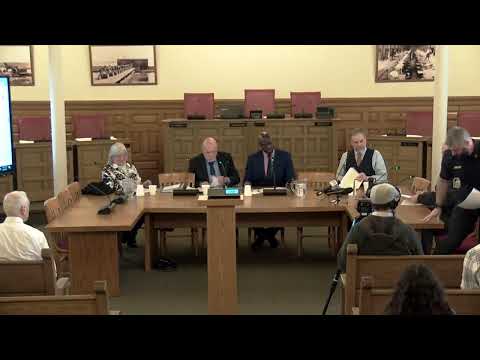
At a Syracuse City Public Safety Committee meeting, police officials described a draft drone-as-first-responder policy and answered councilors' questions about how drones would be used, who would operate them and how footage and flight records would be overseen.
The policy presented by Syracuse Police Department leaders frames drones as a tool to supplement officers during both high-priority incidents—such as active-threats, missing-person searches and fire response—and lower-priority calls where no complainant wishes to meet an officer. Sergeant Wells, who the department identified as the program supervisor, said recent uses included thermal-imaging flights to help firefighters locate roof hotspots and to confirm that a brush fire had not spread toward the zoo. "We were able to put the drone up and using the thermal imaging camera, we were able to see that there was no longer any hot spots on the zoo side of Grand Ave," Wells said, describing those deployments.
Committee members pressed on privacy, supervisory control and program scope. Councilors asked whether residents who request police response would be denied an in-person officer if a drone clears a scene; police leaders said dispatchers ask callers whether they want to meet an officer, and if a caller requests an officer, an officer will be sent. Officials emphasized that the policy forbids targeting individuals based on enumerated characteristics and that the department will not automatically share drone footage with outside agencies without chief approval.
The department demonstrated the public-facing oversight features it plans to use. Flights and basic metadata would be uploaded automatically to a public dashboard through the DroneSense platform (the same vendor shown in the presentation). The dashboard would show flight routes, dates, times, durations and a short description of each flight. Officials said detailed records and related police reports would remain accessible through normal public-records channels and that recorded footage tied to criminal investigations would be retained according to investigative-retention rules.
Officials described planned operational limits and training. The department proposed starting with four-hour coverage blocks targeted to high-call periods, likely two to three blocks per week, with a single certified pilot per launch location. A typical operational radius would be roughly one mile from the launch site, officials said. Pilots must be FAA-certified and the department said it intends to prefer candidates with law-enforcement backgrounds. Sergeant Wells was identified as the program coordinator who will review each flight and maintain records; supervisors will be trained and able to investigate potential policy violations.
Councilors asked for concrete guardrails against "mission creep," noting that the policy language allowing use "anytime a UAS would enhance public safety" could be interpreted broadly. Police leaders said that enumerated uses in the draft policy include hostage situations, mass-casualty incidents, search and rescue, fire suppression, hazardous-material responses, crime-scene documentation, search warrants and special events, and that lower-priority flights are intended to free officers to respond to higher-priority calls.
On data handling, the draft calls for automatic recording during flights; councilors raised concerns that recording during transit between launch site and incident could capture bystanders or private property. Officials said recording the full flight creates an auditable trail and that the city will apply the same privacy redaction tools used for other police video—face and license-plate blurring, and redaction of sensitive information in records released under freedom-of-information requests.
Committee members sought limits on the pilot period and supervision requirements. Several councilors requested an initial one-year pilot with annual reporting rather than a multi-year term; police said they will include language requiring annual reports and said grant funding pays for the initial purchase. Councilors also suggested automatic supervisor notification for each flight; police said they will consider supervisor-notification options while noting 24-hour supervisor presence would be cost-prohibitive.
No formal action or vote on the policy was recorded at the meeting. Committee members concluded the discussion and moved on to a separate agenda item on all-terrain-vehicle updates.