Get Full Government Meeting Transcripts, Videos, & Alerts Forever!
Get email alerts on the Criminal Restitution topic
No spam. Unsubscribe anytime.
Utah Supreme Court hears argument over whether insufficiency reversal bars new restitution hearing
Summary
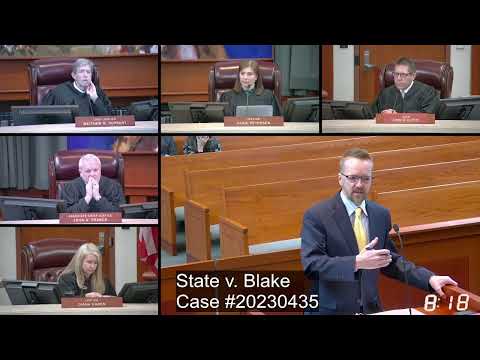
The Utah Supreme Court heard oral argument in State v. Blake on whether a Court of Appeals reversal for insufficient evidence precludes the district court from holding a new restitution hearing on remand.
The Utah Supreme Court heard oral argument in State v. Blake on whether a Court of Appeals reversal for insufficient evidence precludes the district court from holding a new restitution hearing on remand.
Dallas Young, attorney for Shawn Blake, told the court, “There’s an elephant in the room that needs to be addressed,” arguing that if the state may repeatedly present insufficient evidence, be reversed on appeal and then try again, “we are left with no limiting principle” that would stop the state from relitigating restitution repeatedly.
Young urged the justices to treat a sufficiency reversal differently from other reversals, saying that in the sufficiency context the factfinder has already had a “fair hearing” and a second opportunity to present the same claim would violate the ordinary finality that gives litigants a single fair shot. He pointed to the criminal double-jeopardy analogy and said that, absent explicit statutory language to the contrary, the legislature’s use of the word “hearing” suggests a single, finite proceeding.
Daniel Day, counsel for the State, argued the opposite: the district court had discretion to hold a second hearing after the Court of Appeals reversed the restitution award. “The sentencing court did not abuse its discretion by holding a second hearing and, considering the evidence that wasn’t considered the first time that the court of appeals said should have been,” Day said, noting Utah precedent about remittitur and the district court regaining jurisdiction after reversal.
A central dispute at argument was how to treat the Court of Appeals’ disposition in Blake I. Young said he found no explicit remand instructions in the appellate opinion and emphasized that the opinion reversed based on insufficiency of the evidence. Day responded that a reversal and remittitur typically leaves additional matters for the district court to resolve and that appellate decisions do not always need an explicit “remand” paragraph to permit further proceedings under Utah law.
Several justices pressed both sides on related doctrinal questions. The justices asked whether Nelson and related domestic-relief authorities (which the defense cited) meaningfully distinguish enforcement proceedings governed by law of the case from modification proceedings governed by res judicata, and whether that distinction can or should be limited in the restitution context. Young argued Nelson’s line of authorities supports a narrow context for repeated post‑judgment proceedings (domestic relations and limited statutory schemes), while Day said restitution’s statutory framework and practical realities (claims and billing often develop after sentencing) counsel in favor of permitting a second hearing in appropriate cases.
The attorneys also debated how prior case law should be read. Young traced Nelson back through Smith v. Smith, Hogue, and earlier decisions to argue that res judicata has been applied in some contexts and that courts have long cautioned against conflating res judicata with law of the case. Day pointed to Chase Manhattan Bank and other authority to argue that on reversal and remittitur the district court often must take additional steps, and he said the Court of Appeals did not abuse its discretion by allowing the district court to revisit the restitution calculation on remand.
Argument included discussion of practical restitution issues raised in the Blake proceedings. Counsel and the justices discussed (1) that restitution proceedings under Utah law use a relaxed evidentiary regime (see Utah R. Evid. 1101-like discussion in the record), (2) the role of Office for Crime Victims subrogation claims (referred to in the record as OCV or similar acronyms), (3) CPT medical codes and insurance claim forms used to identify procedures and charges, and (4) whether a protective order is needed to get detailed medical billing into the record. Day noted the second hearing included CPT codes and more detailed billing material that the court could consider; Young emphasized that the trial judge deferred too much to the OCV subrogation specialist and that the specialist conceded on cross‑examination he lacked medical training to opine on medical necessity or reasonableness of costs.
Counsel and the justices also addressed victim rights and statutory limits. The record included discussion that victims may seek restitution within one year after sentencing (the one‑year statutory window cited repeatedly at argument) and that OCV’s subrogation interest typically steps into a victim’s shoes to the extent of OCV’s payment. Counsel referenced statutory caps that, as discussed at argument, are commonly cited as $25,000 and under certain conditions $50,000 (these figures were discussed by counsel during argument as statutory caps on OCV payment). Day and Young also debated whether the victim, independent of the State, could pursue additional restitution in the district court after the state declined to present more evidence.
Both sides invited the Supreme Court to clarify the interplay of law-of-the-case, res judicata, remittitur, and the practical operation of restitution hearings when appellate courts reverse for insufficiency. Young urged caution and narrower remand language to avoid a “lather, rinse, repeat feedback loop” of rehearings; Day urged deference to district courts’ discretion to call a second hearing and to consider additional evidence the Court of Appeals said should have been considered.
After extended questioning the court took the case under advisement. The bench did not rule from the bench and adjourned following argument; a decision will issue later.
Votes at a glance: no votes were taken during oral argument; the court took the matter under advisement and will issue a written decision.
Background: State v. Blake originated in the district court sentencing/restitution proceedings, was reversed by the Court of Appeals for insufficiency of evidence (Blake I), and is now before the Utah Supreme Court on certified questions about whether that reversal forecloses a new restitution hearing or permits the district court to take additional evidence on remand.
What to watch next: the Utah Supreme Court’s written opinion will resolve whether (and to what extent) a sufficiency reversal in restitution cases constrains the district court from reopening evidence or holding supplemental hearings and will clarify how remittitur and law-of-the-case/res judicata principles apply in this statutory restitution framework.