Get Full Government Meeting Transcripts, Videos, & Alerts Forever!
Get email alerts on the Interstate Water Export topic
No spam. Unsubscribe anytime.
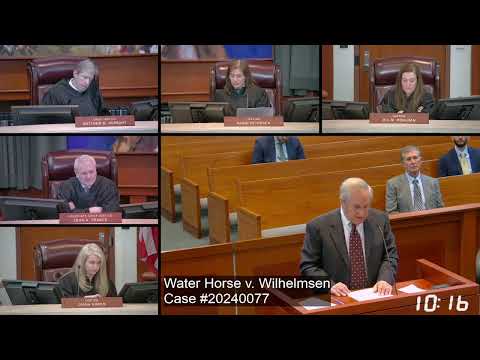
Utah Supreme Court hears challenge over Waterhorse bid to export 55,000 acre‑feet from Green River
Summary
The Utah Supreme Court heard oral argument on Waterhorse Resources' application to divert 55,000 acre‑feet per year from the Green River in Daggett County for use in Colorado.
The Utah Supreme Court heard oral argument on a dispute over an application by Waterhorse Resources to divert 55,000 acre‑feet of water per year from the Green River in Daggett County and transport it for use in Colorado.
Glenn Porzak, counsel for Waterhorse Resources, told the court that the company's petition should be granted under Article 9A of the Upper Colorado River Basin Compact. "This case involves the application of Waterhorse Resources, the appellant, to export 55,000 acre feet of water per year from the Green River in Daggett County for use in Colorado," Porzak said, arguing the compact's language and U.S. Supreme Court precedent support private entities acquiring cross‑border water rights.
Erin Middleton, counsel for the Utah State Engineer, the Utah Division of Water Rights and the Utah Board of Water Resources, urged the court to affirm the district court's denial. Middleton said Waterhorse's theory would permit an end run around the recipient state's water law: "Waterhorse asks this court ... to pipe across the Continental Divide into Colorado, all without a Colorado water right, or without Colorado's involvement, merely because it is a Colorado entity." She told the court Utah's export statute requires evidence that water can be measured, transported and beneficially used in the recipient state before Utah may authorize the export.
David Wright, counsel for the Kane and Wayne County Water Conservancy Districts, and other counsel argued that state sovereignty and the compact preserve each state's power to regulate appropriation and use within its borders. Wright emphasized Article 15(b) of the Upper Basin Compact, saying the compact does not relieve Colorado of its role to decide how its apportionment is allocated within Colorado.
The central legal disputes at argument were fourfold:
- Interpretation of Article 9A of the Upper Colorado River Basin Compact: Waterhorse contends the article's plain language permits an entity of a lower signatory state (here, a Colorado entity) to acquire rights to use water upstream in an upper signatory state so long as the use is within the lower state's apportionment. Porzak cited the U.S. Supreme Court's discussion in Tarrant Regional Water District as supporting that reading.
- Role of the recipient state and Colorado jurisdiction: Utah counsel and intervenors urged that a proposed cross‑border appropriation should begin in the state where the water is to be used, and that Colorado water courts and Colorado law must decide whether a proposed use qualifies as a Colorado water right and whether it will count against Colorado's compact apportionment. Middleton told the court that without a Colorado water right, Utah has only Waterhorse's representations that the water can be used; she said Utah law requires more concrete proof.
- Whether Utah may grant a conditional permit: Justices asked whether Utah could issue an appropriation conditioned on later Colorado approval. Middleton and intervenors warned that permitting an applicant to obtain a Utah priority date subject to later proof of use in Colorado would improperly "tie up" Utah water and create priority dates absent required statutory showings. The Utah export statute was read at argument to require evidence of transportability and beneficial use in the recipient state before an export may be approved.
- Speculation and the "reason to believe" standard: Waterhorse argued the record satisfied Utah's "reason to believe"/good‑faith threshold and that the district court erred in finding the proposal speculative. Counsel for Utah and intervenors countered that demand in the abstract is not a substitute for the specific Colorado process that establishes the lawful right to use water.
Justices repeatedly probed sequencing questions: which state must act first, and what happens if one state grants and the other refuses. Porzak argued the compact and precedent foreclose Colorado jurisdiction to adjudicate a diversion that originates outside Colorado; counsel for Utah and intervenors replied that Colorado courts retain exclusive authority over uses within Colorado and that Utah should not grant an export that effectively resolves Colorado's allocation decisions.
The argument included references to: the Upper Colorado River Basin Compact (Articles 3, 9A and 15(b)); the U.S. Supreme Court's treatment of interstate compacts in the Tarrant Regional Water District litigation; Colorado's water law, including the water court system and a Colorado statute establishing division boundaries for water administration; and Utah's export statute, including a provision identified at argument as section 108(4) that authorizes certain conditions on approvals.
No ruling was issued from the bench. The court thanked counsel and said it would take the matter under advisement.
What happened next: the Utah Supreme Court took the case under advisement; the transcript of oral argument will be part of the record while the justices consider briefing and precedent.
Why it matters: the court's decision could clarify the interplay between an interstate compact provision that permits cross‑border acquisition of rights and a signatory state's export statute and could affect how large out‑of‑state diversion proposals are evaluated across Upper Basin states.