Get Full Government Meeting Transcripts, Videos, & Alerts Forever!
Get email alerts on the Legal Admissions topic
No spam. Unsubscribe anytime.
Utah Supreme Court hears challenge over six-attempt limit and bar exam accommodations in Long v. Utah State Bar
Summary
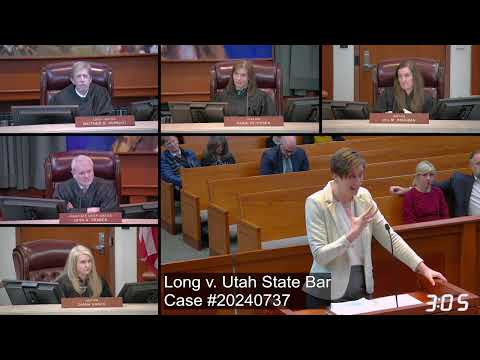
The Utah Supreme Court on the record heard arguments in Long v. Utah State Bar over whether petitioner Jennifer Long should be allowed a sixth accommodated attempt to take the Utah bar exam after pain and cramping in her only functional hand disrupted the February 2024 exam.
The Utah Supreme Court on the record heard arguments in Long v. Utah State Bar over whether petitioner Jennifer Long should be allowed a sixth accommodated attempt to take the Utah bar exam after pain and cramping in her only functional hand disrupted the February 2024 exam.
Emily Adams, counsel for petitioner Jennifer Long, told the court that "Ms. Long showed clear and convincing evidence of good cause" because she did not receive accommodations during multiple earlier attempts and when her fifth accommodated attempt in 2024 left her within five points of passing. Adams said the record shows Long was born without a right hand, received an ADHD diagnosis in high school, and had accommodations through college and law school. Adams argued the admissions and accommodations process should permit a sixth accommodated attempt when an earlier accommodation (handwriting the exam with double time and hourly breaks) proved physically harmful during the February 2024 exam.
Adams described the sequence of accommodations and requests on the record: earlier out-of-state requests in Kansas and Missouri (20072008) sought time-and-a-half for ADHD; the Utah exams in 2023 and 2024 provided double time, a separate room, and hourly breaks, and the 2024 exam produced severe pain and numbness in Long—s left hand that she did not experience in 2023. Adams said Long immediately sought medical care after the 2024 exam and requested in July 2024 to type the exam (rather than handwrite) believing that typing would reduce pain and make passing possible.
Counsel for the Utah State Bar, Emily Lee, told the court the bar reads its rule as limiting "six bar examinations, not six accommodated examinations." Lee explained the admissions committee granted permission for Long to exceed the six-exam limit twice (allowing the 2023 and 2024 attempts) but declined a third exception after reviewing Long—s July 2024 petition. Lee said the committee—s determinations reflect the separate roles of the admissions committee and the test accommodations committee and that allowing repeated, sequential relief based on changing accommodations risks undermining the test-accommodations process.
Justices pressed both sides on legal standards and on gaps in the record. Several justices asked whether the court should exercise independent review in the first instance or instead determine whether the admissions committee—s denial was "unfair, unreasonable, or arbitrary." Adams pointed to Utah precedent (In re Thorne; In re Knowlton) and argued the court can exercise independent judgment because the bar—s denial did not address Long—s argument that she had received only five accommodated attempts and thus had not exhausted the trial-and-error the rules permit for accommodated testing. Lee and the bar explained that the admissions committee had previously granted two exceptions and, while the precise deliberations were not in the record, the committee had warned it was hesitant to grant repeated exceptions.
The justices also questioned what evidence was before the admissions committee for earlier requests dating to 20042008. Counsel acknowledged the record is incomplete for Long—s early requests; some Kansas and Missouri materials appear in the record, but documentation for Utah requests in 2004 and 2005 is not included. The transcript shows the parties and the court discussed a May 23, 2024 denial letter in the record (cited by counsel as record page 248), and a July 2024 petition (page 219) in which Long reported "significant pain," prior surgery, and concern that her only hand was "deteriorating with use."
Justices also asked technical questions about accommodations: counsel agreed that typing the exam is currently a standard option (not considered a special accommodation) but that Long requested to stop handwriting and instead type while keeping double time and breaks. Counsel discussed other possibilities such as talk-to-text but did not identify a specific, previously denied alternative accommodation that had been formally requested and refused. Counsel for Long argued the good-cause inquiry must be fact-specific and that allowing Long a sixth accommodated attempt would not "open the floodgates" because Long—s medical history and long record of documented accommodations distinguish her case from applicants who obtain a late diagnosis after multiple failures.
During argument the court repeatedly returned to the applicable standard and to preservation questions: whether Long had raised the precise argument about "six accommodated attempts" before the admissions committee and whether the committee had been asked to make findings responsive to that argument. Adams acknowledged some arguments were first raised in the request-for-review stage and that the admissions committee—s written denial did not expressly address the claim that Long had only received five accommodated attempts. Lee and bar counsel said the review process is intended to give the admissions committee deference where it makes findings and reasoning, but the committee—s written materials in the record were limited.
After oral argument the justices took the case under advisement and recessed. When the court returned it planned to hear State v. Blake.