Get Full Government Meeting Transcripts, Videos, & Alerts Forever!
Get email alerts on the Land Use Training topic
No spam. Unsubscribe anytime.
Board of Adjustment receives land‑use and quasi‑judicial training from staff and city attorney
Summary
Commerce City staff and City Attorney Elliot Schaffer presented a study session covering the land‑use process, zoning and PUDs, criteria for variances and use‑by permits, ex parte communications, record requirements, and guidance for deliberations and conditions.
Commerce City staff and City Attorney Elliot Schaffer delivered a study session to the Board of Adjustment on land‑use procedures, zoning mechanisms and quasi‑judicial decision making, emphasizing how board members should prepare for hearings, avoid ex parte communications, and base decisions on the administrative record.
Schaffer told the board that in quasi‑judicial matters the board acts like a judge: findings must be based on the record presented at the hearing (staff reports, applicant testimony and public testimony) and board members should enter hearings with an open mind. He warned that ex parte (one‑sided) communications can create grounds for a court to overturn a decision and urged members to direct outside parties to provide testimony at the public hearing rather than privately lobbying board members.
Presenters reviewed the phases of development—comprehensive planning, regulatory rulemaking, horizontal infrastructure (subdivision and utilities) and vertical development (building permits)—and explained the different approval tracks. Key Commerce City specifics covered included:
- Planned Unit Developments (PUDs) in Commerce City replace straight zoning rather than layer on top of it; staff said PUDs must be justified as unique to the proposed development. - Use‑by permits (the category heard by the Board of Adjustment) require findings that the use will not cause an undue adverse impact, that the site is suitable for the use, that services are adequate, and that the use aligns with the comprehensive plan. - Conditional use permits differ from use‑by permits in process and are heard by Planning Commission and City Council rather than the Board of Adjustment. - Variances require findings of unique physical circumstances, non‑self‑imposed hardship, minimal detriment to adjacent properties, and that the relief requested is the minimum necessary.
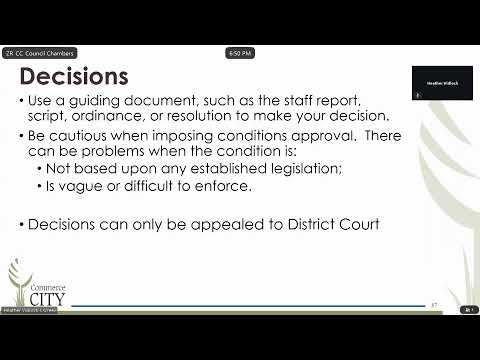
Schaffer reviewed practical hearing procedures: the applicant bears the burden of proof; staff reports are the primary tool for preparation; members should ask questions tied to approval criteria and elicit evidence into the public record; members may continue hearings to request additional information; and conditions imposed by the board should be clear, enforceable and tied to mitigation of identified impacts. He also explained that staff can administratively approve minor modifications up to 20% of a code standard (for example, up to 2 feet on a 10‑foot setback).
Board members asked procedural questions about how to request staff research before hearings, how to use the staff report during deliberations, and whether the board could see criteria slides and the recommended motion during deliberations; staff agreed to provide materials and to make criteria available during deliberations. Schaffer advised that fuller deliberations and explicit findings on the record make legal defense of board decisions stronger if appealed to district court under the “arbitrary and capricious” standard.
Presenters said printed copies of the training materials would be made available to board members. The study session concluded and the board adjourned.