Get Full Government Meeting Transcripts, Videos, & Alerts Forever!
Get email alerts on the Childcare Cameras topic
No spam. Unsubscribe anytime.
Parents and providers clash over proposed statewide camera requirements in licensed childcare centers
Summary
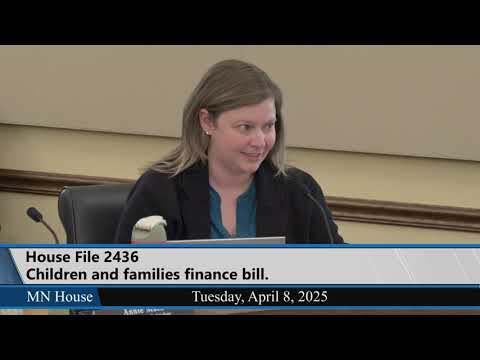
Dozens of Minnesotans told the House Children and Families Finance and Policy Committee on April 6 that mandatory video cameras and longer retention at licensed childcare centers would either protect children or impose untenable costs and privacy risks, depending on whom you ask.
Dozens of Minnesotans testified April 6 before the House Children and Families Finance and Policy Committee over a contentious proposal to require video cameras and retention policies in licensed childcare centers. Testimony included parents of children who were injured while in care, early childhood providers, county officials, public health professionals and advocacy groups.
Parents whose children were harmed urged lawmakers to require cameras and longer retention so evidence would be available for investigations and prosecutions. "Had their footage gone further back there would be a conviction for the atrocities committed against my son," parent Christina Peck told the committee, describing a July 2024 case in Blaine in which a fracture to her 5-month-old was not preserved on video because the center's system overwrote footage after a week. Suzanne Dickerson, a grandparent of a child harmed at the same facility, said the center displayed monitors in the lobby but the footage was overwritten and several victims lacked charges as a result.
Several parents described emergency-room hospitalizations and later medical findings they said were consistent with abuse and said longer camera retention would have helped hold abusers accountable. Becca Kerfeld said hospital scans revealed four broken ribs on her infant and that she and her husband were unable to secure charges because no video evidence remained; she said the lack of video denied her family fuller legal accountability.
Medical and child-protection professionals also supported camera requirements. Dr. Lisa Hollensteiner, a retired emergency-room physician who leads Safe Passage for Children of Minnesota, testified that "children under 3 are at the highest risk for death and injury due to abuse," and said cameras can both document abuse and exonerate staff when injuries are not caused by maltreatment.
Providers and provider associations testified against a blanket mandate, raising privacy, cost and operational concerns. Karen DeVos, owner of small rural centers, told the committee that upgrading camera systems to meet the proposed standards would create significant one-time and ongoing expenses that would likely be passed to families or reduce staff pay. "There is no money in our budget for this," DeVos said, and warned that costs could imperil small, rural child-care providers.
Representatives of large and small providers, including Kindercare, Primrose Schools and local family providers, said cameras alone do not prevent abuse and would create new privacy issues for other children captured on footage. Joe Pickett, a recently retired operator of two center-based programs, said parents given regular access to video would likely begin reviewing footage and seeing routine bumps, bruises or behavior among children that could create new privacy and conflict issues among families.
Several provider and association witnesses proposed alternatives, including stronger investments in staffing, higher compensation, improved training and an incentive-based approach to cameras rather than an unfunded mandate. Claire Sanford of the Minnesota Child Care Association and other witnesses recommended a study or a targeted incentive program instead of a universal requirement, noting reported initial compliance costs between $6,000 and $20,000 per center and ongoing storage and management costs not covered by the DE1 appropriation.
Committee leaders flagged procedural differences between the chairs' signed agreement and the DE1 draft, with Chair West noting that "Article 5, section 2 related to House File 1915, removing the camera requirement, was not in the signed agreement and there will be an amendment tomorrow to resolve that issue." The committee did not vote on the camera language; members scheduled amendments and formal consideration during the upcoming markup.
The public record showed a strong divergence in values and priorities: parents and clinicians focused on evidence preservation and criminal accountability; many providers focused on the practical costs, privacy and workforce impacts of a mandate. Several witnesses, including providers who voluntarily use cameras, said they see benefits for training and transparency but urged careful safeguards around access, privacy and warrant/subpoena standards.
The committee will take up amendments during its next meeting, when chairs expect to reconcile the DE1 with the signed agreement and consider any proposed camera mandate or incentive approach.