Get Full Government Meeting Transcripts, Videos, & Alerts Forever!
Get email alerts on the Traffic Calming Parking topic
No spam. Unsubscribe anytime.
Vista council backs study of neighborhood parking pilot, approves updates to traffic-calming policy including raised crosswalk criteria
Summary
The council directed staff to study a pilot for the Raintree–Lemon neighborhood on angled parking and circulation, asked for a consultant to perform professional analysis, and unanimously approved policy updates to include raised marked crosswalks with specific engineering criteria.
The Vista City Council signaled support for a neighborhood pilot to address chronic parking and circulation problems in the Raintree and Lemon area and approved formal updates to the city’s traffic-calming program to add criteria for marked raised crosswalks.
Councilmember Contreras introduced the parking-and-traffic item after constituent complaints about insufficient parking, red‑curb violations and safety sightlines near Raintree Park. She said residents want “creative ways to maybe enhance the amount of parking or make it safer by doing angled parking, which may necessitate doing one-way streets in some areas.”
Council discussion identified three parallel responses: expanded code-enforcement hours (including nights and weekends), a neighborhood pilot to test angled parking and circulation changes, and a consultant-led engineering analysis. City Manager John Conley told the council staff can perform a surface-level evaluation but that “what you’re asking for will require us to bring a consultant and do some professional analysis.” The council asked staff to return with a scope and contract estimate for consultant work and to include a code-enforcement staffing analysis as part of budget discussions.
Separately the council unanimously approved staff-proposed amendments to the traffic-calming program to add evaluation criteria and construction standards for raised marked crosswalks. Engineering Division Manager Sam Hassinen explained the proposed criteria would evaluate accident history, vehicle and pedestrian volumes, vehicle speeds, street width, number of lanes, horizontal and vertical alignment, neighborhood character, and engineering feasibility including drainage and cost.
Hassinen also described minimum construction characteristics for a marked raised crosswalk: a raised rectangular asphalt table with a minimum width of 10 feet, a height of 3 to 3.5 inches, ramped approaches and standard signs and markings. Staff recommended that any marked raised crosswalk be supplemented by traffic control such as a stop sign or a pedestrian‑activated flashing light system. Councilmembers said such devices generally work best in urban or commercial corridors where motorists expect them and cautioned they are less effective in isolated residential stretches.
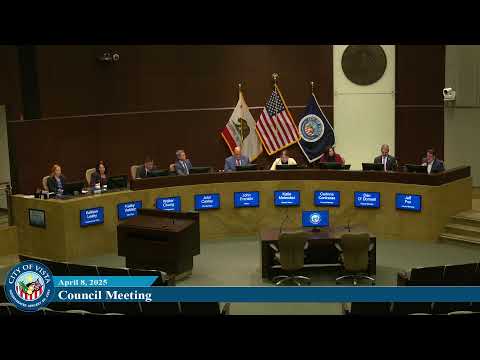
Deputy Mayor Melendez moved approval of the traffic-calming program revisions and O’Donnell seconded; the motion passed unanimously. The council also directed staff to prepare a consultant scope and cost estimate for the Raintree–Lemon pilot and to return with a code‑enforcement staffing/cost analysis for nighttime and weekend enforcement.