Get Full Government Meeting Transcripts, Videos, & Alerts Forever!
Get email alerts on the Energy Policy topic
No spam. Unsubscribe anytime.
Public hearing on possible town opt-out of state solar tax exemption draws proponents and critics
Summary
Representatives from Solar Liberty urged the Town Board to retain New York’s RPTL §487 exemption for solar and battery systems; some board members said opting out could protect local tax revenues from large-scale developers.
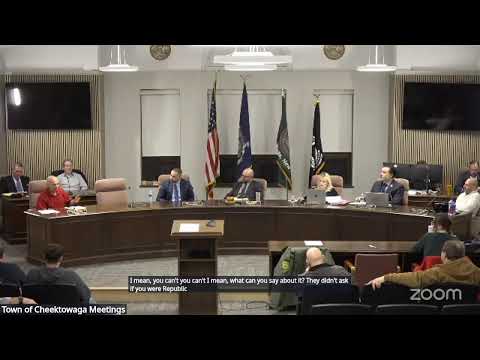
The Cheektowaga Town Board conducted a public hearing on whether to adopt Introductory Local Law No. 1 of 2025 to opt out of Real Property Tax Law §487 — a state provision that allows municipalities to grant a partial property-tax exemption to solar and certain other renewable-energy installations.
Why it matters: RPTL §487 makes solar and certain energy-storage investments more financially attractive by sheltering the increase in assessed value from property tax for a set period. The board is considering whether retaining the exemption helps local homeowners and small businesses afford rooftop systems or whether opting out protects school districts and municipalities from revenue loss when large commercial projects locate in town.
Dean Stanfield, speaking for Solar Liberty, a local solar and battery installer, urged the board to retain the exemption. “We respectfully urge you to retain RPTL §487 and keep the door open to affordable, independent energy for all,” Stanfield said, adding Solar Liberty’s local work had produced “about $150,000 a year in electricity savings” for Cheektowaga customers and employed roughly 90 Western New York residents.
Stanfield told the board that removing the exemption would increase the tax burden on homeowners and small businesses that adopt solar, likely making small residential and commercial installs financially infeasible. He said municipalities that opt out generally “opt out of all sizes and system types,” and he urged the board to weigh the exemption’s role in widening access beyond wealthier households.
Council members voiced conflicting priorities. Council member Diane Benczkowski said opting out would preserve local tax revenue for schools and town services and offered negotiating leverage with large developers; Council member Bridal Pularski asked that Solar Liberty’s public comments be entered into the record. Council member Anthony Phillipski and others acknowledged the policy trade-offs between encouraging residential clean energy and protecting municipal tax bases.
Public commenters raised practical concerns. One resident asked how solar tax credits and federal deductions affected affordability and noted many households take the standard federal deduction and may not benefit from investment tax credits. Another commenter urged the board to consider the distributional effect of any decision on lower-income households.
The board recognized Solar Liberty’s presentation as part of the hearing record. The public hearing was opened and later closed; no final vote on the local law occurred at the meeting. The board will consider the public record, local fiscal impacts and any state legislative approvals required before acting on the proposed opt-out.