Get Full Government Meeting Transcripts, Videos, & Alerts Forever!
Get email alerts on the State Policy Human Services topic
No spam. Unsubscribe anytime.
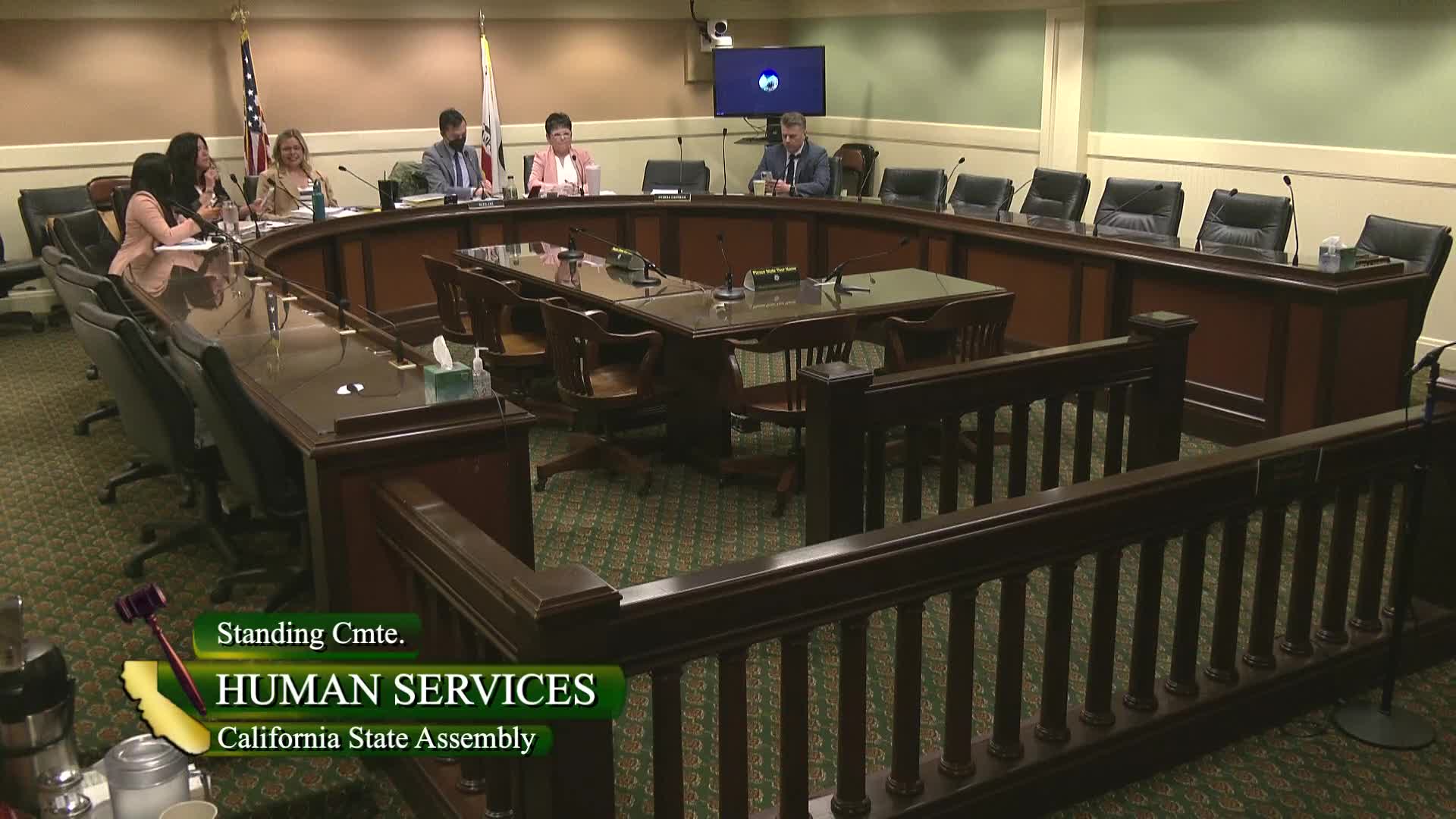
Assembly Human Services committee advances measures on child welfare, childcare staffing, mandated reporting and food aid
Summary
The Assembly Committee on Human Services on Wednesday advanced a package of bills addressing child welfare practices, supports for families with children, and workforce and benefit‑access reforms.
The Assembly Committee on Human Services on Wednesday advanced a package of bills addressing child welfare practices, supports for families with children, and workforce and benefit‑access reforms.
The committee, chaired by Assemblymember Lee, heard testimony on 22 bills, moved dozens to follow‑up committees and recorded roll calls on multiple measures. Topics that drew sustained discussion included: removing criminal penalties for parents of chronically truant elementary and middle‑school students (AB 461); easing residency rules for nonminor dependents (AB 890); creating temporary pathways to permit more associate teachers in child care classrooms (AB 753); a statewide standard training requirement for mandated reporters (AB 601) and related pilot work (AB 970); a rebuttable presumption favoring unsupervised visits between children in foster care and parents unless safety is shown (AB 926); protections so disaster‑displaced residents keep public benefits temporarily (AB 1161); allowing trained staff in adult residential and day programs to give inhalable emergency seizure medication (AB 1172); and steps to protect and study CalFresh benefit levels and eligibility (AB 1211) and to remove “sponsor deeming” barriers in the state CFAP food program (AB 1049).
Why it matters: committee members and witnesses framed the hearing as part of an overarching push to reduce barriers that advocates say keep families from stabilizing — whether the barrier is a criminal sanction, a permit rule that keeps a child care classroom closed, inconsistent mandated‑reporter practice, or paperwork that prevents people from getting food or health coverage during emergencies. Several authors and witnesses said the bills are intended to align state practice with recent administrative guidance and to reduce preventable foster‑care placements, housing instability and hunger.
Several witnesses described personal or programmatic harm under the current rules. Rebecca Gonzales, policy advocate for the Western Center on Law and Poverty, said of AB 461 that “This policy is overly harsh and discriminatory and there is a better way to support these families,” arguing that punitive penalties and cash‑aid sanctions for families with truant children deepen poverty rather than address root causes.
Assemblymember Corey Jackson, author of AB 601, described the need for standardized mandated‑reporter training and told the committee the bill would “require the State Department of Social Services to develop a standardized training no later than 07/01/2027,” while advocates urged both statewide curriculum changes and county‑level pilots to improve decision tools and reduce biased or unnecessary reports.
Committee action and next steps: most measures were passed as amended or passed to fiscal committees for further review. The committee recorded roll calls on individual bills and on the consent calendar; the secretary’s roll calls appear in the official minutes and the committee sent multiple bills to appropriations, education, health, public safety and other committees based on subject matter and fiscal implications.
Votes at a glance (selected bills discussed at length) - AB 461 (attendance; replace criminal penalties with supportive responses): recommended "pass" to the Assembly Public Safety Committee; recorded committee votes moved the bill forward (final committee roll indicated 3–0 in initial subcommittee roll; later recorded final vote on calendar showed 5–1 on the floor of the committee to advance). Sponsors and witnesses included Yesenia Jimenez (End Child Poverty California) and Rebecca Gonzales (Western Center on Law and Poverty). - AB 890 (residency rules for nonminor dependents in extended foster care): moved out of committee for further consideration (vote recorded in the hearing as passed on call); author and witnesses described a one‑year continuous presence rule currently required to transfer cases between counties. - AB 753 (temporary associate teacher pathway to address child‑care staffing shortages): advanced as amended to the Assembly Education Committee (committee vote reported favorably). Providers including Cadango and Child Care Resource Center testified about statewide staffing shortages and long wait lists; supporters said changes would allow interim associate teachers with 6 units to work while completing additional coursework. - AB 563 (requirements for the Early Childhood Education Planning Council report): passed as amended to the Assembly Education Committee; sponsors said the bill will require the council to report on gaps, workforce and facility needs and propose policy and budget recommendations. - AB 601 (standardized mandated‑reporter training): passed as amended to the Assembly Public Safety Committee (committee vote recorded 5–0). Witnesses including the County Welfare Directors Association and multiple child‑welfare and child‑safety organizations supported a statewide online training requirement, an advisory committee and a July 1, 2027 deadline to implement the standardized curriculum. - AB 926 (rebuttable presumption favoring unsupervised parent‑child visits in dependency cases unless safety requires supervision): passed to Assembly Appropriations Committee (committee roll called; reported as a pass to Appropriations). Sponsors and the Children’s Law Center said the bill is intended to reduce unnecessary supervised visits that can impede reunification. - AB 970 (pilot in Los Angeles County to improve mandated‑reporter decisions and create decision‑support tools): passed as amended to Assembly Public Safety Committee; LA County officials and community groups described a two‑year pilot to test training enhancements, a decision tool and evaluation metrics. - AB 1161 (automatic temporary benefit reenrollment and reinstatement after governor‑declared emergencies): advanced to the Assembly Health Committee as amended; sponsors said the measure would protect Medi‑Cal, CalFresh, CalWORKs and other benefits for at least 90 days after a declared emergency. - AB 1172 (allow trained staff in licensed day programs and adult residential facilities to administer inhalable emergency seizure medication): passed as amended to Assembly Judiciary Committee; health and regional‑center witnesses described clinical evidence and practical concerns about response times when only nurses may now administer rescue medications. - AB 363 (CalWORKs Recipients Education Program reforms to expand direct aid and work‑study flexibility): moved to the Assembly Appropriations Committee; supporters said relaxing a 25% private employer match requirement and allowing both program funds for direct aid would expand off‑campus work‑study and better support parenting students. - AB 1211 (protect CalFresh benefit levels from proposed federal rollback and study benefit adequacy/eligibility): advanced to the Assembly Appropriations Committee; sponsors positioned the bill as a safeguard and study mandate in response to federal policy proposals. - AB 1049 (remove sponsor‑deeming requirements for CFAP applicants in first 3 years of admission): passed to the Assembly Appropriations Committee; immigrant‑rights and anti‑hunger groups testified that eliminating sponsor‑deeming will reduce paperwork barriers and help eligible immigrants access state‑funded food benefits. - AB 969 (expand CalWORKs domestic‑violence waivers for survivors): passed as amended to the Assembly Appropriations Committee; supporters said the bill would standardize waiver forms, expand waiverable requirements beyond welfare‑to‑work and extend reassessment periods from 3 to 6 months.
What committees will do next: several bills with fiscal implications were referred to Assembly Appropriations for budget review before they can be considered on the Assembly floor. Education, Health, Public Safety, Judiciary and other policy committees will further review bills tied to their subject areas.
Quotes and testimony highlights - “This policy is overly harsh and discriminatory and there is a better way to support these families,” Rebecca Gonzales, Western Center on Law and Poverty, testified in support of AB 461. - “This bill would require the State Department of Social Services to develop a standardized training no later than 07/01/2027,” Assemblymember Corey Jackson said while presenting AB 601.
The hearing record shows broad coalition support from advocacy groups, county agencies and providers on many measures; several county associations and labor groups also testified. Where bills change program eligibility or create new benefits or administrative mandates, authors and staff flagged that the measures will advance to fiscal committees for further review.
The committee noted quorum procedures and consent‑calendar scheduling at the start of the hearing and moved multiple items as a subcommittee while waiting for all members to be present. Further hearing dates and appropriations analyses will determine when individual bills reach the Assembly floor.