Get Full Government Meeting Transcripts, Videos, & Alerts Forever!
Get email alerts on the Pfas Drinking Water topic
No spam. Unsubscribe anytime.
Committee backs state-level bill to lock in federal PFAS drinking-water standard
Summary
AB 794 would direct the State Water Board to adopt maximum contaminant levels for PFAS consistent with the recently finalized federal standard. Supporters called it necessary to protect pregnant women and children; water agencies cautioned about emergency regulation authority and costs to utilities.
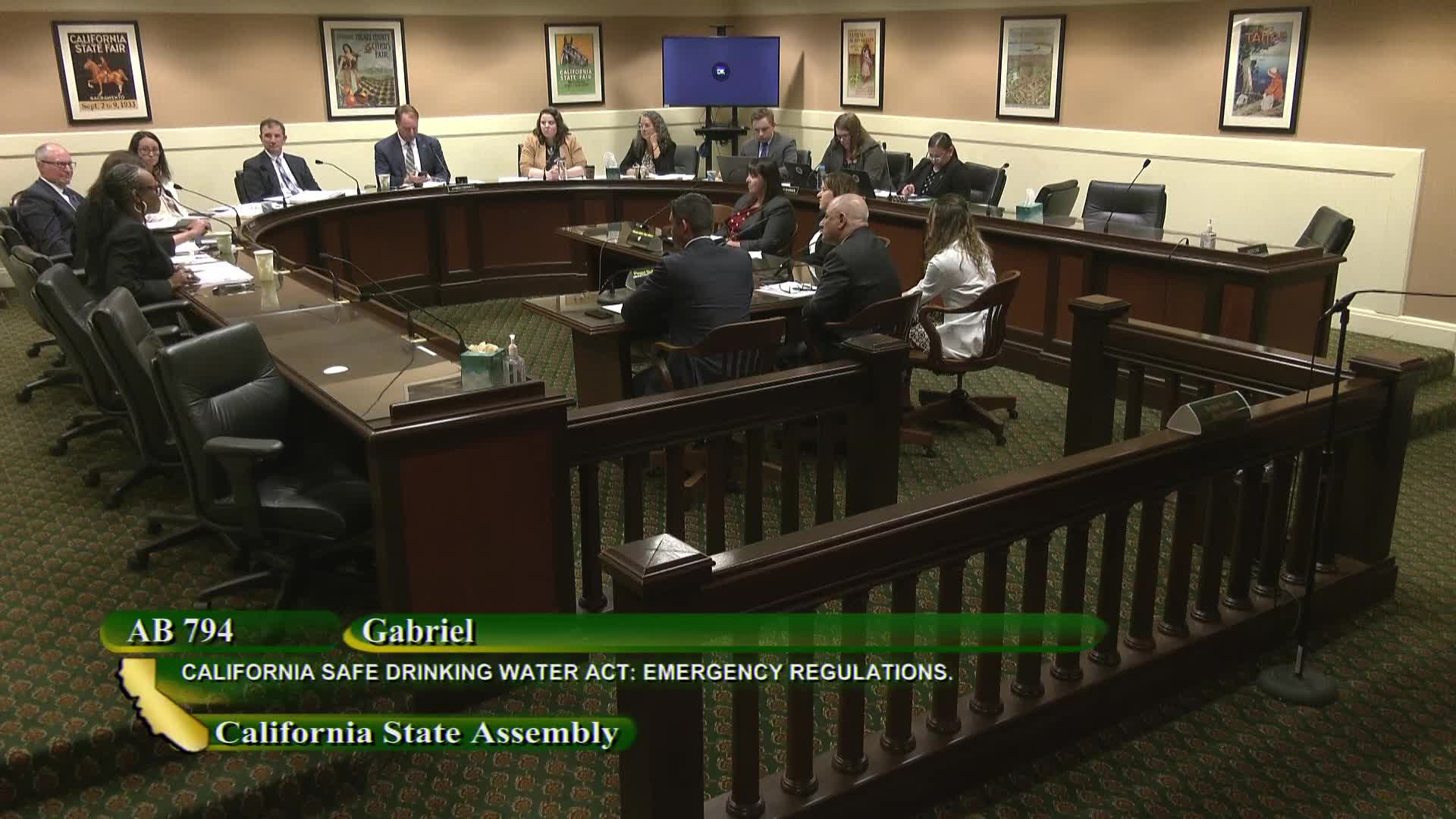
The Assembly Environmental Safety and Toxic Materials Committee on April 8 voted to pass AB 794 as amended to the Committee on Appropriations. The committee vote was recorded in favor and the item advanced by committee majority.
Assemblymember Eduardo Gabriel, the bill's author, said AB 794 would require the State Water Board to establish a maximum contaminant level (MCL) that mirrors the federal PFAS drinking-water standard and to align compliance timelines with the federal rule. He framed the bill as a precaution in case federal protections are delayed or challenged in court and said California should ensure consistent protections for residents.
Scott Faber of the Environmental Working Group told the committee PFAS had been detected above the federal standard in drinking water serving about 11.8 million Californians and estimated that 264 California drinking-water systems could be subject to the new standard. He said there are federal resources — including roughly $9 billion in the bipartisan infrastructure law for PFAS — and litigation recoveries that water systems could use for treatment.
Dr. Sarah Kirschner, an OB‑GYN testifying for the American College of Obstetricians and Gynecologists (District IX), described associations between PFAS exposure and miscarriage, preterm birth, low birth weight and preeclampsia and warned PFAS have been found in umbilical cord blood and breast milk.
Opposition came from water utilities and associations. The California Municipal Utilities Association, Association of California Water Agencies, Metropolitan Water District of Southern California and several other water suppliers and local government groups urged amendments or a no vote. Their testimony focused on concerns that the bill grants the State Water Board emergency regulatory authority for primary drinking water standards (a change they said would bypass standard state rulemaking requirements), could impose more stringent standards than the federal rule without full economic and technical feasibility review, and could produce financial burdens on small water systems.
Committee members questioned costs, feasibility, and whether federal funding would cover needed upgrades. Supporters said federal funding and litigation recoveries provided substantial resources and argued that many water systems already have treatment in place for other contaminants and could adapt. Several members stressed phasing, timelines and the importance of working with water agencies on implementation.
The committee recommended the bill be passed as amended to the Committee on Appropriations. Supporters and opponents both signaled a willingness to continue negotiations on scope, timelines and regulatory processes before floor consideration.