Get Full Government Meeting Transcripts, Videos, & Alerts Forever!
Get email alerts on the Economic Development topic
No spam. Unsubscribe anytime.
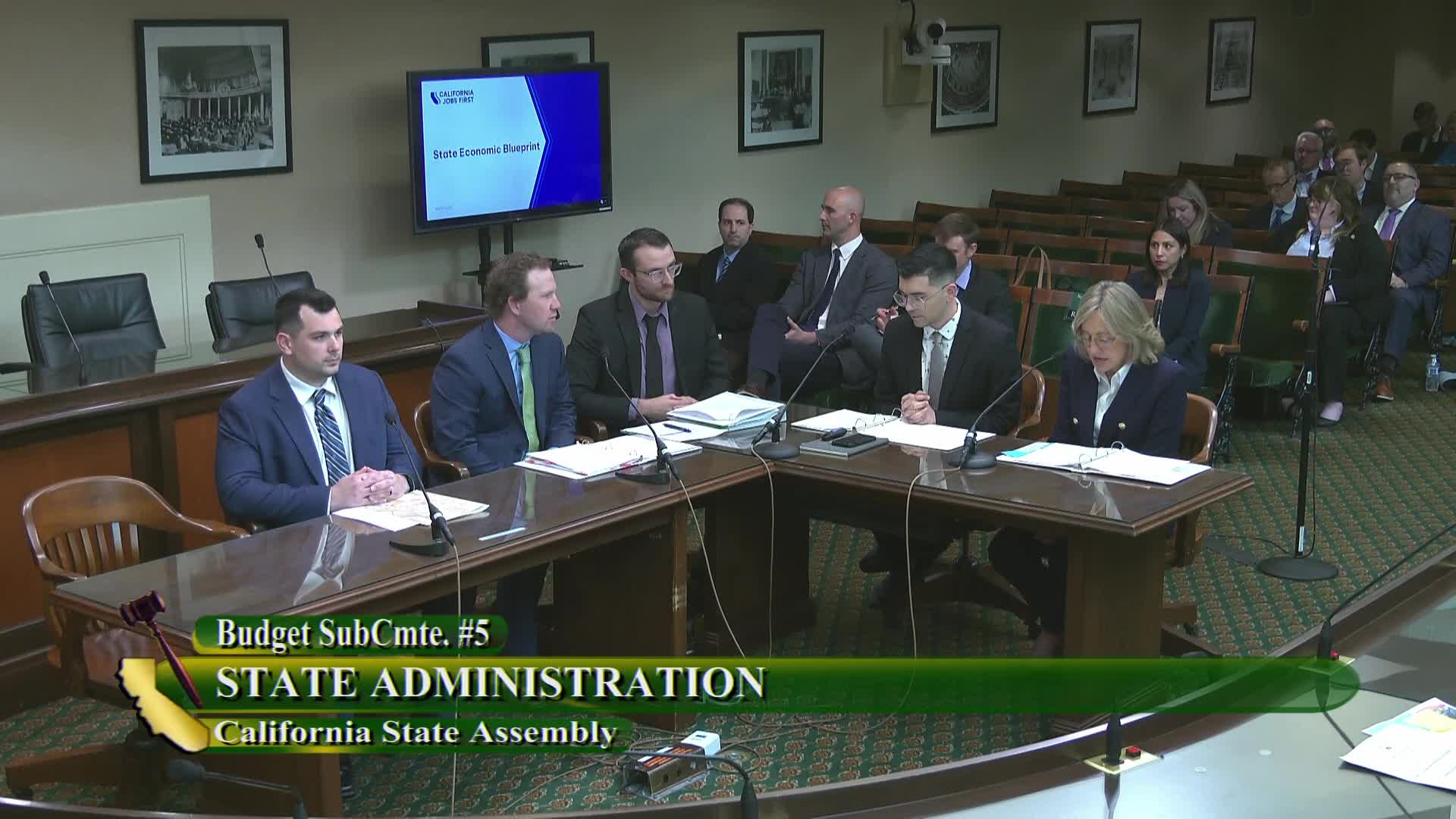
GO-Biz outlines California Jobs First blueprint to steer regional, tradable-sector growth
Summary
The Governor's Office of Business and Economic Development (GO-Biz) presented California Jobs First, a statewide economic-development blueprint focused on region-led investments in tradable sectors, workforce and anchor services; officials described implementation work already underway and notable prior investments.
The Governor's Office of Business and Economic Development (GO-Biz) described on Oct. 27 its implementation plan for California Jobs First, the state'wide economic development strategy intended to guide investments in workforce, tradable sectors and local-serving anchor industries.
"California Jobs First is about ensuring that we're building capacity and understanding the vision of local communities," said DeeDee Myers, director of GO-Biz. Myers told the Assembly Budget Subcommittee No. 5 that the program grew from legislation enacted in 2021 and planning work that engaged more than 10,000 Californians.
The blueprint seeks to move from planning to implementation across 13 economic regions identified during the planning phase. Derek Kirk, senior advisor for economic policy at GO-Biz, told the committee the administration has focused its early tradable-sector investments on ag tech and farm equipment, life sciences, semiconductors and microelectronics, and space/defense and satellites, with an emphasis on advanced and precision manufacturing.
GO-Biz described prior and current funding for Jobs First: the original 2021 legislative appropriation of $600 million was reduced in later budget actions to $450 million; GO-Biz reported $286 million invested to date, including roughly $65 million for regional planning and about $40 million for pilot projects. The office also said it has provided predevelopment investments (roughly $14 million per region) to help communities prepare projects for implementation.
GO-Biz officials said the program pairs investments in tradable sectors with support for local-serving anchor sectors'child care, health care, housing, workforce training and infrastructure'that officials say are necessary to sustain job growth. "None of that tradable sector growth can happen without strategic and connected investments in our anchor local serving sectors," Kirk said.
Committee members pressed GO-Biz on outcome measurement and on aligning Jobs First with budget priorities. Several members emphasized that durable investment in anchor services and higher education is necessary to sustain the skilled workforce Jobs First seeks to support. GO-Biz said implementation will involve multiple state agencies and that some future steps will require separate budget requests.
Why it matters: GO-Biz frames Jobs First as the state's first comprehensive economic-development strategy in two decades and as a 10-year effort that will extend beyond the current administration. Officials said the strategy is intended to attract private co-investment, link statewide and regional planning, and create pathways to good-paying jobs.
What's next: GO-Biz told the committee it is moving from planning into early implementation and coordinating with co-chair agencies, such as the Labor and Workforce Development Agency, to carry forward regionally led projects. Specific budget proposals to support elements of Jobs First may appear in future budget cycles.