Get Full Government Meeting Transcripts, Videos, & Alerts Forever!
Get email alerts on the Children And Youth Digital Safety topic
No spam. Unsubscribe anytime.
Assembly committee advances bill to hold social platforms financially liable for harms to children
Summary
Assemblymember Gonzales introduced AB 2 to create enhanced financial penalties for large social media companies when negligence causing harm to children is proven in court; the Judiciary Committee advanced the measure after supporters and tech-industry opponents debated First Amendment and preemption concerns.
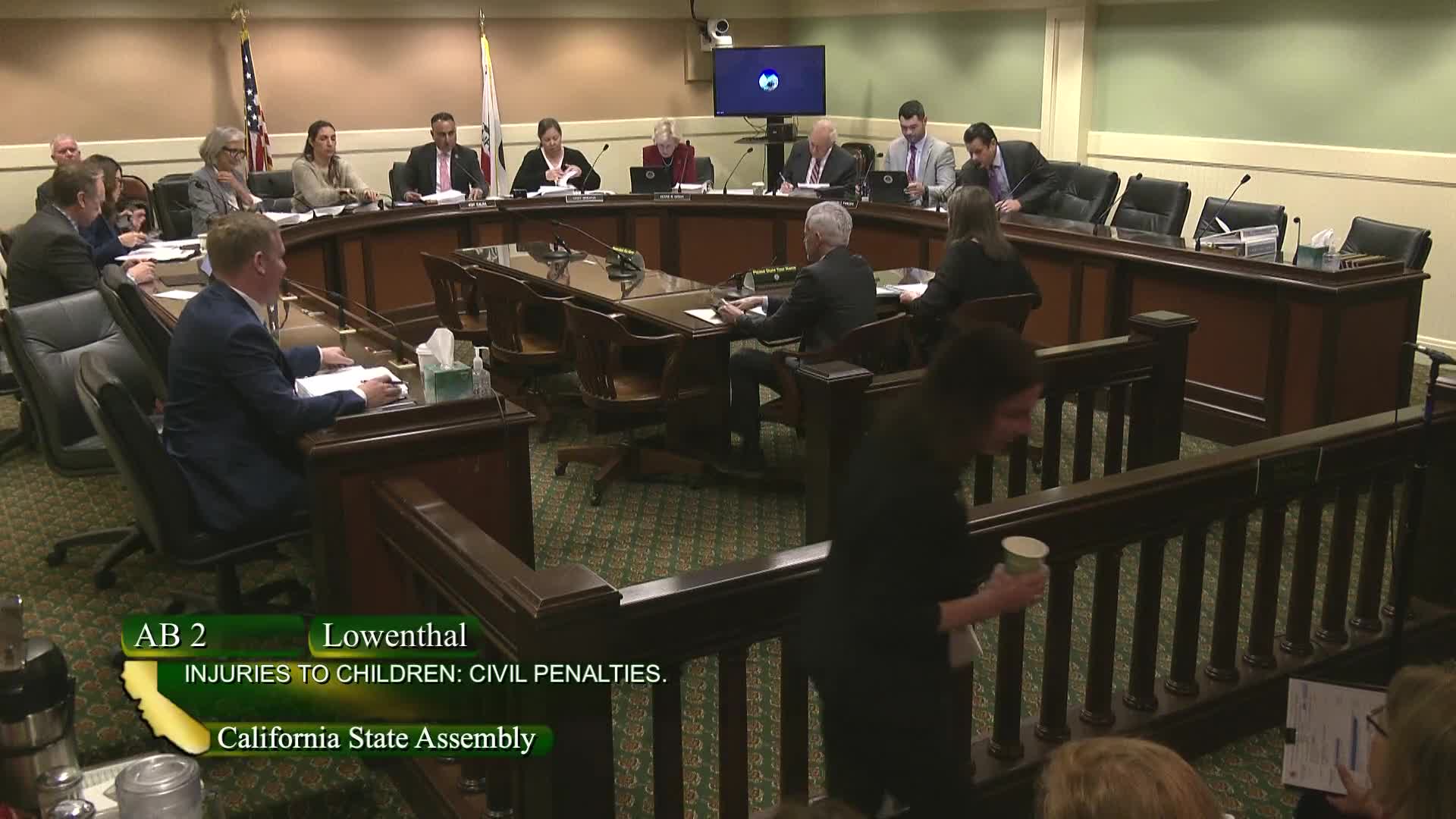
Assemblymember Gonzales presented AB 2 to the Assembly Judiciary Committee as a measure to “hold social media platforms accountable for the harm they cause children and teenagers,” saying the bill would impose enhanced financial penalties when a court finds negligence. Gonzales said the measure builds on existing negligence law and ‘‘applies appropriate financial incentives and accountability’’ to platforms whose design and algorithms drive young people to harmful content.
Nicole Rocha of Common Sense Media told the committee that platforms already face negligence claims under California civil law and that AB 2 ‘‘builds upon existing law and creates enhanced financial penalties for large social media companies who have breached the ordinary standard of care causing harms to children.’’ Rocha said the bill does not redefine the burden of proof in court and does not itself regulate content.
Opponents including Technet and the Computer and Communications Industry Association argued the bill is vague about what ‘‘ordinary care’’ requires for different harms and said the measure could prompt a surge of litigation, chill legitimate content, or interfere with end‑to‑end encryption. Technet’s Dylan Hoffman warned that platforms would struggle to operationalize a single standard of care across disparate harms such as cyberbullying and fraud. CCIA’s Bridal Downey told the panel the bill could have ‘‘broad sweeping repercussions’’ and said federal law, including Section 230, may preempt aspects of state regulation.
Committee members expressed concern about definitional clarity—especially how the law would distinguish harmful versus beneficial content and how to protect gender‑identity or suicide‑prevention resources from being mistakenly labeled harmful. Gonzales responded that AB 2 ‘‘does not change what determines harm’’ and that harms must still be proven in court; she said the bill’s intent is to give courts guidance on damages when negligence is shown.
After discussion and a roll‑call sequence, the committee moved AB 2 out of the Judiciary Committee. The measure drew bipartisan floor commentary from members who described youth mental‑health trends and linked those trends to increased social‑media use; proponents cited studies and internal platform documents and opponents highlighted constitutional and technical concerns.
Votes and next steps: The committee acted to advance AB 2 to the next committee (recorded roll call in the hearing transcript).