Get Full Government Meeting Transcripts, Videos, & Alerts Forever!
Get email alerts on the Budget topic
No spam. Unsubscribe anytime.
PSD budget outlook shifts as new school finance act and debt-free mill levy reshape 2025–26 planning
Summary
At its April 8 meeting the Poudre School District Board received a budget briefing showing projected enrollment declines, proposed state school finance changes and the effects of the recently approved debt-free mill levy on next year’s preliminary budget and school allocations.
Poudre School District officials on April 8 told the Board of Education that shifting state school finance proposals, declining enrollment and the district's new debt-free mill levy will all shape a preliminary 2025–26 budget that the district will present to the board later this month.
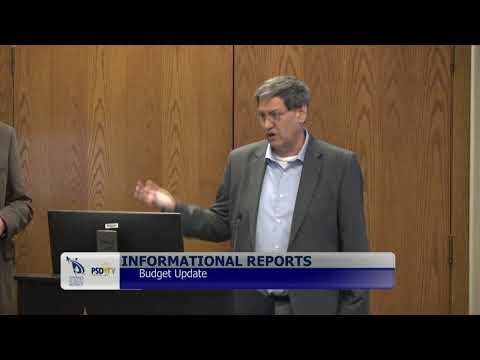
Budget Director Brian Gustafson and Chief Financial Officer Dave Montoya told the board the district is preparing a “preliminary budget” to show the gap between likely revenues and current expenditures. Gustafson said the district’s internal projection anticipates about 514 fewer full‑time‑equivalent students on next year’s October count and a funded‑pupil reduction of roughly 291.9 pupils under the current averaging method used in Colorado school finance calculations.
Those pupil changes come as the state’s proposed school finance updates would raise the per‑pupil rate by roughly $406.26 in the governor/JBC proposals the district has been tracking. Gustafson presented a working figure of $11,184.05 per funded pupil and a district funded‑pupil count the team used for initial planning of 28,613.9. Using those assumptions, total program funding would rise by roughly $9 million compared with the current year; after removing charter passthroughs, the district’s net program increase in district modeling is about $7.3 million, Gustafson said.
“We’re in our preliminary budget development phase,” Gustafson told the board. He and Montoya stressed that the numbers are fluid while the legislature finalizes the long bill and the joint budget committee work continues.
Montoya outlined how the debt‑free mill levy (the voter‑approved “4A” measure that creates a separate capital/operations fund) will change the district’s accounting and spending. Montoya said moving certain operating costs into the new debt‑free mill fund will free about $21.5 million of general‑fund capacity. That reallocation, Montoya said, is the primary reason the district can propose targeted uses in next year’s general fund.
“That is about $21,500,000 relief on general fund,” Montoya said. The administration told the board it proposes to use the freed general‑fund capacity to target three priorities: $4 million for small‑school supports and programming, $15 million toward competitive compensation distributed pro rata across employee groups, and $2.5 million for replacement cycles (curriculum, instruments, athletics supplies and similar items).
Budget staff also described how the district intends to use the new debt‑free mill levy money itself (about $49 million in the district’s modeling) for capital and maintenance priorities: electrical, plumbing and HVAC upgrades; fleet replacement; software and hardware; sound systems and other facilities investments. A small pro rata share of the debt‑free mill allocation will be distributed to district charter schools, Montoya said.
Small schools were a central focus. The district showed a three‑tier approach: an SBB (student‑based budgeting) “floor” that limits how small budgets can drop, extra stabilization for schools under about 200 FTE and targeted funding to cover larger portions of assistant principal (AP) time at smaller sites. Officials said the small‑school package now has dollar figures attached and will be reflected when schools receive their allocations.
Staff also warned the board about other fiscal variables: the statewide change to averaging (moving from a five‑year average toward fewer years or a single October count over time) and a hold‑harmless provision included in current proposals that would prevent any district from receiving less funding than it received in fiscal year 2025 during the phase‑in. The district is monitoring the Charter School Institute calculation, Montoya said, because CSI schools are funded off the district’s program total and changes there could change passthrough amounts.
Executive Director of Finance Cara Badalamenti reviewed the district’s fund structure and federal and state grant funding. She noted PSD receives roughly $40.2 million in federal and state program grants across special education (IDEA), Title I, child nutrition, Head Start and other programs; those funds are typically restricted and must be spent on top of—not instead of—existing services. Badalamenti said most grant dollars go to staffing and that rising compensation reduces the purchasing power of restricted grants.
Staff gave the board a timeline: a preliminary budget showing revenue/expenditure gaps will be submitted April 22; the legislature is expected to finalize the long bill on or about May 8; the district’s proposed budget will be presented to the board May 27; and the statutory budget adoption deadline is June 30.
The board asked staff how school budgets are set and reviewed. Montoya, Gustafson and Assistant superintendents described a multi‑step comp‑plan process in which schools develop compensation plans and staffing proposals, review them with site stakeholders and then submit them to finance, HR and assistant superintendents for verification and approval. Montoya said schools can carry forward a modest contingency but that district policy limits the percent of allocation that may be swept at year‑end.
Board President Kristen Draper praised the clarity of the briefing and asked staff to return with updated runs when legislative action is final. Montoya and Gustafson said they expect day‑to‑day changes while the legislature moves the school finance act through the final budgeting process.
Next steps: staff will present the preliminary budget April 22 and return with finalized revenue runs for the board after the legislature completes the long bill.