Get Full Government Meeting Transcripts, Videos, & Alerts Forever!
Get email alerts on the Police Hiring Policy topic
No spam. Unsubscribe anytime.
Brownsburg narrows lifetime bans, shortens drug-disqualification windows in hiring policy revision
Summary
The Brownsburg Police Department revised its selection-and-placement policy to reduce prior-substance-use disqualification periods (marijuana 1 year, certain narcotics 3 years, other controlled substances 5 years), remove a residency requirement, and clarify certified vs. lateral hiring pathways.
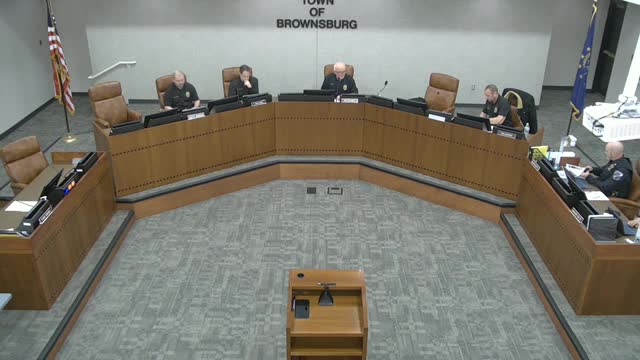
BROWNSBURG, Ind. — The Brownsburg Police Department on April 8 approved revisions to its selection-and-placement policy that shorten disqualification timelines for prior drug use, remove a residency requirement and clarify certified and lateral hiring tracks, department leaders said at the Police Commission meeting.
Major Watts, who led the policy presentation, described the changes as the product of medical review and policy-board discussion and said the revision moves the department toward standards used by neighboring agencies.
"There are really no drug uses that would prevent someone from being a police officer at any point in their life," Major Watts said, describing the medical review that informed the policy changes. "Page 7... it'll reduce the marijuana use to 1 year. 3 years for the narcotics that had previously been 5 and then 5 years for the controlled substances that had previously been a complete elimination in the past." (Transcript phrasing paraphrased for clarity.)
Chief Joseph Grimes said the revision also reflects changes in state law and practice. The new policy removes a decades-old residency requirement; candidates must now maintain reliable telephone service for contact by the agency rather than reside in a specified area.
Why it matters
The changes affect who is eligible to apply for sworn and civilian roles. Under the revision, applicants with past marijuana use may qualify after one year of abstinence; some other narcotics carry longer waiting periods (three or five years depending on classification). The policy also gives the chief's office discretion to limit reapplication after an applicant has been disqualified.
What was discussed and approved
- Lateral vs. certified: The policy clarifies that lateral officers are already state-certified and typically have at least one year of agency experience; certified applicants hold state-recognized certification (for example, from an Indiana University police program) but may lack agency experience.
- Drug-use disqualifiers: The revised policy reduces previously stricter or lifetime disqualifications. The transcript records staff saying the thresholds will be one year for marijuana derivatives, three years for certain narcotics, and five years for specified controlled substances; the policy packet language will be the controlling text for exact definitions and classifications.
- Discretion and reapplication: The policy adds language allowing the office of the chief of police to set a period during which a previously eliminated applicant may not reapply, giving the agency administrative discretion to avoid repetitive background processing for applicants already denied.
Limitations and next steps
Major Watts said some minor typographical edits remain to be corrected in the packet language, but the commission voted to adopt the revision. The department indicated it had consulted a medical reviewer (Dr. Jim Nasett) and the policy review board. The approved policy will be implemented by department personnel staff and posted per the revision date.
Provenance
Discussion and the motion to approve the selection-and-placement policy appear in the meeting transcript in the April 8 agenda item labeled 07.04 (selection and placement of personnel), with presentation beginning at roughly the 2605-second mark and the commission recording the motion as carried near the 3028-second mark.