Get Full Government Meeting Transcripts, Videos, & Alerts Forever!
Get email alerts on the Zoning Overlay Woods topic
No spam. Unsubscribe anytime.
Middletown approves Wood Services overlay to guide campus growth, with supervisors split
Summary
The Middletown Township Board of Supervisors approved a Community Development Transitional (CDT) overlay for the Woods Services campus, 4-1, allowing conditional future development (including one apartment building) under strict review and with several requested revisions.
The Middletown Township Board of Supervisors approved on a 4-1 vote an overlay zoning ordinance that creates a Community Development Transitional (CDT) district covering portions of the Woods Services campus in Langhorne.
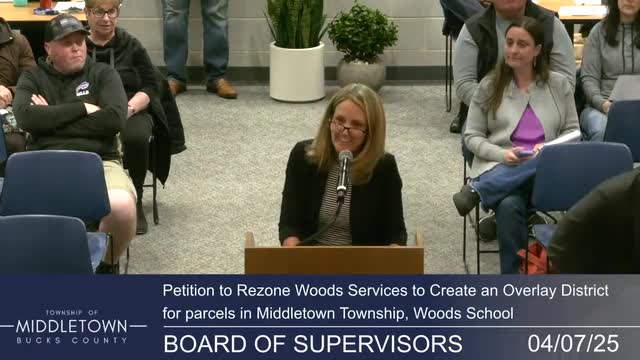
The ordinance lets Woods seek conditional-use approval for a restricted set of institutional, medical and mission-related uses already present on the campus and permits one apartment building aimed at affordable/attainable housing. Dawn Diamond, chief executive officer of Woods Services, told the supervisors the ordinance "is very important to us" and that the revised proposal removes more than 100 acres and most nonresidential uses from an earlier version.
Supporters said the overlay formalizes existing campus activities and replaces repeated zoning-board petitions with a conditional-use and land-development review process before the township. Michael McGinnis, counsel for Woods, said the campus is currently zoned R-1 and that "anything that Woods does requires zoning relief in the township," making the overlay a way to align zoning with long-standing campus operations.
Opponents and residents urged caution, saying the overlay could be used to add more residential units or to change the campus over time. Fran Grama, a nearby resident who spoke at the planning commission and at the meeting, said the planning commission had recommended against the ordinance and described Woods' past actions as raising trust issues. Eric Bruno, another resident, told supervisors: "I don't trust them," and urged a narrow, tightly restricted ordinance if supervisors chose to approve it.
Woods and its planning team described several guardrails written into the ordinance. Uses not directly tied to Woods’ mission were removed from the current draft. Most future projects will be reviewed as conditional uses, giving the supervisors and township staff the opportunity to impose conditions on individual land-development applications. Woods also proposed limiting the apartment program to a single building; the first phase was described in testimony as 42 units, with 20% of phase 1 units earmarked for people with intellectual or developmental disabilities under the Pennsylvania Housing Finance Agency (PHFA) funding rules.
Separately during discussion, Woods requested two technical revisions that supervisors accepted as part of the motion: change the standard language from "best efforts" to "reasonable efforts" in one section, clarify a 50% limit for professional office uses as a square-footage percentage, and reduce a proposed maximum impervious-surface cap from 75% to 60% for the district. Woods counsel and the township’s engineering witness said the overlay requires that natural-resource, stormwater and other environmental calculations be applied across the overall tract as projects come forward rather than assumed on a parcel-by-parcel basis.
After public comment and deliberation, a supervisor moved to adopt the petition to enact the CDT overlay with the revisions proposed by Woods' counsel; another supervisor seconded the motion. The ordinance passed 4-1.
What was decided: supervisors adopted the CDT overlay ordinance with the revisions discussed at the meeting. Future development proposals on the campus will proceed through the township’s planning and conditional-use review process rather than via the zoning hearing board process that Woods has used historically.
What remains: the ordinance sets standards and caps but relies on case-by-case conditional-use review for individual projects; residents and some commissioners said they want stronger, more prescriptive minimums for open-space and resource protection in future applications.
Community reaction: supporters told supervisors the overlay stabilizes Woods' ability to modernize services and provide attainable housing. Several neighborhood speakers and members of the Environmental Advisory Council urged caution and asked for stronger guarantees that wooded, wetland and open-space parcels would remain protected.
The board’s vote was recorded as "carries 4-1."