Get Full Government Meeting Transcripts, Videos, & Alerts Forever!
Get email alerts on the Transit topic
No spam. Unsubscribe anytime.
El Cajon launches two‑year on‑demand microtransit pilot using state grant and Via software
Summary
City staff and contractor Via updated the council on an on‑demand microtransit pilot launched March 17 with a $1.5 million Clean Mobility Options grant. The service uses four EVs, has early ridership growth and can expand its service zone as demand requires; the grant covers two years and the city may consider third‑year funding later.
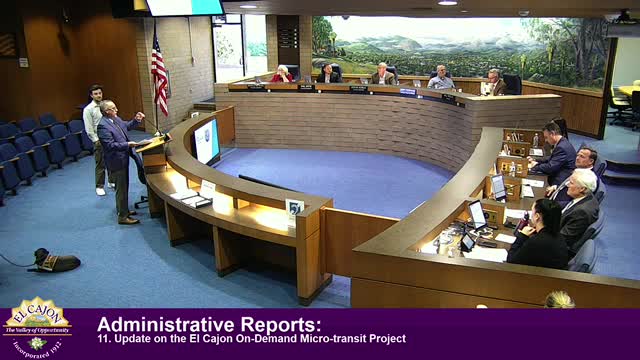
City staff and contractor Via briefed the El Cajon City Council April 8 on the newly launched El Cajon on‑demand microtransit service, a pilot funded by a state Clean Mobility Options grant and operated by Via.
City engineer Mario Sanchez told the council the city received a $1,500,000 Clean Mobility Options grant in October 2023 to encourage alternative transportation. Via representative Alex Newman described the service architecture and early results: riders can book through a Via San Diego mobile app or by phone and drivers use a driver app while staff monitor operations on a web dispatch portal. "We have 2 vehicle types. They're all EVs as per the grant," Newman said, noting the pilot uses four vehicles (Teslas and Ford eTransits) with wheelchair capacity and ChargePoint charging locally.
Via reported about 350 user accounts created and steady ridership growth since launch; a second week tally showed about 80 rides and subsequent increases in later weeks. The pilot area is a configurable service zone; Via and city staff said the zone can be expanded or contracted quickly based on demand, but cautioned that enlarging the zone without adding vehicles could degrade service and increase wait times. The contract provides roughly 70 hours of vehicle time per week per vehicle under the current arrangement.
Council members raised questions about zone boundaries, whether riders outside the zone can be added, and accessibility. Via said wheelchair users can flag that need in their account or by phone and specially trained drivers operate e‑Transit vans and provide door‑to‑door assistance for wheelchair riders. City staff said communications and monitoring will be handled jointly; communications staff member Chris Berg will work with Via on outreach.
Council also asked about funding beyond the two‑year grant. Staff said the grant covers two years and the city would be expected to assume costs in a third year if the program continued; there is no legal obligation to fund a third year, and the state might consider additional funding if the city requests it.
Staff said they will continue to monitor ridership and consider phased expansions after several weeks of operational data. The council received the update.