Get Full Government Meeting Transcripts, Videos, & Alerts Forever!
Get email alerts on the Water And Sewer Rates topic
No spam. Unsubscribe anytime.
Oswego officials review updated Lake Michigan water financing and three rate scenarios; board asks staff for tap‑on fee and structure options
Summary
Village staff and consultants presented three rate scenarios to cover Lake Michigan connection and other capital projects, outlining WIFIA and other loan plans; trustees asked staff to explore raising tap‑on fees and favored gradual rate increases over sudden spikes.
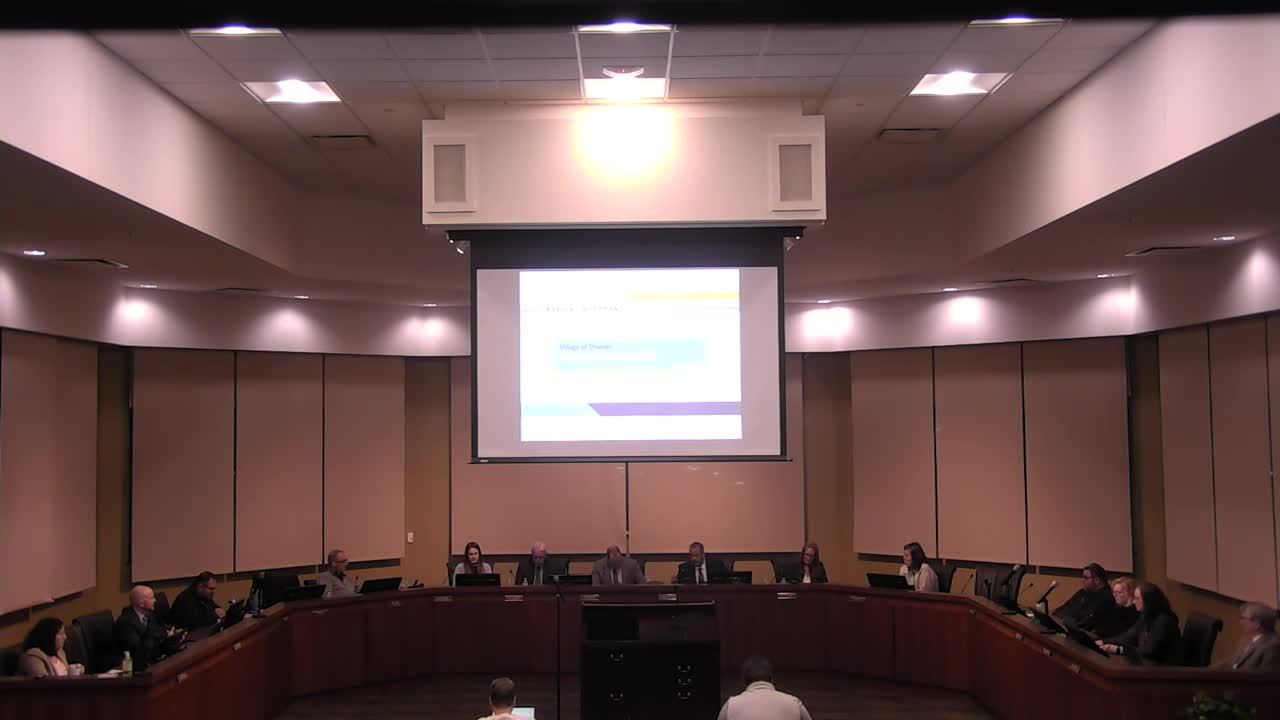
Village of Oswego officials heard an update April 8 on an updated water and sewer rate study tied to the village’s planned connection to Lake Michigan water and a slate of near‑term capital projects.
Finance Director Andrea Lambert and consultant Mark Seifert of Baxter & Woodman told the Board of Trustees that capital cost estimates have risen substantially since the 2023 study and that staff and consultants prepared three scenarios to fund utilities and required debt reserves. The village plans to present an ordinance amending rates alongside the fiscal 2026 budget; any new rates would take effect Jan. 1, 2026, appearing on bills issued in March 2026.
The update matters because the village is planning a large set of projects — including the Lake Michigan connection, two proposed general‑obligation (GO) bond issues, an Illinois Environmental Protection Agency (IEPA) low‑interest loan, and a potential WIFIA loan — that will significantly increase debt service beginning in 2028. Seifert said the village’s projected capital cost for projects has grown from about $92.5 million in 2023 to roughly $130.1 million as of April 1, driven by scope definition, inflation and schedule pushes.
Baxter & Woodman presented three scenarios: a baseline using the current ordinance (annual fixed‑fee and volumetric increases), scenario 1 (fully funded capital plan without using grocery‑tax revenue), scenario 2 (use of a local grocery tax directed to the water/sewer capital fund with delayed fixed‑fee increases in early years), and scenario 3 (existing rate structure plus grocery tax with steady annual fixed‑fee increases). All three keep the utility fund above the village’s operating and debt reserve goals over the study period, but they shift when and how customers would see increases.
Under the scenarios, volumetric increases for water tiers range roughly from 7% (tier 1) to 12% (tier 3) annually in the near term; fixed fees for a 3/4‑inch meter could rise in steps (example scenario figures included $2, $3, $4, $4, $10, $15 increases over successive years in one scenario). Seifert said the WIFIA loan application contemplates about $60 million of WIFIA financing; the full financing plan also includes roughly $20 million and $16 million GO bonds and a roughly $15.5 million IEPA loan. The village expects WIFIA loan closing in late Q3/early Q4 2025 and DWC bid results over late summer; IEPA award notices were expected in June 2025.
On revenues, staff proposed considering an increase to the village’s connection (tap‑on) fee — currently $2,200 — to a higher level such as $5,000 or more. Lambert and the consultant warned that any increase to connection fees would apply only to developments approved after the change and therefore would not materially affect near‑term revenue because many projects already locked in the lower fee. Seifert said redirecting the existing 1% local grocery tax from the general fund into the water/sewer capital fund could reduce a typical household’s annual utility bill by roughly $100 under some scenarios and provide greater fund‑balance flexibility for early principal prepayments or other WIFIA repayment strategies.
Board members questioned the conservatism of some revenue assumptions (notably real estate transfer tax projections) and asked staff to provide more detailed comparative projections for neighboring communities (Yorkville, Plainfield, Montgomery) using comparable escalation assumptions. Several trustees said they favored gradual, predictable rate increases so residents and businesses could plan; others said they preferred to avoid adding a new local tax and to rely on user rates instead.
The board gave staff direction to return with more detailed analyses, including: updated tap‑on fee options (staff recommended at least $5,000 as a possible floor), clearer real estate transfer tax projections, and more comparable neighboring‑community scenarios. Staff said they will present more information before a final rate ordinance in the fall. No formal rate ordinance vote occurred at the meeting.
Trustees and staff emphasized that all three scenarios are designed to keep the fund balance above required operating and debt reserves and to preserve flexibility in WIFIA repayment (for example, deferring interest payments early in the amortization or making early principal payments if reserves permit). Seifert and staff repeatedly called out that the WIFIA financing’s primary benefit is flexibility and that model sensitivity will be updated as bids, loan terms and final project costs become available.
The village will discuss the grocery tax and detailed tap‑on fee options at its April 22 Committee of the Whole and expects to present a draft ordinance with specifics as part of the fiscal 2026 budget process in November.