Get Full Government Meeting Transcripts, Videos, & Alerts Forever!
Get email alerts on the Animal Control Land‑use topic
No spam. Unsubscribe anytime.
Marion County adopts animal‑related land‑use definitions; waives $1,000 special‑use fee for high‑volume owners through April 30, 2026
Summary
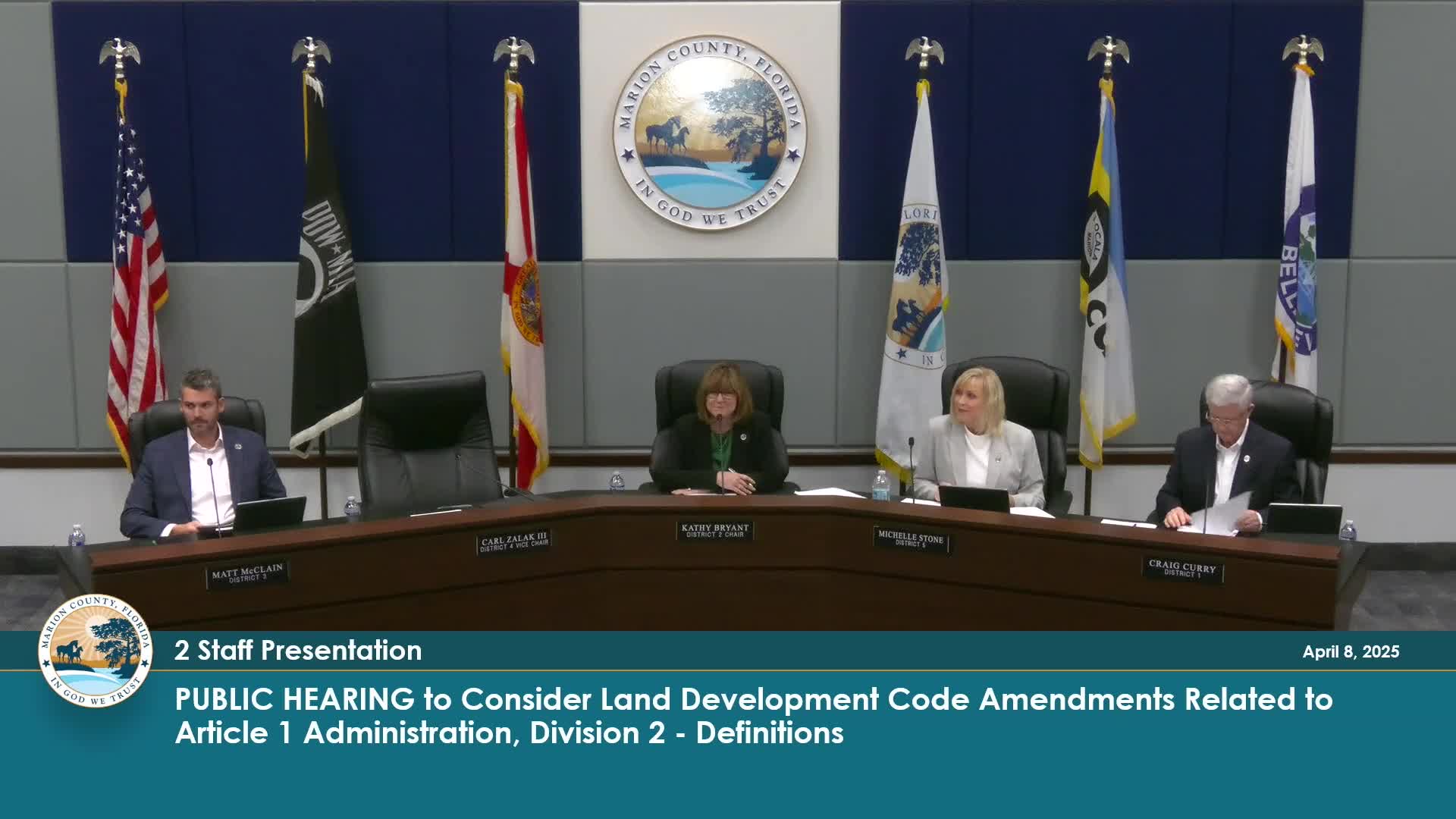
The Marion County Board of County Commissioners on March 25 approved amendments to Land Development Code Article 1, Division 2 definitions that clarify animal‑related terms and set a special‑use permit trigger at 30 or more dogs and/or cats for personal owners.
The Marion County Board of County Commissioners on March 25 approved amendments to Land Development Code Article 1, Division 2 definitions that clarify terms for animal‑related business, animal‑related organization, commercial breeder and a new “high‑volume owner” designation. The board also adopted a policy that will require a special‑use permit for personal owners with 30 or more dogs and/or cats and agreed to waive the $1,000 special‑use application fee for qualifying high‑volume owners who apply by April 30, 2026.
Assistant county attorney Dana Lasky and county staff told the board the changes align the Land Development Code with recent changes to the county’s animal ordinance and make explicit which activities already require special‑use review. Lasky explained the practical effect: “What this language does is that it increases that if you have 30 or more dogs or cats in aggregate, you now would also need a special use permit.” Staff emphasized the amendments do not remove existing permit or inspection requirements already in the animal ordinance for owners with 15 or more animals.
The amendments and board discussion focused largely on thresholds and fees. County staff listed current fees and inspection practices: the animal‑permit application is $100; staff said inspection fees start at $45 for lower‑volume operations and increase for larger operations; a special‑use permit application is $1,000, with typical advertising costs of $50–$100 per notice and administrative renewals of $300. Stephanie Owens, animal control manager, told the commission: “Today, for any animal permit, the application fee is a hundred dollars.” County staff also said annual inspections are now expected (the animal ordinance previously required semiannual inspections).
Public comment ran more than an hour and a half and included breeders, fox‑hound clubs, hobby breeders, rescue operators and other residents. Speakers who operate rescues urged the board to avoid fees or processes that would make small rescues unsustainable. “They are front porch operations that are fueled by classroom bake sales, strangers pocket change, and animal loving community,” said Rachel Perez, describing local rescue groups. Several hobby breeders said the proposed fees and permit requirements could be financially burdensome for small, noncommercial operations. Fox‑hound and field‑sport representatives asked whether national‑association oversight (for example, membership in the Masters of Fox Hounds Association or American Kennel Club) could be recognized in the permitting process.
Board members debated the tradeoffs between a public special‑use review (which includes mailed notice to neighbors, public hearings and the ability to attach site‑specific conditions) and administratively issued animal permits. Commissioners who favored retaining the special‑use requirement at a higher threshold said it preserves neighborhood notice and gives the board the ability to impose location‑specific conditions. Commissioners concerned about fee impacts proposed a one‑year amnesty for existing high‑volume owners so they could come into compliance without paying the $1,000 special‑use fee.
The motion the board approved (mover not specified in the transcript; seconded by Commissioner Curry) adopted the definitions as proposed, set the high‑volume owner trigger at 30 animals for the special‑use requirement for personal owners, and directed staff to prepare a resolution granting a temporary waiver of the $1,000 special‑use application fee for qualifying high‑volume owners who apply by April 30, 2026. Commissioners voted unanimously to adopt the ordinance language and the amnesty approach.
County staff said that regardless of the special‑use decision, the animal ordinance already requires owners of 15 or more animals to obtain an animal permit that includes proof of rabies vaccination and county licensure, a contingency plan in case of owner death or incapacitation, a working relationship with a licensed veterinarian, and inspections. Staff noted the director of animal services can deny, modify or revoke animal permits based on capacity to care and standards of care in the ordinance.
The board asked staff to publish clear guidance and frequently asked questions explaining the difference between the animal permit and the special‑use process, and to advise high‑volume owners about the amnesty and how to apply. Commissioners said they would revisit the matter if enforcement data or additional applications suggested the threshold or fees needed adjustment.