Get Full Government Meeting Transcripts, Videos, & Alerts Forever!
Get email alerts on the Behavioral Health Response topic
No spam. Unsubscribe anytime.
Dallas outlines RightCare co‑response teams as behavioral‑health calls rise
Summary
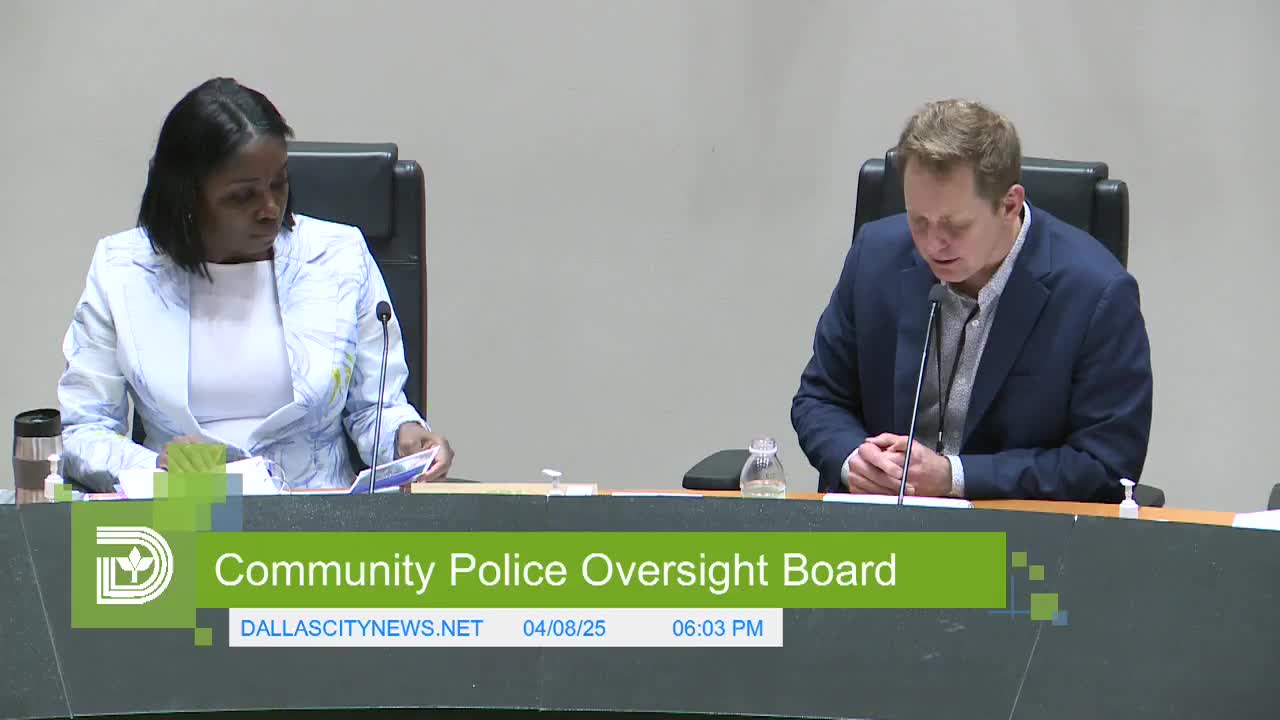
City staff and Parkland Health representatives told the Community Police Oversight Board that the RightCare co‑response teams answered 12,412 calls in 2024 and handled about half of the police department's behavioral‑health incidents, while also responding to many non‑behavioral calls.
The City of Dallas’ RightCare co‑response teams answered 12,412 calls in 2024 and handled about 51% of the police department’s behavioral‑health incidents, city staff told the Community Police Oversight Board on April 1.
Tabitha Castillo, program manager in the Office of Emergency Management and Crisis Response, told the board the Rapid Integrated Group Health Care Team—or RightCare—operates citywide and pairs one Dallas Police Department officer, one Dallas Fire‑Rescue paramedic and one Parkland Health social worker in a single vehicle for most behavioral‑health responses.
“The team’s goal is to divert individuals from jail and hospitalization while building trust with communities,” Castillo said. She described RightCare as a co‑response model that began as a pilot in January 2018 and became a citywide unit in 2020.
Castillo presented operational metrics showing RightCare answered an average of about 1,100 calls per month in 2024 and served roughly 750 clients monthly, with an average of 49 jail diversions per month. She also told the board that 40% of the calls RightCare responded to were ultimately non‑behavioral health calls, a figure she said reflected the unit’s broad utility and demand.
Curtis Young, senior director of social work for behavioral health services at Parkland, described the social‑work staffing for the program. “All the social workers are licensed,” Young said, adding many have clinical experience in Parkland’s psychiatric emergency department or inpatient units. He said Parkland requires annual de‑escalation training and a multi‑day program orientation for RightCare clinicians.
Sergeant Jacob Perez of Dallas Police explained how dispatch designates behavioral‑health call signals that guide the response: a 46 CIT call (general behavioral health), a 46A (behavioral health requiring an ambulance), and a 46RC (RightCare response without additional patrol elements). Perez said the initial 9‑1‑1 call taker documents the nature of the call; dispatch then confirms whether RightCare should be assigned based on call history and available units.
Board members pressed for local breakdowns and operational detail. Jonathan Maples (District 2) asked whether the RightCare report can be broken down by council district; Castillo said a mental health dashboard exists that can report by council district and police division. Several board members raised staffing and coverage questions; Castillo said the city deploys 18 teams on a rotating schedule (seven primary division teams, two afternoon rovers and two overnight teams), so that typically seven teams are available at a time across the city.
Castillo and Young presented trend slides the board was shown, including a reported decrease in certain emergency detentions since RightCare’s 2020 expansion. Castillo said the unit saw a 23% decrease in emergency detentions between 2020 and 2022, followed by an 8% increase between 2022 and 2024; Parkland data showed a similar long‑term reduction in psychiatric emergency admissions tied to the teams’ work.
Board members asked about intoxication, youth responses and safety. Castillo said intoxication responses depend on the substance and the patient’s medical stability, which can change whether a clinician can perform a mental‑health assessment; she said the program currently serves adults only and is exploring a youth pilot.
Castillo said RightCare conducts reality‑based scenario training twice a year at the DPD academy and that the teams practice safety signals and shared protocols to manage in‑car or in‑home risks. The team follows up 24–72 hours after a contact to check whether patients were connected to referred services.
Why it matters: The RightCare model is central to Dallas’ efforts to handle mental‑health emergencies outside traditional arrest and detention pathways. Board members repeatedly asked for district‑level data and suggested expanding the unit if demand continues to grow.
Provenance evidence: the board’s RightCare presentation and the subsequent Q&A were presented during the meeting’s agenda item for the RightCare overview and Q&A; board members referenced program staffing, call counts and follow‑up procedures during the discussion.