Get Full Government Meeting Transcripts, Videos, & Alerts Forever!
Get email alerts on the Land Use topic
No spam. Unsubscribe anytime.
FPRA accepts Western Peninsula master plan outlining continuous waterfront promenade and village at Causeway Cove
Summary
The Fort Pierce Redevelopment Agency accepted a publicly-vetted Western Peninsula Master Plan that lays out a continuous waterfront promenade and a village-style redevelopment vision for Causeway Cove Marina and adjacent public lands.
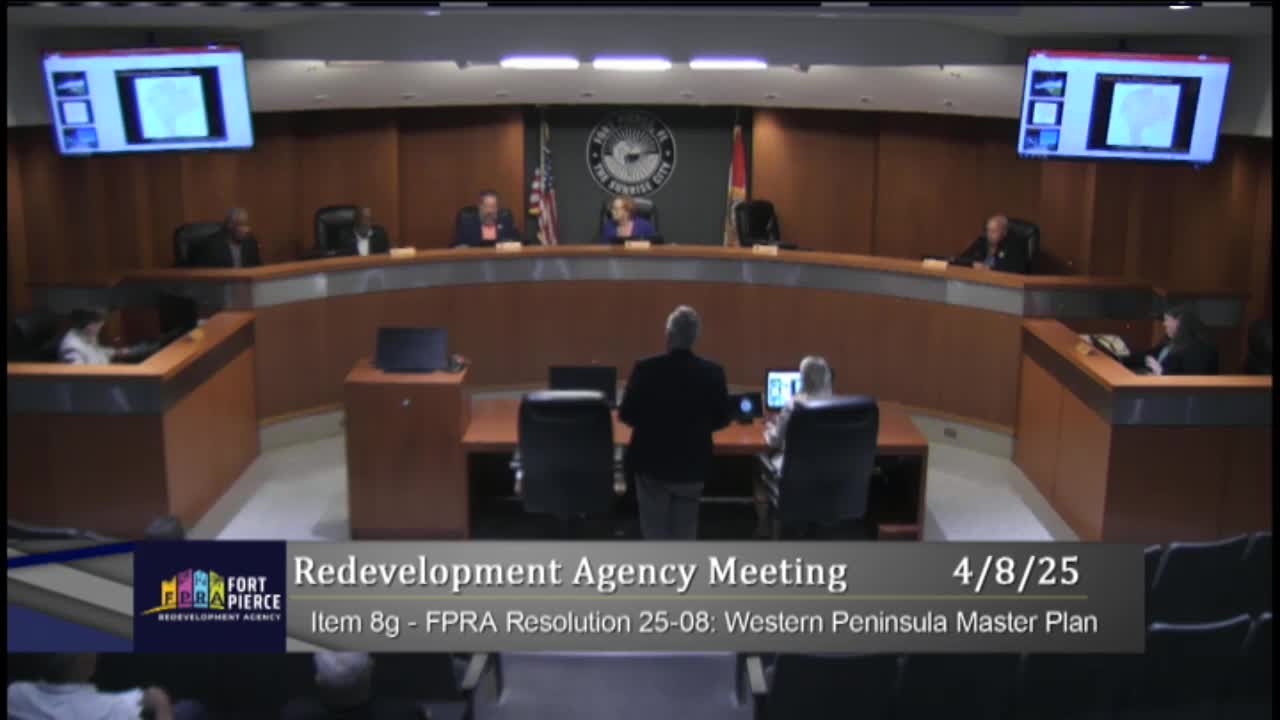
The Fort Pierce Redevelopment Agency on Tuesday accepted the Western Peninsula Master Plan prepared by the Treasure Coast Regional Planning Council, a public planning document that lays out redevelopment concepts for the Causeway Cove Marina, FPUA (public) lands and Museum Pointe area.
The plan, presented by Dana Little with the Treasure Coast Regional Planning Council, describes a year-and-a-half process of stakeholder interviews, title and survey research, a market study and a five-day public design charette that produced concept designs the consultants say respect an existing four-story height limit along South Beach while proposing a one-and-a-half-mile continuous waterfront promenade connecting South Causeway Park, Museum Point, the wastewater-treatment-plant site and Causeway Cove.
Why it matters: The plan recommends a mix of public amenities and private development over time, including a hotel anchor at Seaway Drive, a 20,000-square-foot event space in a hotel, an amphitheater and a village-scale mixed-use promenade at Causeway Cove with marine service areas and formalized trailer and boat parking under the causeway. The consultants tested development scenarios they say could yield approximately 241 residential units and about 120 hotel rooms in a conservative two-to-three story scenario; those numbers were presented as market-based illustrations rather than adopted development entitlements.
Commissioners thanked the consultants for extensive public outreach and raised implementation concerns. Commissioner Broderick and others noted the site has multiple owners and encumbrances (county land, FPUA parcels, private parcels and reverter clauses) and that the plan is a long-term, multi-owner exercise rather than an immediate city-only project. Commissioners also flagged operational issues that will matter in implementation — noise from an amphitheater, mosquito/no-see-um mitigation, parking and marina wave protection — and staff suggested the parking-under-the-causeway concept could be an early deliverable requiring coordination with FDOT and property owners.
The FPRA—s acceptance is not an authorization to build; the board voted to accept the document as a planning guide. Chairwoman Julie Hudson and Commissioners Broderick, Gaines and Taylor approved the resolution on a 4-0 roll call.
Ending: Staff said acceptance provides a publicly vetted framework that the FPRA and partner agencies can use for grant applications, resilience planning and future negotiations with private owners. The plan will inform follow-up actions including targeted feasibility studies, permitting checks and outreach to property owners and to the Florida Public Utilities Authority about parcel-specific constraints and reverter conditions.