Get Full Government Meeting Transcripts, Videos, & Alerts Forever!
Get email alerts on the Racial Profiling Analysis topic
No spam. Unsubscribe anytime.
Police and outside analyst report 2024 traffic-stop review found no indications of racial profiling, city says
Summary
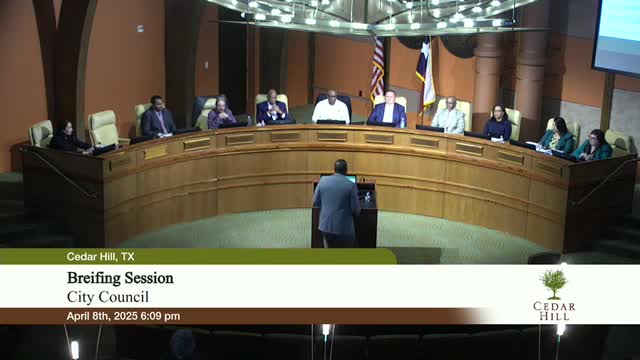
Cedar Hill city officials and an outside consultant presented the city—s 2024 racial profiling analysis on April 8, reporting the department is compliant with state reporting requirements and that the consultant—s comparative analyses found no indications of racial profiling in traffic stops.
Cedar Hill city officials and an outside consultant presented the city—s 2024 racial profiling analysis on April 8, reporting the department is compliant with state reporting requirements and that the consultant—s comparative analyses found no indications of racial profiling in traffic stops.
Chief (Director of Public Safety) told council the department has policies that prohibit racial profiling and that officers receive ongoing training on implicit bias, duty to intervene and de‑escalation. “I am pleased to report that an analysis of our traffic stop data shows no indications of racial profiling or any other type of bias occurring in Cedar Hill,” the chief said.
Dr. Eric Fritch of Justice Research Consultants, who has conducted the city—s analysis for about 20 years, summarized the required comparative analyses under state law and Commission guidance. He reported the department recorded roughly 10,580 traffic stops in 2024 and said the most reliable analyses compare stop outcomes after officers had identified a driver—s race or ethnicity at contact.
Key findings presented by Dr. Fritch and the chief included:
- About 5.8% of stops in 2024 resulted in a search. Of the searches, roughly 49% were based on probable cause and about 44% were incident to arrest; 12 searches in 2024 were consent searches (a small fraction of total stops and searches). - Contraband (most commonly drugs) was recovered in 52% of searches, above the 2023 statewide average cited in the presentation (47%). - The consultant noted variability in arrest rates can be explained in part by the fact that about three‑quarters of arrests were for outstanding warrants, which affects both arrest and search rates. - The department recorded two racial‑profiling complaints in 2024; internal investigations did not sustain those complaints.
Dr. Fritch cautioned about the limits of benchmarking: census population or driver-license demographics are imperfect proxies for the driving population that is stopped, and many stops involve nonresidents. He said that when an officer knows a driver—s race prior to the stop (which the consultant observed occurs in a minority of stops), outcome comparisons by race are more meaningful because the officer had identified race at contact.
Council members commended the department for transparency, training and community engagement programs such as the Citizen Police Academy. No vote was recorded; the analysis was listed on the consent agenda for acceptance.